No two scoliosis cases are the same. Scoliosis can range widely in severity, affect all ages, and progress at different rates, but a shared factor among different severity levels and age groups is the more scoliosis progresses, the more challenging it can be to treat. In addition, the more scoliosis progresses, the more it can disrupt a person’s quality of life.
The most important thing to understand about scoliosis is that the best time to start treatment is always now. As scoliosis is progressive, even scoliosis diagnosed as mild can become severe with time and growth. While there are no treatment guarantees, treatment success is associated with early detection and intervention.
The best way to improve a scoliosis patient’s health and well-being is to be proactive with a customized treatment plan.
Being Diagnosed with Scoliosis
Being diagnosed with scoliosis means the spine has developed an unnatural curve that bends to the side and rotates (1).
Being diagnosed with scoliosis means an important decision has to be made: the type of treatment to commit to and when it should start (2).
With progressive conditions like scoliosis, when treatment is started can be a key factor. Is treatment started early in the progressive line of scoliosis, before significant progression has occurred? Or is treatment started later, after significant progression has already occurred? Most importantly, how does the timing of treatment onset shape its potential outcome?
A scoliosis diagnosis can be overwhelming, and being aware of the different treatment options available is important to ensure patients can make informed treatment choices.
In many cases of scoliosis, surgical treatment is unnecessary, particularly when diagnosed early and treated proactively (2).
Being diagnosed with scoliosis means being diagnosed with a progressive condition. The nature of scoliosis is to become more severe, and it’s growth that triggers progression, so young patients are at risk for rapid advancement due to rapid and unpredictable growth spurts (1).
Without treatment, scoliosis can become severe and lead to complications, but in many cases, early intervention can prevent increasing severity and related complications (2).
Why is Early Intervention so Helpful?
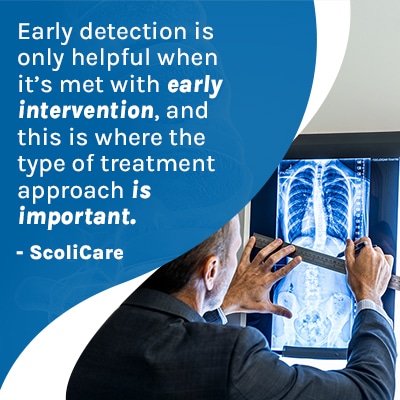 Early detection is only helpful when it’s met with early intervention, and this is where the type of treatment approach is important.
Not all approaches to scoliosis treatment are proactive; some value observation and watching and waiting, but this can amount to wasting treatment time.
There are no treatment guarantees, but as mild scoliosis curves are smaller and simpler to correct, it’s optimal to start treatment while scoliosis is still mild.
Progression makes the spine increasingly rigid, and this can make it less responsive to treatment: another benefit to starting treatment early.
The effects of scoliosis can be widespread, but in children, the main symptoms involve postural changes, and in adults, it’s back and nerve pain that leads most patients to a diagnosis (3).
Early detection is important because it provides an opportunity: starting treatment early while scoliosis is mild, the curve is small, more flexible, and likely to respond well (2).
Early intervention can mean working towards prevention: preventing scoliosis from becoming more severe, its effects from becoming more overt and disruptive, and the need for more invasive treatment in the future (2).
In some cases, the indicators of scoliosis can be subtle, so awareness of the early signs can help lead to an assessment and diagnosis.
Initial Assessment and Diagnosis
The path towards scoliosis treatment success starts with a patient’s initial assessment and diagnosis.
Here at ScoliCare, the accuracy and comprehensiveness of a patient’s initial assessment and first scoliosis X-ray are prioritized (4).
A patient’s initial assessment will include taking their medical history, family history, performing a posture, mobility, and strength assessment, and an Adam’s forward bend test.
An Adam’s forward bend test is a common scoliosis screening examination that involves patients standing in front of a clinician while bending forward as if trying to touch the toes; a patient’s spine and trunk are highly visible in this position and are examined for indicators of scoliosis.
Indicators include a spine that doesn’t appear straight, uneven shoulders, shoulder blades, a rib cage arch, and/or uneven hips (3).
If an initial assessment finds indicators of scoliosis, the next step is a scoliosis X-ray; this is the only way to reach a diagnosis of scoliosis as a variety of measurements are needed and rotation needs to be confirmed (4).
The accuracy of an initial assessment and scoliosis X-ray are key because the results will inform the customization of treatment plans moving forward.
A key measurement is the Cobb angle, and this determines the size of the scoliosis and is referred back to throughout the course of treatment to gauge efficacy (5).
So if the initial assessment or X-ray results are lacking or inaccurate, the foundation upon which treatment plans are built is unstable.
If a patient’s X-ray confirms the scoliosis has a Cobb angle of 10+ degrees and rotation, a diagnosis of scoliosis is reached, and the next step is deciding how to respond with treatment (5).
Scoliosis Treatment Options
The most important decision regarding scoliosis is how to treat it, and when to start treatment.
For patients interested in a modern nonsurgical approach, ScoliCare Clinics around the world can offer an innovative and revolutionary approach to nonsurgical scoliosis correction.
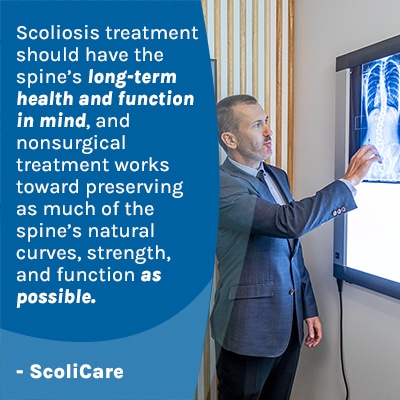
Scoliosis treatment should have the spine’s long-term health and function in mind, and nonsurgical treatment works toward preserving as much of the spine’s natural curves, strength, and function as possible.
Nonsurgical treatment is integrative and combines the best of what a number of scoliosis-specific treatment disciplines have to offer.
ScoliBalance® is a customized treatment plan that blends what established scoliosis-specific physical therapy programs have learned with new concepts and chiropractic care (6, 7, 8).
The potential of scoliosis-specific exercise is at the center of ScoliBalance® which customizes a plan based on the specifics of a patient’s posture, scoliosis, and ability, and works to improve strength and endurance in a patient-customised way (6).
Scoliosis-specific exercises have corrective potential and can help slow/stop progression, reduce curve size, increase the spine’s flexibility, and improve the spine’s surrounding muscle strength and balance for 3-dimensional correction (6, 7, 8).
ScoliBalance® also prioritizes patient education, a fundamental component of scoliosis specific exercises; patients work closely with a team of experienced clinicians who teach the patient about their curve characteristics, and then the exercises taught to patients can be performed from home to sustain treatment results and further stabilize the spine (6, 7, 8).
Teaching postural awareness is key so patients understand how to position their bodies for the best spinal alignment and to counteract the uneven forces of the scoliosis.
The principles of Chiropractic BioPhysics®, Schroth and other types of scoliosis specific exercises have been harnessed to develop the ScoliBalance® program (6, 7, 8). Each patient is given a personalised program based on curve type, size, postural balance, pain and other symptoms (6, 7, 8).
A change in the spine’s alignment needs to be supported, so works well with scoliosis-specific exercise that has the potential to strengthe
n the spine’s surrounding muscles so they can offer the spine more support and stability (2, 6).
In many cases, particularly young patients who are still growing, bracing is also at the heart of nonsurgical treatment, and the ScoliBrace® is unparalleled in its potential for 3D correction (9).
The ScoliBrace® difference is in its design; it’s 100-percent customized to a patient’s body and scoliosis type so it’s more comfortable and effective (6, 8, 9).
The ScoliBrace® positions the spine in an overcorrective position through the use of spinal coupling, and while the spine is in this position, the body’s 3-dimensional posture is improved, and the neurological connection between the brain, joints, and muscles that shape body posture is strengthened (9).
So scoliosis-specific exercise, and corrective bracing work together towards a common goal: improving the spine’s position, the spine’s surrounding muscle balance and strength, and body posture so scoliosis is impacted on multiple levels for optimal spinal health (6, 8, 9). Adjunctive care, such as Chiropractic Biophysics® may also have a place in some cases of treatment whereby the patient’s multiple signs and symptoms are treated using a multidisciplinary approach.
Conclusion
The best way to improve the health and well-being of a scoliosis patient is to address the scoliosis proactively.
As a progressive condition that can become more complex to treat over time, observing and waiting to start treatment can mean wasting valuable treatment time.
When scoliosis is diagnosed while mild, there is the opportunity for early intervention.
Scoliosis ranges from mild to severe, but in many cases, progression may be preventable through a proactive treatment response.
Here at ScoliCare, the focus is patient-centered, and we work towards the best possible treatment outcome through a combination of scoliosis-specific exercise, chiropractic care, and corrective bracing.
Through combining the potential of multiple facets of scoliosis treatment, plans can be customized and adjusted throughout the course of treatment, based on how the spine and patient are responding.
So when is the best time to treat scoliosis? Now is always the answer.
References:
- Negrini S, Donzelli S, Aulisa AG, Czaprowski D, Schreiber S, de Mauroy JC, Diers H, Grivas TB, Knott P, Kotwicki T, Lebel A, Marti C, Maruyama T, O’Brien J, Price N, Parent E, Rigo M, Romano M, Stikeleather L, Wynne J, Zaina F. 2016 SOSORT guidelines: orthopaedic and rehabilitation treatment of idiopathic scoliosis during growth. Scoliosis Spinal Disord. 2018 Jan 10;13:3. doi: 10.1186/s13013-017-0145-8. PMID: 29435499; PMCID: PMC5795289
- Dunn J, Henrikson NB, Morrison CC, et al. Screening for Adolescent Idiopathic Scoliosis: A Systematic Evidence Review for the U.S. Preventive Services Task Force [Internet]. Rockville (MD): Agency for Healthcare Research and Quality (US); 2018 Jan. (Evidence Synthesis, No. 156.) Available from: https://www.ncbi.nlm.nih.gov/books/NBK493367/
- Hong KS, Van Minh P, Nguyen HT, Phan MH, Nguyen HN, Pham TP. Re-evaluation of Incorrect Posture as a Diagnostic Criterion for Scoliosis in School Screenings: A Cross-Sectional Study in Vietnam. Cureus. 2025 Mar 31;17(3):e81535. doi: 10.7759/cureus.81535. PMID: 40314041; PMCID: PMC12043434
- Ng SY, Bettany-Saltikov J. Imaging in the Diagnosis and Monitoring of Children with Idiopathic Scoliosis. Open Orthop J. 2017 Dec 29;11:1500-1520. doi: 10.2174/1874325001711011500. PMID: 29399226; PMCID: PMC5759132
- Wang, J., Zhang, J., Xu, R. et al. Measurement of scoliosis Cobb angle by end vertebra tilt angle method. J Orthop Surg Res 13, 223 (2018). https://doi.org/10.1186/s13018-018-0928-5
- Marchese R, Du Plessis J, Pooke T, McAviney J. The Improvement of Trunk Muscle Endurance in Adolescents with Idiopathic Scoliosis Treated with ScoliBrace® and the ScoliBalance® Exercise Approach. J Clin Med. 2024 Jan 23;13(3):653. doi: 10.3390/jcm13030653. PMID: 38337346; PMCID: PMC10856658
- Oakley PA, Harrison DD, Harrison DE, Haas JW. Evidence-based protocol for structural rehabilitation of the spine and posture: review of clinical biomechanics of posture (CBP) publications. J Can Chiropr Assoc. 2005 Dec;49(4):270-96. PMID: 17549209; PMCID: PMC1840024
- Nalda, A., Mirenzi, R., Doueihi, N. L., & McAviney, J. (2025, June). A Non-Surgical Multimodal Approach to Severe Thoracic Adolescent Idiopathic Scoliosis Combining ScoliBrace and Scoliosis-Specific Rehabilitation Therapies: A Case Series. In Healthcare (Vol. 13, No. 13, p. 1522). MDPI.
- Lim, K. B. L., Mak, H. K. W., Abdul Rahaman, S. H., Ong, L. L., Ooi, S. Y. J., & Lee, N. K. L. (2024). A pilot study on the “ScoliBrace” in the treatment of adolescent idiopathic scoliosis. European Journal of Orthopaedic Surgery & Traumatology, 34(4), 1803-1809.