There are no treatment guarantees, but the sooner scoliosis is diagnosed and treated, the better. The best way to increase the potential efficacy of nonsurgical treatment is to be proactive, and as progression is triggered by growth, managing childhood scoliosis effectively during periods of rapid growth is crucial.
Scoliosis is a complex progressive condition that’s ongoing, but it can be highly treatable. Managing scoliosis effectively involves working towards reducing the size of the scoliosis, improving posture, core strength, and counteracting progression during growth.
Corrective treatment results may be within reach, and one of the main factors that increases the likelihood of treatment success is early detection.
Early Detection is Key
When reading about scoliosis, the term early detection will resurface, and this is because as a progressive condition, the nature of scoliosis is to become more severe over time.
Scoliosis causes the development of an unnatural lateral spinal curvature combined with rotation, and progression increases the size and effects of the unnatural spinal curve (1).
Scoliosis also causes the spine to rotate, so as it’s 3-dimensional, successful treatment has to offer 3-dimensional improvement.
Progression is triggered by growth, so childhood scoliosis, in particular, needs to be taken seriously and treated proactively (1).
While scoliosis affects all ages, it’s most often diagnosed in children, and the most common type overall is adolescent idiopathic scoliosis, diagnosed around the age of 11 or 12 in females and a little later in males (1).
Adolescents are the most at risk for rapid advancement due to the rapid and unpredictable nature of pubescent growth spurts (1, 2).
So especially when it comes to childhood scoliosis, there are benefits associated with diagnosing and treating scoliosis prior to the first significant pubescent growth spurt; managing scoliosis proactively during growth is key to counteracting progression (1, 3).
Early detection is beneficial because the more scoliosis progresses (3), the more challenging it can be to treat. Smaller curves are easier to correct, and progression increases spinal rigidity, making it less responsive to treatment that aims to improve curve size and posture (1).
 Body posture and spinal health are linked, and when it comes to early detection, knowing the early signs of scoliosis is the key, and in most cases, these involve postural changes (3, 4).
Recognizing the Early Signs of Scoliosis
Despite the potential benefits of early detection, it’s not always easy to achieve.
Scoliosis ranges from mild to severe, and while the goal is to diagnose patients while still mild, the signs of mild scoliosis can be subtle and difficult to recognize; knowing what to look for can help.
As an asymmetrical condition, scoliosis disrupts the body’s overall symmetry through postural changes due to the uneven forces introduced by the misaligned spine, and in most cases of childhood scoliosis, these are the earliest indicators (4).
Uneven shoulders and hips are often the earliest telltale signs of childhood scoliosis, and additional postural changes to watch for include uneven shoulder blades, a rib cage arch where one side protrudes more than the other, arm and leg length discrepancy, and an uneven waist line (4).
What parents can also look for is clothing seeming suddenly ill-fitting with shirt necklines pulling to one side and clothing sleeves and legs appearing uneven.
The more scoliosis progresses, the more it’s likely to disrupt healthy movement patterns, so parents can also watch out for changes to a child’s balance, coordination, and/or gait (5).
When discussing adolescent scoliosis, it’s also important to be aware that many adolescents aren’t going to share confusing bodily changes; in fact, many try to conceal them with baggy clothing, and this can be a further barrier to early detection.
Adolescents are also not generally known for their healthy posture, so postural changes can also appear to be little more than a typical adolescent slouch.
In addition, a significant barrier to early detection of childhood scoliosis is the lack of compression; compression is one of the main causes of scoliosis pain, but scoliosis doesn’t become compressive until growth has stopped.
While children can still experience pain for a number of reasons, including strained and unbalanced muscles, compressive back pain and nerve pain aren’t generally considered common symptoms of childhood scoliosis, but pain is what brings most patients in for assessment and diagnosis (6, 7).
Back and nerve pain is one of the main scoliosis symptoms that leads to adults being diagnosed (8).
So as we keep mentioning early detection and the importance of proactive treatment, let’s discuss what makes treatment proactive and effective.
Understanding Scoliosis Treatment Options
There is more than one way to work towards corrective results, meaning the scoliosis curve size is reduced, the spine’s alignment and body posture is improved, and the spine’s surrounding muscles are balanced, strong, and supportive (2, 9).
While spinal surgery was the dominant scoliosis treatment choice for many years, we have since learned that scoliosis can be highly responsive to a proactive nonsurgical treatment plan that combines the power of multiple scoliosis-specific treatment disciplines.
Here at ScoliCare, the treatment focus is patient-centered and proactive.
While traditional scoliosis treatment can involve recommendations to watch and wait, a proactive focus means starting treatment as close to the time of diagnosis as possible, before more progression occurs.
A proactive approach values prevention: preventing progression, increasing condition effects, and the need for invasive surgical intervention in the future.
Through the complete customization of treatment plans, the specifics of a patient’s symptoms, posture, ability, and condition type can be addressed for the most specific treatment results.
Nonsurgical treatment is integrative so doesn’t just depend on one form of treatment, but harnesses the potential of different types of treatment so scoliosis is impacted on every level; we don’t just want to improve the health of the spine, but also its surroundings, and the entire body.
Restoring Balance to the Spine and Body
Restoring balance to the spine can improve the entire body’s balance and stability, and improving posture and core strength will also benefit the spine.
Integration is at the heart of the ScoliCare approach that combines scoliosis-specific exercise, and corrective bracing for 3-dimensional correction (8, 9, 10).
ScoliBalance®
ScoliBalance® is a program capable of restoring balance to the spine by combining the potential of scoliosis-specific chiropractic care, physical therapy, and corrective bracing, and these disciplines complement one another and work towards a shared goal (8, 9, 10).
Scoliosis-specific exercise plans are tailored to address the specifics of each patient’s body, posture, and scoliosis type; it’s an individualized scoliosis-specific exercise program that teaches patients the importance of healthy posture, particularly during movement, and how to sustain treatment results through consistent corrective exercises that can be performed from home (9).
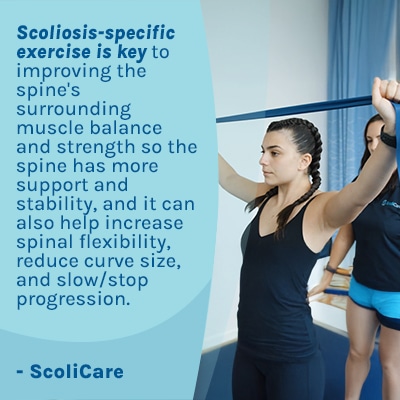 Scoliosis-specific exercise is key to improving the spine’s surrounding muscle balance and strength so the spine has more support and stability, and it can also help increase spinal flexibility, reduce curve size, and slow/stop progression (9).
In most cases, scoliosis-exercise alone isn’t enough to achieve 3D correction, but when combined with the potential power of scoliosis-specific exercises in theScoliBrace® program, research shows muscle endurance and spinal flexibility can be further improved (9, 10).
The ScoliBrace®
The ScoliBrace® offers an advanced approach to scoliosis bracing that’s evidence-based and customized (10).
No two braces are the same, just as no two cases of scoliosis are the same.
Braces use the latest in 3D scanning technology and computer aided design (CAD) to ensure each brace is as bespoke to its wearer as possible; this makes it more comfortable and improves rates of compliance (10).
Compliance can be a barrier to brace success because no brace, regardless of its potential efficacy, can be effective if it’s not worn exactly as it’s prescribed.
While traditional scoliosis braces are designed around the concert of spinal immobilization, the ScoliBrace® recognized the limits of this approach and responded with a brace designed with movement in mind; that way, bracing can be combined with other treatment disciplines for the best potential results (9, 10, 11).
The ScoliBrace® places the spine in an overcorrective position and uses spinal coupling to improve the spine’s 3D position and body posture (10, 11, 12).
While the spine is held in a corrective position, this improves the body’s overall posture and can also help improve the neurological connection between the brain, joints, and muscles that control body posture and support the spine.
Conclusion
As a progressive condition, scoliosis is ongoing, but it can be highly treatable, and a scoliosis diagnosis doesn’t have to disrupt a patient’s goals or quality of life, particularly when treated proactively.
Although we don’t always know what causes scoliosis, and there are no treatment guarantees, we know how to treat it effectively, and we know the key is managing/counteracting the progressive nature of scoliosis.
While there are different approaches to scoliosis treatment, a proactive nonsurgical approach that has 3-dimensional correction as its goal combines the power of multiple scoliosis-specific treatment disciplines.
The ScoliCare approach is to extract the best of what scoliosis-specific chiropractic care and different exercise approaches have to offer, and combine it with the innovative ScoliBrace® for 3D correction.
Through targeting the spines position and body posture with different disciplines, its alignment can be improved and a healthier posture can be restored, and through postural awareness that’s taught at part of the ScoliBalance® program, patients are taught to be mindful of posture and are taught a variety of scoliosis-specific exercises to help counteract the scoliosis and sustain treatment results.
References:
- Weinstein, S. L. (2019). The natural history of adolescent idiopathic scoliosis. Journal of Pediatric Orthopaedics, 39, S44-S46.
- Negrini S, Donzelli S, Aulisa AG, Czaprowski D, Schreiber S, de Mauroy JC, Diers H, Grivas TB, Knott P, Kotwicki T, Lebel A, Marti C, Maruyama T, O’Brien J, Price N, Parent E, Rigo M, Romano M, Stikeleather L, Wynne J, Zaina F. 2016 SOSORT guidelines: orthopaedic and rehabilitation treatment of idiopathic scoliosis during growth. Scoliosis Spinal Disord. 2018 Jan 10;13:3. doi: 10.1186/s13013-017-0145-8. PMID: 29435499; PMCID: PMC5795289
- Konieczny MR, Senyurt H, Krauspe R. Epidemiology of adolescent idiopathic scoliosis. J Child Orthop. 2013 Feb;7(1):3-9. doi: 10.1007/s11832-012-0457-4. Epub 2012 Dec 11. PMID: 24432052; PMCID: PMC3566258
- Dunn J, Henrikson NB, Morrison CC, et al. Screening for Adolescent Idiopathic Scoliosis: A Systematic Evidence Review for the U.S. Preventive Services Task Force [Internet]. Rockville (MD): Agency for Healthcare Research and Quality (US); 2018 Jan. (Evidence Synthesis, No. 156.) Available from: https://www.ncbi.nlm.nih.gov/books/NBK493367/
- Hong KS, Van Minh P, Nguyen HT, Phan MH, Nguyen HN, Pham TP. Re-evaluation of Incorrect Posture as a Diagnostic Criterion for Scoliosis in School Screenings: A Cross-Sectional Study in Vietnam. Cureus. 2025 Mar 31;17(3):e81535. doi: 10.7759/cureus.81535. PMID: 40314041; PMCID: PMC12043434
- Khorramroo F, Rajabi R, Mousavi SH. Gait kinetics in individuals with scoliosis: a systematic review and meta analysis. BMC Musculoskelet Disord. 2025 Jul 26;26(1):710. doi: 10.1186/s12891-025-08941-0. PMID: 40713561; PMCID: PMC12297666
- Ilharreborde B, Simon AL, Shadi M, Kotwicki T. Is scoliosis a source of pain? J Child Orthop. 2023 Nov 28;17(6):527-534. doi: 10.1177/18632521231215861. PMID: 38050593; PMCID: PMC10693849
- Zaina F, Marchese R, Donzelli S, Cordani C, Pulici C, McAviney J, Negrini S. Current Knowledge on the Different Characteristics of Back Pain in Adults with and without Scoliosis: A Systematic Review. J Clin Med. 2023 Aug 9;12(16):5182. doi: 10.3390/jcm12165182. PMID: 37629224; PMCID: PMC10455254
- Marchese R, Du Plessis J, Pooke T, McAviney J. The Improvement of Trunk Muscle Endurance in Adolescents with Idiopathic Scoliosis Treated with ScoliBrace® and the ScoliBalance® Exercise Approach. J Clin Med. 2024 Jan 23;13(3):653. doi: 10.3390/jcm13030653. PMID: 38337346; PMCID: PMC10856658
- Haggard JS, Haggard JB, Oakley PA, Harrison DE. Reduction of progressive thoracolumbar adolescent idiopathic scoliosis by chiropractic biophysics® (CBP®) mirror image® methods following failed traditional chiropractic treatment: a case report. J Phys Ther Sci. 2017 Nov;29(11):2062-2067. doi: 10.1589/jpts.29.2062. Epub 2017 Nov 24. PMID: 29200657; PMCID: PMC5702847
- Lim KBL, Mak HKW, Abdul Rahaman SH, Ong LL, Ooi SYJ, Lee NKL. A pilot study on the “ScoliBrace” in the treatment of adolescent idiopathic scoliosis. Eur J Orthop Surg Traumatol. 2024 May;34(4):1803-1809. doi: 10.1007/s00590-024-03845-6. Epub 2024 Feb 28. PMID: 38416233
- Nalda, A., Mirenzi, R., Doueihi, N. L., & McAviney, J. (2025, June). A Non-Surgical Multimodal Approach to Severe Thoracic Adolescent Idiopathic Scoliosis Combining ScoliBrace and Scoliosis-Specific Rehabilitation Therapies: A Case Series. In Healthcare (Vol. 13, No. 13, p. 1522). MDPI.