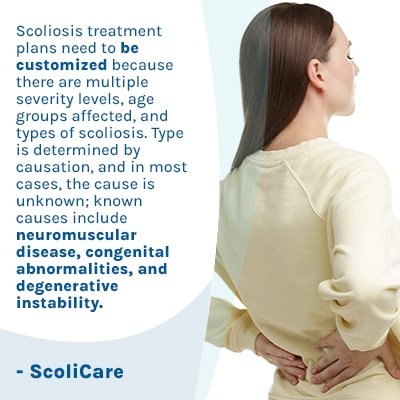
Scoliosis treatment plans need to be customized because there are multiple severity levels, age groups affected, and types of scoliosis. Type is determined by causation, and in most cases, the cause is unknown; known causes include neuromuscular disease, congenital abnormalities, and degenerative instability.
Typical scoliosis cases involve the most common form: idiopathic scoliosis with right-bending curves. Atypical cases are associated with neuromuscular, congenital, or degenerative causes, can involve left-bending curves, and are generally more severe. Treatment needs are case-specific; typical scoliosis is simpler to treat than atypical types.
Scoliosis treatment plans need to be customized around a number of key factors, one of which is the type of scoliosis.
The Main Types of Scoliosis
Scoliosis affects the spine by causing an unnatural sideways spinal curve with a rotational component to develop, and because it’s progressive, its nature is to become more severe over time (1).
Scoliosis treatment plans need to be shaped around the specifics of each patient and their scoliosis: age, posture, experienced symptoms, the main spinal section affected, severity and cause.
There is an important distinction to be made between addressing the symptoms of scoliosis, or their cause: the scoliosis itself.
When it comes to determining the type of scoliosis, this involves its underlying cause which, in most typical cases, isn’t known (1).
Idiopathic Scoliosis
Most scoliosis cases are classified as idiopathic, meaning not clearly associated with a single-known cause.
The general consensus is that idiopathic scoliosis is multifactorial: caused by a combination of factors that can vary from patient to patient.
Idiopathic scoliosis is the most common type to affect all ages, and the most prevalent form of scoliosis overall is adolescent idiopathic scoliosis, commonly diagnosed at the onset of puberty (1, 2).
Adolescent Idiopathic Scoliosis
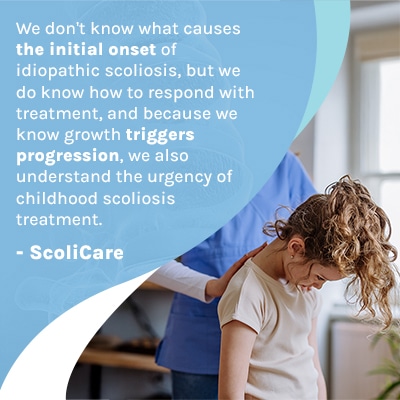
We don’t know what causes the initial onset of idiopathic scoliosis, but we do know how to respond with treatment, and because we know growth triggers progression, we also understand the urgency of childhood scoliosis treatment (3).
Adolescent idiopathic scoliosis is most often diagnosed at the onset of puberty, and because growth triggers progression, this age group is the most at risk for rapid advancement, and treating scoliosis proactively during growth is important (2, 3).
Symptoms of idiopathic scoliosis include postural changes such as uneven hips, uneven shoulders, and pain (more common in adults) (3, 4).
Treatment plans for idiopathic scoliosis need to be customized around a number of variables and can include a combination of scoliosis-specific exercise rehabilitation and corrective bracing (3, 5).
Approximately 80 percent of diagnosed scoliosis cases are idiopathic, and the remaining 20 percent consist of atypical types associated with known causes (6).
Atypical Scoliosis
Atypical cases of scoliosis tend to be more severe and advance at faster rates.
Idiopathic scoliosis cases are typical and most often involve right-bending curves in the thoracic spine (the largest spinal section). Typical curves will bend to the right, while most atypical cases involve left-bending thoracic curves (1).
When a left-bending curve is detected on an X-ray, this is an indicator that the scoliosis may have an underlying cause and is an atypical form.
Neuromuscular Scoliosis
Neuromuscular scoliosis (NMS) develops due to an issue with the muscles and nerves that control posture and movement (7).
Neuromuscular scoliosis most often develops as a secondary complication of an underlying neurological or muscular disorder such as muscular dystrophy, cerebral palsy, or spina bifida (7).
NMS affects both the alignment of the spine and the spine’s surrounding muscle strength, balance, and endurance, and treatment has to address the underlying pathology: the neurological or muscular disorder causing the scoliosis (7).
Patients with NMS may experience a noticeable disruption to quality of life through movement changes, pain, increased falls and injury, and some patients requiring mobility aids and/or becoming wheelchair-bound (7).
Congenital Scoliosis
Congenital scoliosis is also considered atypical, is a rare type, and affects approximately 1 in 10,000; babies are born with congenital scoliosis due to the spine forming abnormally while in utero (8).
Common malformations can include multiple vertebrae becoming fused together instead of forming into separate vertebral bodies, or misshapen vertebrae that interfere with the spine’s ability to form in a straight alignment (8).
Nonsurgical intervention can involve bracing for mild cases, and in more severe cases, surgical intervention may be necessary (8).
Degenerative Scoliosis
Degenerative de-novo scoliosis is most often caused by natural age-related degenerative changes in the spine; it affects older adults (45+), and lower back pain (4) and curve progression are common due to increasing degenerative instability (9).
As is the case with all types of scoliosis, while there are no treatment guarantees, when it comes to potential treatment efficacy, early detection and intervention are key.
The sooner treatment is started, the better, and when it comes to degenerative scoliosis, fall prevention through increasing the spine’s support and core stability is a focus of treatment plans.
Conclusion
At ScoliCare Clinics around the world, scoliosis treatment plans are shaped around a number of important variables that can change from patient to patient, one of which is the type of scoliosis diagnosed.
The most common type overall is idiopathic scoliosis, with no single-known cause, and while its cause is unknown, we do know how to respond with treatment and customize treatment plans accordingly.
When it comes to potential treatment success, diagnosing scoliosis while still mild has a number of benefits, but the potential benefits are only available when paired with a proactive treatment plan.
Typical cases of idiopathic scoliosis can respond well to a combination of scoliosis-specific exercise rehabilitation plans and corrective bracing, and the more atypical and/or severe, the more complex treatment needs are likely to be.
With atypical forms such as neuromuscular scoliosis, congenital scoliosis, and degenerative scoliosis, the underlying cause of the scoliosis has to be addressed: the neurological or muscular disorder, the spine’s structural abnormalities, and degenerative instability.
In many cases, scoliosis is highly treatable, and here at ScoliCare, the treatment process is individualized, comprehensive, and nonsurgical.
Find Your Nearest Clinic
ScoliCare Clinics, affiliates and product providers are in over 200 locations around the world. Find your nearest ScoliCare location here.

References:
- Janicki JA, Alman B. Scoliosis: Review of diagnosis and treatment. Paediatr Child Health. 2007 Nov;12(9):771-6. doi: 10.1093/pch/12.9.771. PMID: 19030463; PMCID: PMC2532872
- Weinstein, S. L. (2019). The natural history of adolescent idiopathic scoliosis. Journal of Pediatric Orthopaedics, 39, S44-S46
- Negrini, S., Donzelli, S., Aulisa, A. G., Czaprowski, D., Schreiber, S., de Mauroy, J. C., … & Zaina, F. (2018). 2016 SOSORT guidelines: orthopaedic and rehabilitation treatment of idiopathic scoliosis during growth. Scoliosis and spinal disorders, 13(1), 3
- Zaina, F., Marchese, R., Donzelli, S., Cordani, C., Pulici, C., McAviney, J., & Negrini, S. (2023). Current Knowledge on the Different Characteristics of Back Pain in Adults with and without Scoliosis: A Systematic Review. Journal of Clinical Medicine, 12(16), 5182. https://doi.org/10.3390/jcm12165182
- Marchese, R., Du Plessis, J., Pooke, T., & McAviney, J. (2024). The Improvement of Trunk Muscle Endurance in Adolescents with Idiopathic Scoliosis Treated with ScoliBrace® and the ScoliBalance® Exercise Approach. Journal of Clinical Medicine, 13(3), 653. https://doi.org/10.3390/jcm13030653
- Fadzan M, Bettany-Saltikov J. Etiological Theories of Adolescent Idiopathic Scoliosis: Past and Present. Open Orthop J. 2017 Dec 29;11:1466-1489. doi: 10.2174/1874325001711011466. PMID: 29399224; PMCID: PMC5759107.
- Allam AM, Schwabe AL. Neuromuscular scoliosis. PM R. 2013 Nov;5(11):957-63. doi: 10.1016/j.pmrj.2013.05.015. PMID: 24247014.
- Peng Z, Zhang H, Wang S, Zhang J. Advances in the diagnosis and treatment of congenital scoliosis. Eur J Med Res. 2025 Jul 29;30(1):683. doi: 10.1186/s40001-025-02943-3. PMID: 40731016; PMCID: PMC12306066
- Kotwal S, Pumberger M, Hughes A, Girardi F. Degenerative scoliosis: a review. HSS J. 2011 Oct;7(3):257-64. doi: 10.1007/s11420-011-9204-5. Epub 2011 Jun 11. PMID: 23024623; PMCID: PMC3192887
More news
-
 25 November 2025
Scoliosis is complex but treatable—nonsurgical care like scoliosis-specific chiropractic can support spinal health and function when part of a proactive plan.
-
 25 July 2025
Scoliosis can be highly responsive to treatment, particularly when conditions are diagnosed and treated early. The different types of scoliosis can have distinct treatment needs, and patients need to decide…
-
 15 July 2024
In recent years, patient-centred care has revolutionised the approach to scoliosis treatment by focusing on the unique needs, preferences and values of each patient. This approach places patients at the…