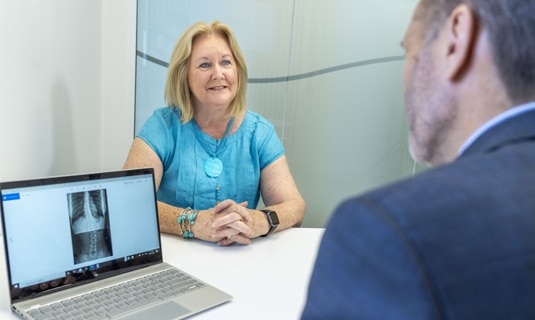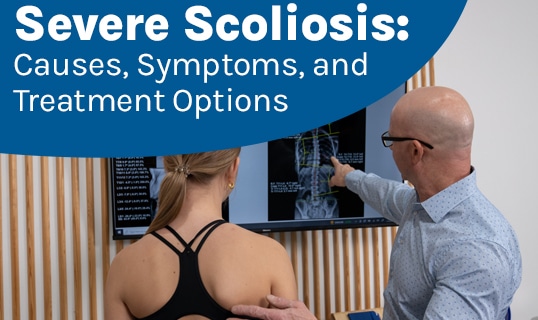
Scoliosis is an unnatural lateral spinal curvature, but its effects can be felt throughout the body. The more severe scoliosis is, the more noticeable its effects are likely to be. If left untreated, complications can develop, but when treated proactively, scoliosis can be highly treatable.
Scoliosis severity is mainly determined by the size of the unnatural spinal curve. Scoliosis severity ranges from mild scoliosis to moderate and severe scoliosis and is determined during X-ray by a patient’s Cobb angle measurement.
The potential efficacy of scoliosis treatment plans are shaped by a patient’s initial assessment and X-ray, so their accuracy is key, particularly when measuring a patient’s Cobb angle.
Assessing and Diagnosing Scoliosis
A patient’s treatment journey starts with an initial assessment and diagnosis, and accurate assessment is the first step towards a positive treatment outcome.
The information learned in a patient’s initial assessment and scoliosis X-ray will inform the customization of their treatment plan, so the accuracy and comprehensiveness of these initial examinations and measurements taken are crucial (1).
An initial assessment will include taking a patient’s family and medical history, performing a strength, mobility, and postural assessment, and examining the spine and trunk while in a forward bend position to look for indicators of scoliosis (2).
If a clinician detects an unnatural spinal curve and/or related trunk asymmetries such as uneven shoulders, hips, and a rib cage arch, further testing is warranted (X-ray), and necessary, to reach a diagnosis of scoliosis (1).
Two guidelines that have to be met for an unnatural spinal curvature to be diagnosed as scoliosis is the size of the curve and the presence of rotation; the size of scoliosis determines its severity.
The presence of rotation makes scoliosis 3-dimensional, and the size of the unnatural lateral spinal curvature has to be at least 10 degrees to be diagnosed as scoliosis: determined by a patient’s Cobb angle measurement (3).
Cobb Angle Measurement
A patient’s Cobb angle expresses the degree of scoliosis, and it’s critical that it’s measured accurately not only because it’s used to diagnose scoliosis, but also because the measurement is referred back to throughout the course of treatment to gauge treatment efficacy; a focus of treatment is on reducing a patient’s Cobb angle measurement to restore as much of the spine’s healthy curves as possible and for 3-dimensional postural improvement (3).
Determining a patient’s Cobb angle involves the curve’s most unnaturally-tilted vertebrae at the apex of the curve, and curve size is measured in degrees; the higher a patient’s Cobb angle, the larger and more severe the scoliosis (3).
Scoliosis severity is a key piece of information that treatment plans are shaped around; for example, in children whose curves are mild, meaning less than 20 degrees, they can be highly responsive to scoliosis-specific exercise and/or corrective bracing (4).
For patient’s larger curves that measure 20-25+ degrees, scoliosis-specific exercise alone is unlikely to be effective so is often recommended for a combination of scoliosis-specific exercises and full-time scoliosis bracing (4).
When a patient’s curve size is over 60 degrees and/or in atypical cases, surgery can be recommended.
What patients really need to understand about scoliosis is that as a progressive unnatural spinal curve, it’s unlikely to resolve on its own, and if left untreated, complications can develop.
Progression and Scoliosis Effects
So as scoliosis is progressive, even for patients diagnosed with mild scoliosis, being proactive is important because scoliosis can progress, and its effects can change quickly.
We don’t know what causes most cases of scoliosis to develop initially, but we know it’s growth that triggers progression, so for young patients still growing, there is a lot of potential progression that can occur (5).
Progression involves the size and rotation of the scoliosis increasing, and this increases the severity of related symptoms, and the more severe scoliosis becomes, the more difficult it can be to improve and/or reverse its effects.
In children, the main effects of scoliosis involve postural changes caused by the uneven forces of the unnatural spinal curve disrupting the body’s symmetry (6).
The earliest symptoms of scoliosis in children are often uneven shoulders, hips, and a noticeable rib cage arch, but in mild scoliosis cases, scoliosis effects can be subtle and difficult to recognize, hence the power of awareness so parents know what to look for (6).
Increasing postural changes include uneven shoulder blades, an uneven waist line, arm and leg length discrepancies, and change to movement also occurs that involves balance, coordination, and gait (6).
Back and radiating pain is the main symptom of adult scoliosis, and this is partially because scoliosis becomes progressive once skeletal maturity is reached; treating adult scoliosis involves pain management, and like other effects of scoliosis, pain increases alongside progression, ranging from mild to chronic pain (7).
While a patient’s Cobb angle is a prime indicator of severity, there are additional factors that shape the severity of a patient’s scoliosis, experienced symptoms, rates of progression, and quality of life.
Additional Indicators of Severity
In addition to a patient’s Cobb angle measurement, the main spinal section affected is another key factor treatment is customized around.
Rapid advancement isn’t just shaped by a patient’s age, but also the location of the scoliosis; the thoracic spine is the largest spinal section, the only one that attaches to the rib cage, and is the most commonly affected by scoliosis (8).
Thoracic scoliosis is also the most prone to rapid advancement and more vertebral rotation, so severity isn’t just based on the size of the unnatural curvature of the spine, but also its location and amount of rotation (8).
Another factor that determines severity is the underlying cause of scoliosis; in most cases, the cause is unknown and classified as idiopathic scoliosis, but there are some atypical forms associated with known causes: neuromuscular scoliosis and degenerative de-novo scoliosis.
Neuromuscular scoliosis tends to be severe because it’s caused by the presence of an underlying neurological and muscular condition such as spina bifida, cerebral palsy, or muscular dystrophy, and needs to be the focus of treatment (9).
Degenerative de-novo scoliosis is caused by degenerative instability so these cases are almost always painful and progressive, and a focus of treatment is improving the spine’s stability and fall prevention (10).
Conclusion
Scoliosis ranges widely in severity from mild scoliosis to severe scoliosis, but regardless of severity, the sooner treatment is started, the better, and there is more than one treatment approach for patients to choose from.
A traditional treatment approach commonly recommends watching and waiting following a diagnosis of mild scoliosis, but mild doesn’t mean a minor, or that there is less urgency, and/or the scoliosis is less likely to progress, but it can mean wasting valuable treatment time.
A proactive nonsurgical approach, also known as functional treatment, will start active treatment immediately following a diagnosis because as a progressive condition, treating scoliosis should involve working towards preventing progression and increasing effects.
Scoliosis diagnosed as mild means a small unnatural spinal curve has developed, and because it’s mild and hasn’t experienced significant progression, the spine is still flexible and likely to respond well; in addition, the effects of scoliosis are mild and simpler to correct.
Many cases of scoliosis respond well to proactive nonsurgical treatment, particularly those that were diagnosed and treated early, but there are no treatment guarantees.
When it comes to preventing scoliosis from becoming more severe, the milder scoliosis is at the start of treatment, the better, and the fewer limitations there are to conservative treatment.
Many cases of scoliosis are highly treatable with a customized combination of scoliosis-specific chiropractic adjustments, scoliosis specific exercises, and corrective bracing that work towards impacting the underlying structural nature of scoliosis, supporting structural changes with stronger and more balanced muscles, and improving the spine’s alignment, body positioning and posture.
While there are different scoliosis degrees, symptoms, types, and rates of progression, a shared factor is the need for treatment, and the sooner treatment is started, the better.
References:
- Ng SY, Bettany-Saltikov J. Imaging in the Diagnosis and Monitoring of Children with Idiopathic Scoliosis. Open Orthop J. 2017 Dec 29;11:1500-1520. doi: 10.2174/1874325001711011500. PMID: 29399226; PMCID: PMC5759132
- Côté P, Kreitz BG, Cassidy JD, Dzus AK, Martel J. A study of the diagnostic accuracy and reliability of the Scoliometer and Adam’s forward bend test. Spine (Phila Pa 1976). 1998 Apr 1;23(7):796-802; discussion 803. doi: 10.1097/00007632-199804010-00011. PMID: 9563110
- Horng MH, Kuok CP, Fu MJ, Lin CJ, Sun YN. Cobb Angle Measurement of Spine from X-Ray Images Using Convolutional Neural Network. Comput Math Methods Med. 2019 Feb 19;2019:6357171. doi: 10.1155/2019/6357171. PMID: 30996731; PMCID: PMC6399566
- Marchese R, Du Plessis J, Pooke T, McAviney J. The Improvement of Trunk Muscle Endurance in Adolescents with Idiopathic Scoliosis Treated with ScoliBrace® and the ScoliBalance® Exercise Approach. J Clin Med. 2024 Jan 23;13(3):653. doi: 10.3390/jcm13030653. PMID: 38337346; PMCID: PMC10856658
- Negrini S, Donzelli S, Aulisa AG, Czaprowski D, Schreiber S, de Mauroy JC, Diers H, Grivas TB, Knott P, Kotwicki T, Lebel A, Marti C, Maruyama T, O’Brien J, Price N, Parent E, Rigo M, Romano M, Stikeleather L, Wynne J, Zaina F. 2016 SOSORT guidelines: orthopaedic and rehabilitation treatment of idiopathic scoliosis during growth. Scoliosis Spinal Disord. 2018 Jan 10;13:3. doi: 10.1186/s13013-017-0145-8. PMID: 29435499; PMCID: PMC5795289
- Hong KS, Van Minh P, Nguyen HT, Phan MH, Nguyen HN, Pham TP. Re-evaluation of Incorrect Posture as a Diagnostic Criterion for Scoliosis in School Screenings: A Cross-Sectional Study in Vietnam. Cureus. 2025 Mar 31;17(3):e81535. doi: 10.7759/cureus.81535. PMID: 40314041; PMCID: PMC12043434
- Zaina F, Marchese R, Donzelli S, Cordani C, Pulici C, McAviney J, Negrini S. Current Knowledge on the Different Characteristics of Back Pain in Adults with and without Scoliosis: A Systematic Review. J Clin Med. 2023 Aug 9;12(16):5182. doi: 10.3390/jcm12165182. PMID: 37629224; PMCID: PMC10455254
- Weinstein SL, Ponseti IV. Curve progression in idiopathic scoliosis. J Bone Joint Surg Am. 1983 Apr;65(4):447-55. PMID: 6833318.
- Weinstein SL, Ponseti IV. Curve progression in idiopathic scoliosis. J Bone Joint Surg Am. 1983 Apr;65(4):447-55. PMID: 6833318.Wishart BD, Kivlehan E. Neuromuscular Scoliosis: When, Who, Why and Outcomes. Phys Med Rehabil Clin N Am. 2021 Aug;32(3):547-556. doi: 10.1016/j.pmr.2021.02.007. Epub 2021 May 12. PMID: 34175013
- Marty-Poumarat, Catherine MD*; Scattin, Luciana MD†; Marpeau, Michèle MD*; Garreau de Loubresse, Christian MD‡; Aegerter, Philippe MD, PhD§. Natural History of Progressive Adult Scoliosis. Spine 32(11):p 1227-1234, May 15, 2007. | DOI: 10.1097/01.brs.0000263328.89135.a6