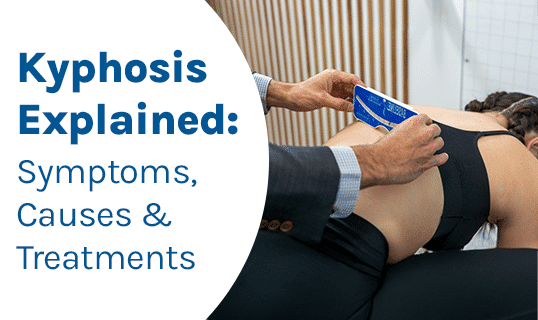
As the body’s main structural support, the spine plays a number of key roles in overall health. For healthy movement patterns and posture to protecting important organs and the spinal cord within, the spine’s healthy curves are key.
Kyphosis is a type of spinal curvature that curves outwards in a reverse C-shape, when viewed from either side. Kyphosis is a natural curve that characterizes the thoracic spine, and while there is a normal range of kyphosis, too much or too little may become problematic.
Before getting to the specifics of what’s considered too much or too little kyphosis, let’s talk generally about why the spine’s curves are so important.
A Healthy Spine
A healthy spine is important for a number of reasons: to facilitate healthy movement patterns, structural support, proper posture, protecting important organs, and the spinal cord (1).
The spine’s healthy curves make it stronger and more resistant to injury and/or strain, flexible, and facilitate its ability to evenly adsorb and distribute mechanical stress incurred during daily activity (1).
If the spine’s healthy curves are in place, its vertebrae are aligned in a straight and neutral position, which is optimal for spinal health and function, and as the spinal cord and brain work together as the central nervous system, the health of the spine can directly affect the nerves’ ability to receive and send input between the brain and body (1).
A healthy spine is one that can support good posture and healthy movement patterns; it’s one that can evenly absorb/distribute mechanical stress and the upper body’s weight over the pelvis and lower body (1).
The health of a person’s spine is shaped by a number of factors, one of the most important is the spine’s alignment because this shapes its balance and stability.
Kyphosis Explained
Kyphosis is a type of spinal curvature that when viewed from either side, will have a reverse C-shape because the spine curves outwards; lordosis is the opposite spinal-curve type that curves inwards in a standard C shape (when viewed from either side) (2).
Kyphosis refers to the rounded shape of the middle/upper back.
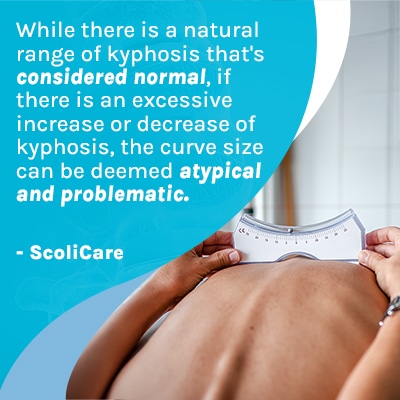
The size of spinal curves are measured in degrees. While there is a natural range of kyphosis that’s considered normal, if there is an excessive increase or decrease of kyphosis, the curve size can be deemed atypical and problematic (2).
What’s considered a normal range of kyphosis can vary, but generally falls within 20 to 45 degrees (2).
The spine has three main sections: the cervical spine, thoracic spine, and the lumbar spine.
While the cervical and lumbar spinal sections have natural lordosis, the largest spinal section, the thoracic spine, features a kyphotic curve.
Each spinal section has specific roles to play in maintaining the spine’s strength and flexibility, and the thoracic spine is the largest spinal section with 12 vertebral bodies.
The thoracic spine refers to the middle and upper back and is the only section of the spine that attaches to the rib cage, so it helps anchor the rib cage, gives structural support, protects the heart and lungs, the spinal cord, and facilitates a wide range of trunk motion.
The ability of the thoracic spine to perform these roles will depend on the health of its discs, vertebrae, and degree of kyphosis (2, 3).
Hyperkyphosis: Too Much Kyphosis
If a person’s degree of kyphosis is moderate and falls within a normal range, the curve is considered typical, but if there is a significant increase in kyphosis that’s considered excessive, this is diagnosed as hyperkyphosis and can become problematic (2).
Hyperkyphosis is commonly diagnosed at 45+ degrees, and there are also different types of hyperkyphosis.
Common symptoms of hyperkyphosis include poor posture with a noticeable slouch in the middle/upper back, pain in the middle/upper back, and spinal rigidity.
Postural Hyperkyphosis
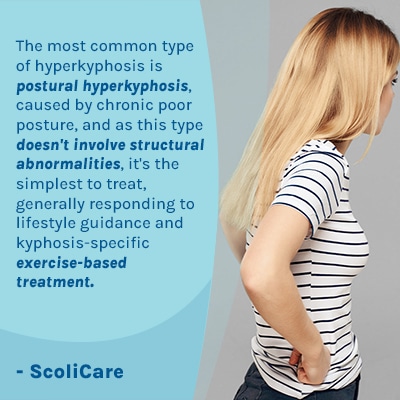
The most common type of hyperkyphosis is postural hyperkyphosis, caused by chronic poor posture, and as this type doesn’t involve structural abnormalities, it’s the simplest to treat, generally responding to lifestyle guidance and kyphosis-specific exercise-based treatment (2).
Postural hyperkyphosis is most prevalent among adolescents.
Scheuermann’s Hyperkyphosis
Scheuermann’s kyphosis is also commonly diagnosed during adolescence, but this type involves vertebrae with structural abnormalities, so the curve is rigid and more complex to treat (2).
True Scheuermann’s hyperkyphosis is diagnosed when 3 or more vertebrae are misshapen and develop a wedge shape; this can also damage the discs that sit between adjacent vertebrae, further compromising the spine’s stability (2, 3).
 Because Scheuermann’s kyphosis is structural, kyphosis-specific exercise needs to be combined with kyphosis-specific bracing for the best potential treatment outcome (4).
Age-Related Hyperkyphosis
Age-related hyperkyphosis is common as the muscles and ligaments that support the spine can become weaker over time, and particularly for females going through menopause and experiencing bone density loss, compression fractures are a risk as the front of the vertebrae can collapse (4).
Maintaining a strong core and straight upright posture is important as we age; if upright posture is disrupted, hyperkyphosis can develop, causing increasing instability (4).
Kyphosis-specific exercise (5) and kyphosis-specific bracing can work towards restoring a straight posture and increasing core strength for more stability (4).
Hypokyphosis: Too Little Kyphosis
A diagnosis of thoracic hypokyphosis means the thoracic spine has too little kyphosis and the curve has flattened out and/or curves forward (6).
If the thoracic spine loses its natural kyphosis and straightens out, the spine can become rigid, painful, and issues with balance, mobility, and digestion can develop (6).
If the spine’s middle section flattens out, it can also affect the health of the cervical and lumbar spinal sections.
Common symptoms of thoracic hypokyphosis include a stiff and rigid back, back pain, shoulder pain, disruptions to balance, a stooped-forward posture, and in severe cases and/or when left untreated, breathing and digestion can also be affected (6).
Conclusion
Spinal health is key to quality of life; it can shape movement, comfort, posture, and nerve health.
If the spine loses one or more of its healthy curves, its balance and stability is disrupted, and this can affect its ability to function optimally.
Kyphosis refers to the spine’s natural outward curvature that forms a reverse C-shape when viewed from either side.
If there is too much kyphosis, the curve is too large, causing an excessively-rounded middle/upper back known as hyperkyphosis, and if the thoracic spine loses its kyphosis and flattens out, this is hypokyphosis.
As the largest spinal section, the health of the thoracic spine shapes the other sections, so if its degree of kyphosis increases or decreases beyond a normal range, the entire spine’s biomechanics can be disrupted.
Here at ScoliCare, we offer kyphosis-specific exercise rehabilitation programs and custom-made kyphosis-specific braces with corrective potential.
References:
- Cologne, Germany: Institute for Quality and Efficiency in Health Care (IQWiG); 2006-. In brief: How does the spine work? [Updated 2022 May 11]. Available from: https://www.ncbi.nlm.nih.gov/books/NBK279468/
- Lam JC, Mukhdomi T. Kyphosis. [Updated 2023 Aug 8]. In: StatPearls [Internet]. Treasure Island (FL): StatPearls Publishing; 2025 Jan-. Available from: https://www.ncbi.nlm.nih.gov/books/NBK558945/
- Scarcia L, Pileggi M, Camilli A, Romi A, Bartolo A, Giubbolini F, Valente I, Garignano G, D’Argento F, Pedicelli A, Alexandre AM. Degenerative Disc Disease of the Spine: From Anatomy to Pathophysiology and Radiological Appearance, with Morphological and Functional Considerations. J Pers Med. 2022 Nov 1;12(11):1810. doi: 10.3390/jpm12111810. PMID: 36579533; PMCID: PMC9698646
- Ailon T, Shaffrey CI, Lenke LG, Harrop JS, Smith JS. Progressive Spinal Kyphosis in the Aging Population. Neurosurgery. 2015 Oct;77 Suppl 4:S164-72. doi: 10.1227/NEU.0000000000000944. PMID: 26378354
- Ponzano M, Tibert N, Bansal S, Katzman W, Giangregorio L. Exercise for improving age-related hyperkyphosis: a systematic review and meta-analysis with GRADE assessment. Arch Osteoporos. 2021 Sep 21;16(1):140. doi: 10.1007/s11657-021-00998-3. Erratum in: Arch Osteoporos. 2021 Dec 29;17(1):9. doi: 10.1007/s11657-021-01040-2. PMID: 34546447
- Mitchell JR, Oakley PA, Harrison DE. Nonsurgical correction of straight back syndrome (thoracic hypokyphosis), increased lung capacity and resolution of exertional dyspnea by thoracic hyperkyphosis mirror image® traction: a CBP® case report. J Phys Ther Sci. 2017 Nov;29(11):2058-2061. doi: 10.1589/jpts.29.2058. Epub 2017 Nov 24. PMID: 29200656; PMCID: PMC5702846