Understanding the signs and symptoms of scoliosis can lead to early diagnosis and intervention. There are never treatment guarantees, but when scoliosis is diagnosed while mild and treated proactively, it can be highly responsive and treatable.
The early signs of scoliosis can be subtle. In children, the earliest symptoms of scoliosis include uneven shoulders and hips. Postural changes are the main signs in children, and the main symptom of adult scoliosis is back and nerve pain.
Before getting to the specific signs and symptoms to watch for, let’s first talk generally about how scoliosis affects the body.
Living with Scoliosis
Being diagnosed with scoliosis means an unnatural lateral spinal curvature has developed, and as the curve is progressive, it’s likely to increase in size over time.
Most cases of scoliosis are idiopathic, meaning cause unknown, but we know it’s growth that triggers progression, so childhood scoliosis, in particular, can advance rapidly, and this means the symptoms of scoliosis can also change quickly (1).
As scoliosis is not a static condition, parents and/or caregivers need to fully understand that a patient’s scoliosis severity at the time of diagnosis doesn’t indicate that’s where it will stay; some patients hear the word mild and think it means there is less need for treatment, or that treatment can be delayed, or that the scoliosis should merely be observed, but this can have consequences (1).
Starting treatment while scoliosis is mild is the optimal time to act because the curve is small, flexible, and scoliosis effects aren’t yet well established (2).
The spine gets increasingly rigid alongside progression, and this makes the spine less responsive to treatment and the scoliosis harder to correct.
Scoliosis is also associated with muscular imbalance as the spine’s unnatural bend and twist can pull its surrounding muscles in opposite directions, causing muscle on one side of the spine to work harder, while muscles on the opposite side can become weak from lack of use.
The more progression occurs prior to the onset of treatment, the more established scoliosis effects become and the more difficult they can be to improve and/or reverse.
The sooner treatment is started, the better, particularly when it comes to managing childhood scoliosis during growth (1, 2).
Adults also benefit from early detection and proactive treatment, particularly older adults facing spinal degeneration with increasing instability.
Because scoliosis progression involves increasing severity, its effects become more noticeable, which is why most scoliosis patients are diagnosed while moderate, when the subtle signs of mild scoliosis have been missed, but the more overt signs of moderate and/or severe scoliosis are easier to recognize; this is why a focus of ScoliCare is educating the public on the early signs of scoliosis so more patients are diagnosed early in the progressive line (2, 3).
So now that we’ve talked generally about scoliosis and its progressive nature, let’s talk about its specific signs and symptoms across different age groups.
Childhood Scoliosis
Scoliosis affects all ages, but children are most commonly diagnosed. Childhood scoliosis includes infantile scoliosis, juvenile scoliosis, and adolescent idiopathic scoliosis is the most prevalent type of scoliosis overall.
Adolescent idiopathic scoliosis is diagnosed around 11 or 12 years of age in females and a little older in males, and due to the rapid and unpredictable growth spurts of puberty, this age group is the most at risk for rapid progression (4).
Children have the most to benefit from early detection, but the subtlety of the early signs of scoliosis and the lack of compressive pain due to the constant lengthening motion of growth the spine is experiencing can be a barrier (2, 3); awareness chips away at that barrier.
Every parent, and/or caregiver, with awareness of how important early detection is, along with the early signs of scoliosis to watch for, can lead to a child being diagnosed early, and when diagnosed early, the opportunity for early intervention is within reach (2, 3).
Postural Changes
As scoliosis develops and progresses, it introduces uneven forces to the spine, its surroundings, and the entire body.
A spine with an unnatural spinal curve won’t function optimally; the spine’s healthy curves are needed to maintain its flexibility, strength, handle mechanical stress, and protect the spinal nerves within.
The uneven forces of scoliosis disrupt the spine’s alignment and the body’s overall symmetry (5).
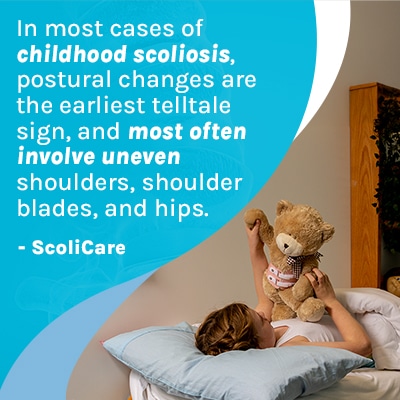
In most cases of childhood scoliosis, postural changes are the earliest telltale sign, and most often involve uneven shoulders, shoulder blades, and hips (5).
Additional postural changes to watch for include the head not being centered over the torso, an uneven eye line, development of a rib cage arch, and uneven arm and leg length (5).
The more severe scoliosis is, or becomes, the more noticeably posture is disrupted, and movement can also be affected (6).
Changes to balance, coordination, and gait are additional signs of scoliosis to watch for (6).
Pain
The topic of scoliosis pain is an interesting one. There are many factors that shape a patient’s potential pain level, and some patients who don’t experience pain at all (mainly young patients who are being treated proactively) (7).
When scoliosis becomes compressive, back and nerve pain are common, and it’s sometimes not until skeletal maturity is reached that this occurs (7).
When growth stops, back pain tends to increase, as does nerve pain.
Localized back pain and pain that radiates into the extremities are the main symptoms of scoliosis in adults.
Adults also experience postural changes, along with a prominent lean to one side, but it’s pain that tends to be more noticeable and leads to an assessment and diagnosis (7).
The two main types of scoliosis to affect adults are Adolescent Scoliosis in Adult (ASA) and Degenerative De-Novo Scoliosis (DDS); ASA often involves cases of adolescent scoliosis that were undiagnosed and untreated during adolescence, and DDS is caused by degenerative instability (8).
The prevalence of adolescent scoliosis in adults highlights the importance of early detection and intervention because had these adult patients been diagn
osed and treated during adolescence, progression may have been preventable (3, 8).
Degenerative scoliosis affects older adults, and these cases are almost always progressive and painful, the main sign being lower back pain; the sooner these patients are diagnosed, the earlier fall prevention efforts can be put into place (8).
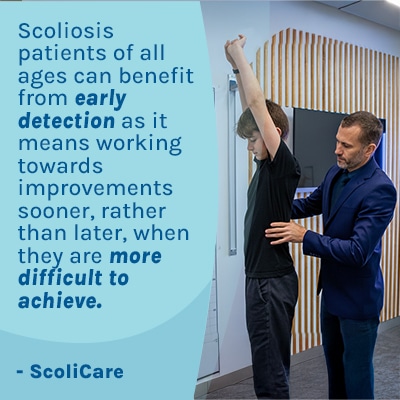
Scoliosis patients of all ages can benefit from early detection as it means working towards improvements sooner, rather than later, when they are more difficult to achieve.
Conclusion
The signs and symptoms of scoliosis aren’t always overt, particularly when mild, so it’s important to be aware of what to look for.
When it comes to childhood scoliosis, these cases can progress quickly due to the constant trigger of growth occurring, and while children can still experience back and muscle pain, it’s postural changes that are the earliest signs.
Postural changes can include uneven shoulders and hips, and movement changes are also common.
In adult scoliosis cases, it’s most often back and nerve pain that alerts patients to the need for assessment, but in many cases, significant progression has already occurred, and the goal is always early detection and intervention.
As a leader in scoliosis education, ScoliCare delivers comprehensive, innovative, and effective nonsurgical scoliosis treatment, while increasing awareness of the importance of early detection.
References:
- Negrini S, Donzelli S, Aulisa AG, Czaprowski D, Schreiber S, de Mauroy JC, Diers H, Grivas TB, Knott P, Kotwicki T, Lebel A, Marti C, Maruyama T, O’Brien J, Price N, Parent E, Rigo M, Romano M, Stikeleather L, Wynne J, Zaina F. 2016 SOSORT guidelines: orthopaedic and rehabilitation treatment of idiopathic scoliosis during growth. Scoliosis Spinal Disord. 2018 Jan 10;13:3. doi: 10.1186/s13013-017-0145-8. PMID: 29435499; PMCID: PMC5795289
- Dunn J, Henrikson NB, Morrison CC, et al. Screening for Adolescent Idiopathic Scoliosis: A Systematic Evidence Review for the U.S. Preventive Services Task Force [Internet]. Rockville (MD): Agency for Healthcare Research and Quality (US); 2018 Jan. (Evidence Synthesis, No. 156.) Available from: https://www.ncbi.nlm.nih.gov/books/NBK493367/
- de Groot C, Heemskerk JL, Willigenburg NW, Altena MC, Kempen DHR. Educating Parents Improves Their Ability to Recognize Adolescent Idiopathic Scoliosis: A Diagnostic Accuracy Study. Children (Basel). 2022 Apr 15;9(4):563. doi: 10.3390/children9040563. PMID: 35455607; PMCID: PMC9025014
- Weinstein SL. The Natural History of Adolescent Idiopathic Scoliosis. J Pediatr Orthop. 2019 Jul;39(Issue 6, Supplement 1 Suppl 1):S44-S46. doi: 10.1097/BPO.0000000000001350. PMID: 31169647
- Hong KS, Van Minh P, Nguyen HT, Phan MH, Nguyen HN, Pham TP. Re-evaluation of Incorrect Posture as a Diagnostic Criterion for Scoliosis in School Screenings: A Cross-Sectional Study in Vietnam. Cureus. 2025 Mar 31;17(3):e81535. doi: 10.7759/cureus.81535. PMID: 40314041; PMCID: PMC12043434
- Xu J, Chen M, Wang X, Luo X. Biomechanical changes in adolescent idiopathic scoliosis during walking: A protocol for systematic review and meta-analysis. Medicine (Baltimore). 2023 Dec 8;102(49):e36528. doi: 10.1097/MD.0000000000036528. PMID: 38065886; PMCID: PMC10713143
- Ilharreborde B, Simon AL, Shadi M, Kotwicki T. Is scoliosis a source of pain? J Child Orthop. 2023 Nov 28;17(6):527-534. doi: 10.1177/18632521231215861. PMID: 38050593; PMCID: PMC10693849
- Marty-Poumarat, Catherine MD*; Scattin, Luciana MD†; Marpeau, Michèle MD*; Garreau de Loubresse, Christian MD‡; Aegerter, Philippe MD, PhD§. Natural History of Progressive Adult Scoliosis. Spine 32(11):p 1227-1234, May 15, 2007. | DOI: 10.1097/01.brs.0000263328.89135.a6