
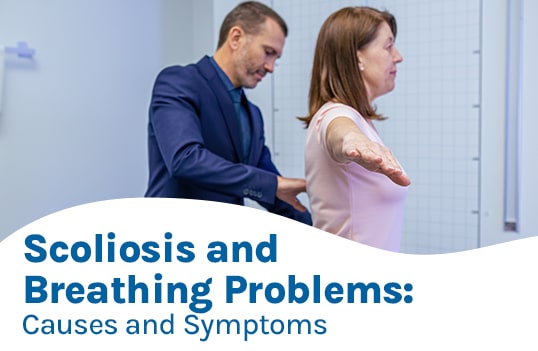
Scoliosis can affect people differently, but common symptoms involve postural and mobility changes, and pain. Breathing problems aren’t common in mild and moderate cases and are more closely associated with severe cases; preventing increasing symptom severity is a benefit of proactive treatment.
Scoliosis develops in the spine, but its effects can be widespread, particularly if severe or left untreated. Breathing difficulties aren’t considered a common symptom of typical and/or mild scoliosis, but progression can make symptoms more severe, and breathing problems may develop as a related complication.
Scoliosis breathing difficulties can be caused by severe curves disrupting the position and symmetry of the rib cage. The good news is that with early treatment and avoiding the progression to larger sized cures, most people do not experience any breathing difficulties.
Scoliosis Breathing Difficulties
Not all cases of scoliosis involve breathing difficulties, but the effects of scoliosis can also change over time.
Scoliosis is progressive, so its nature is to increase in severity, and while we don’t know why most cases of scoliosis develop initially, we understand growth spurts trigger progression (1).
It can be a mistake for patients diagnosed with mild scoliosis to think that mild indicates a lack of urgency, or that its effects will stay mild without treatment, and/or during rapid periods of growth (1).
 There are never treatment guarantees, but one of the main benefits of being proactive with treatment is the potential to prevent progression, increasing symptom severity, and the development of related complications such as breathing problems.
Scoliosis breathing difficulties can involve a loss of space for the lungs to function within and/or changes to diaphragm-muscle health, particularly with large thoracic curves or a scoliosis associated with severe hyperkyphosis.
Scoliosis can be diagnosed as mild, moderate, or severe, and the milder the scoliosis, the more subtle its symptoms are going to be, but the longer it’s left untreated, the more severe it may become.
Chest Wall Restriction
In severe cases, the unnatural spinal curve is large and has more rotation, and when scoliosis develops in the thoracic spine, a common effect is a disruption to the position of the rib cage (2).
The thoracic spine is the only spinal section that’s attached to the rib cage, and if that section of the spine has an unnatural curve and twist, it can pull excessively on one side of the rib cage, causing it to protrude and form an arch (2).
As the lungs are protected by the rib cage, an unnatural shift in the position of the rib cage maycan cause chest-wall restriction and make it difficult for the rib cage to expand fully and the lungs to fill fully with air (2).
With less space within the chest cavity, the lungs don’t have the space needed to function optimally, and respiratory muscles can also be affected (2).
The diaphragm is the main muscle used in breathing, and if scoliosis restricts the muscle’s natural movement, it takes more effort to breathe deeply, commonly causing increasing shortness of breath and tiredness.
As breathing problems are more related to severe cases, let’s discuss the factors that determine scoliosis severity.
Severe Scoliosis and Lung Impairment
The main factor that determines severity is a patient’s Cobb angle: a measurement taken during X-ray.
The measurement is taken from the apex of the curve, and the larger the angle that’s measured, the more severe the scoliosis.
As scoliosis is 3-dimensional, the angle of trunk rotation (ATR) is another factor that shapes severity; the more rotation there is in the spine, the harder it can be to correct, and the more it’s going to affect its surroundings, including the position of the rib cage.
In addition, thoracic curves are more prone to rapid advancement and bronchial compression (3).
Most mild and moderate cases won’t involve noticeable changes to lung function; patients most likely to notice changes in lung function are those whose scoliosis is severe (2, 3).
Even in some severe cases, the most likely patients to notice changes in lung function may be those who place atypical demands on their respiratory muscles and systems (professional athletes, long- distance runners).
The effects of mild scoliosis can be subtle, but when/if scoliosis progresses and becomes severe, symptoms can increase, becoming more noticeable and disruptive: asymmetrical posture, changes to gait, balance, coordination, back and nerve pain, and difficulty taking deep breaths.
A diagnosis of severe scoliosis means the size and rotation of the unnatural spinal curve is significant, and the more severe scoliosis becomes, the more likely it is to continue progressing as the spine becomes increasingly unbalanced and unstable.
Atypical Scoliosis and Breathing
There are also atypical types of scoliosis, and these cases tend to be more severe, can progress quickly, and are more likely to affect lung function.
In the main type of scoliosis, idiopathic scoliosis, with no single-known cause, curves bend to the right, away from the heart, but there are cases that involve left-bending curves, and this generally indicates an underlying pathology like neuromuscular disease.
When scoliosis develops as a secondary complication of a neurological condition (neuromuscular scoliosis) like spina bifida, muscular dystrophy, or cerebral palsy, these cases can involve very severe scoliosis patients.
 Some neuromuscular scoliosis patients require walking aids; additional complications can include disruptions to respiratory function, pulmonary function, increasing pain, injury, cardiovascular issues, nerve damage, and digestive issues (4).
However, it is unclear whether the respiratory muscle weakness and loss of lung volume in NMS patients is more closely related to the underlying neuromuscular disease, or the scoliosis itself (4).
The more severe and atypical, the more potential there is for related complications like shallow breathing and reduced lung volume.
Starting treatment while scoliosis is still mild means while the spine’s unnatural curve is small and the spine is still flexible; as progression occurs, the spine becomes increasingly rigid, and this can make it less responsive and harder to correct with nonsurgical treatment.
Starting treatment while scoliosis is still mild can also mean minimizing its potential effects and complications, including breathing difficulties.
Conclusion
Not everyone with scoliosis will experience breathing problems, particularly milder cases or patients being treated proactively.
In severe and/or atypical cases that tend to be more severe, scoliosis related lung impairment can develop, and the more regularly a patient engages in strenuous cardiovascular activity, the more likely they are to notice any changes in lung capacity.
Breathing difficulties are also more closely associated with thoracic scoliosis that develops in the thoracic spine (middle/upper back) because it’s the only spinal section that attaches to the rib cage.
A common effect of thoracic scoliosis is the development of a rib cage arch as the spine’s unnatural bend and twist pulls on one side of the rib cage, causing an arch to form; disrupting the position and symmetry of the rib cage can affect important organs protected within, including the lungs.
Chest wall restriction means there is less room for the lungs to function optimally within.
If there is chest wall restriction due to changes in the rib cage’s position, the rib cage may not be able to expand fully during deep breaths, and this can interfere with lung expansion and cause more shallow breathing and shortness of breath.
A scoliosis curve can also impact diaphragmatic breathing if the curve restricts movement of the diaphragm muscle, impacting its function.
People with scoliosis need to understand the importance of proactive treatment, and because scoliosis is progressive, its effects can change over time, particularly in severe cases and/or if left untreated.
The best way to minimize the potential effects and complications of scoliosis is to respond to a diagnosis with a proactive and customized treatment plan; here at ScoliCare, treatment plans are comprehensive and individualized.
Find Your Nearest Clinic
ScoliCare Clinics, affiliates and product providers are in over 200 locations around the world. Find your nearest ScoliCare location here.


References:
- Negrini, S., Donzelli, S., Aulisa, A. G., Czaprowski, D., Schreiber, S., de Mauroy, J. C., … & Zaina, F. (2018). 2016 SOSORT guidelines: orthopaedic and rehabilitation treatment of idiopathic scoliosis during growth. Scoliosis and spinal disorders, 13(1), 3
- Hu Z, Leng Y, Zhao D, Zhong R, Zhang Z, Jiang D, Wang F, Liang Y. The risk factors for type ii respiratory failure in patients with severe scoliosis (less than 40-year old). J Orthop Surg Res. 2025 Feb 28;20(1):213. doi: 10.1186/s13018-025-05630-5. PMID: 40016796; PMCID: PMC11869721
- Qiabi M, Chagnon K, Beaupré A, Hercun J, Rakovich G. Scoliosis and bronchial obstruction. Can Respir J. 2015 Jul-Aug;22(4):206-8. doi: 10.1155/2015/640573. Epub 2015 Jun 17. PMID: 26083538; PMCID: PMC4530852
- Inal-Ince D, Savci S, Arikan H, Saglam M, Vardar-Yagli N, Bosnak-Guclu M, Dogru D. Effects of scoliosis on respiratory muscle strength in patients with neuromuscular disorders. Spine J. 2009 Dec;9(12):981-6. doi: 10.1016/j.spinee.2009.08.451. Epub 2009 Oct 9. PMID: 19819188
More news
-
 8 August 2025
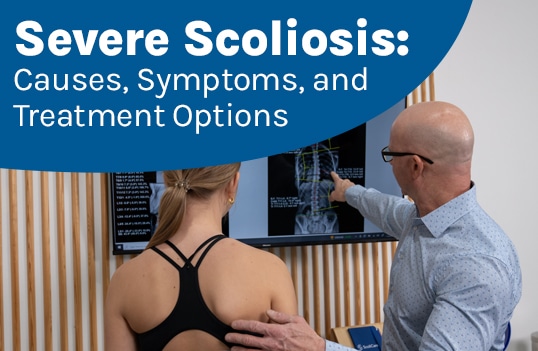
What patients need to understand about severe scoliosis is that it doesn't start that way; as a progressive condition, scoliosis severity can increase over time, and while young patients can…
-
 14 March 2021
Kurt Cobain and his Scoliosis Part of our series of famous people who have/had a Scoliosis. Next up is Kurt Cobain! Kurt Cobain is best known as the lead…
-
 3 March 2026
Early signs of scoliosis—like uneven shoulders or hips—can be subtle. Spotting them early boosts the chances of successful, proactive treatment.