The thoracic spine is the largest spinal section, and its health and function is shaped, in part, by its degree of kyphosis. If a person’s kyphosis becomes excessive, the upper back and shoulders round forward noticeably, causing postural and movement changes.
The spine’s curves facilitate a number of its functions from shock absorption to structural support and flexibility. Kyphosis refers to a type of outward-curving spinal curvature that can be healthy or unhealthy, depending on its size. Excessive kyphosis is diagnosed as hyperkyphosis.
There is a natural range of healthy kyphosis, but if a person’s degree of kyphosis becomes excessive and doesn’t fall within a typical range, the curve can become unhealthy and problematic.
Healthy Kyphosis
The spine can be divided into three main sections: the cervical spine (neck), thoracic spine (middle/upper back), and the lumbar spine.
The thoracic spine is the largest spinal section, and if its healthy degree of kyphosis is lost, this commonly involves the curve becoming excessive (1).
The thoracic spine has the unique role of protecting important organs like the heart and lungs as it attaches to the rib cage; it also anchors the rib cage, facilitates a wider range of motion in the upper body, and protects the spinal nerves within (1).
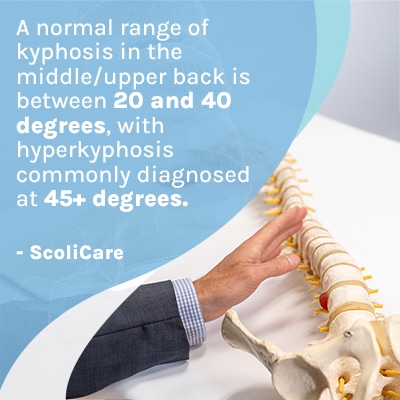 A normal range of kyphosis in the middle/upper back is between 20 and 40 degrees, with hyperkyphosis commonly diagnosed at 45+ degrees.
Being diagnosed with hyperkyphosis means the thoracic spine has too much kyphosis, and this causes the spine to curve too far outward and become misaligned.
Hyperkyphosis Symptoms
Hyperkyphosis can also be referred to simply as kyphosis.
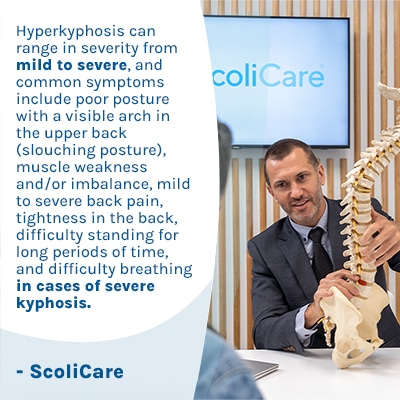
Hyperkyphosis can range in severity from mild to severe, and common symptoms include poor posture with a visible hump in the upper back (slouching posture), muscle weakness and/or imbalance, mild to severe back pain, tightness in the back, difficulty standing for long periods of time, and difficulty breathing in cases of severe kyphosis (2, 3).
If left untreated, the excessive kyphosis can become more severe over time as the uneven forces of the unnatural spinal curvature further disrupt the spine’s alignment, balance, and stability.
Hyperkyphosis most often appears during adolescence, and there are also different types of kyphosis determined by its underlying cause: postural kyphosis, Scheuermann’s kyphosis (4), and age-related kyphosis (5).
Hyperkyphosis Causes
Postural kyphosis is the most common type, and as a nonstructural condition, the excessive curvature of the spine is flexible and is caused by chronic poor posture.
Over time, chronic poor posture can strain the vertebrae and supportive muscles/ligaments, disrupting their ability to support the spine and maintain its alignment.
As the curve is postural, it can be reduced with a change in body position.
Scheuermann’s Kyphosis
Scheuermann’s kyphosis is structural so is caused by structural abnormalities within the spine itself, and this most commonly involves vertebral wedging caused by misshapen vertebrae (bones of the spine) disrupting the thoracic spine’s ability to maintain its healthy degree of kyphosis (4).
Scheuermann’s kyphosis is more common in females due to changes in bone density related to menopause, and it can get worse over time, particularly when growth is occurring (4, 5).
Age-Related Kyphosis
Age-related kyphosis is caused by degenerative instability. Often, spinal degeneration starts with the discs that sit between adjacent vertebrae (5). It can often appear with degenerative scoliosis (6).
The discs give the spine flexibility, structure, cushioning between adjacent vertebrae, and act as the spine’s shock absorbers.
If one or more discs experience degenerative changes, they can become desiccated and change shape, and this can affect the position of vertebrae attached, causing an unnatural spinal curve to develop.
Age-related kyphosis is almost always progressive and painful because it involves the spine becoming increasingly unstable, and when there is too much movement within the spine, patients are at more at risk of injury through a fall (5,7).
Hyperkyphosis Treatments
When it comes to hyperkyphosis treatments, different types have different characteristics and treatment needs.
Postural kyphosis, for example, is the simplest to treat because as it’s not structural, the curve is flexible, and in most cases, will respond to lifestyle guidance and kyphosis-specific physical therapy (8).
Physical therapy can help by strengthening and balancing the spine’s surrounding muscles so the spine has more support and stability; it can also help to correct posture and teach postural awareness (4).
Scheuermann’s kyphosis features stiff and rigid curves because it’s structural, so in many cases, kyphosis-specific exercise alone won’t be enough to significantly improve the spine’s alignment and position; this is where corrective bracing (KyphoBrace) comes in (9, 10).
The KyphoBrace is a 3-D custom-designed brace that’s worn around the torso to improve the spine’s position and balance and improve a patient’s degree of kyphosis so it falls within a health range (5).
The KyphoBrace may help stop progression, reduce the size of the unnatural spinal curve, improve the spine’s sagittal balance, posture, and provide pain relief (5).
In cases of childhood Scheuermann’s kyphosis, bracing is almost always recommended to manage progression during growth, and in adults, bracing can help by stabilizing the spine/posture and providing short-term pain relief (4, 5).
While some severe kyphosis cases may be recommended for surgical treatment, when diagnosed early and treated proactively, particularly during growth, improvements can be made that include improving the spine’s surrounding muscle strength and balance, along with the spine’s position and alignment.
Conclusion
The spine’s healthy curves are important; they make the spine stronger, more flexible, and more capable of evenly absorbing and distributing mechanical stress.
Kyphosis is a type of spinal curvature that curves outwards, and lordosis is the opposite curve type that bends inwards.
The thoracic spine has a natural range of kyphosis that falls between 20 and 40 degrees, so curve size can vary and not be problematic, but if a person’s curve size becomes excessive and measures at 45+ degrees, this is considered hyperkyphosis.
Hyperkyphosis means the middle/upper back has an excessive spinal curvature that curves too far outwards, causing the development of rounded shoulders and an excessively rounded-forward upper back.
How we hold our bodies and spines during daily activity is important, and through postural awareness and correction, kyphosis can be improved, and when combined with the power of a corrective KyphoBrace, there are fewer limits to a nonsurgical treatment approach.
Here at ScoliCare, treatment plans are 100-percent customized and proactive, so treatment is started immediately following a diagnosis, especially in young patients experiencing growth.
References:
- Katzman, W. B., Wanek, L., Shepherd, J. A., & Sellmeyer, D. E. (2010). Age-related hyperkyphosis: its causes, consequences, and management. Journal of Orthopaedic & Sports Physical Therapy, 40(6), 352-360.
- Katzman, W. B., Wanek, L., Shepherd, J. A., & Sellmeyer, D. E. (2010). Age-related hyperkyphosis: its causes, consequences, and management. Journal of Orthopaedic & Sports Physical Therapy, 40(6), 352-360.
- Li, W. Y., Lu, J., Dai, Y., Tiwari, A., & Chau, P. H. (2023). A feasibility study on home-based kyphosis-specific exercises on reducing thoracic hyperkyphosis in older adults. International Journal of Nursing Sciences, 10(2), 133-141.
- Lonner, B., Yoo, A., Terran, J. S., Sponseller, P., Samdani, A., Betz, R., … & Newton, P. (2013). Effect of spinal deformity on adolescent quality of life: comparison of operative scheuermann kyphosis, adolescent idiopathic scoliosis, and normal controls. Spine, 38(12), 1049-1055.
- Roghani, T., Zavieh, M.K., Manshadi, F.D. et al. Age-related hyperkyphosis: update of its potential causes and clinical impacts—narrative review. Aging Clin Exp Res 29, 567–577 (2017). https://doi.org/10.1007/s40520-016-0617-3
- Aebi, M. (2005). The adult scoliosis. European spine journal, 14(10), 925-948.
- Gasavi Nezhad, Z., A. Gard, S., & Arazpour, M. (2025). The Effects of Hyperkyphosis on Gait Parameters in Older Adults: A Systematic Review. Health Science Reports, 8(7), e70958.
- Hinman, M. R. (2004). Comparison of thoracic kyphosis and postural stiffness in younger and older women. The spine journal, 4(4), 413-417.
- Aulisa AG, Marsiolo M, Calogero V, Giordano M, Falciglia F. Long-term outcome after brace treatment of Scheuermann’s kyphosis: an observational controlled cohort study. Eur J Phys Rehabil Med. 2023 Aug;59(4):529-534. doi: 10.23736/S1973-9087.23.08070-X. PMID: 37746785; PMCID: PMC10548888
- Gubbels, C. M., Oakely, P. A., McAviney, J., Harrison, D. E., & Brown, B. T. (2019). Reduction of Scheuermann’s deformity and scoliosis using ScoliBrace and a scoliosis specific rehabilitation program: a case report. Journal of Physical Therapy Science, 31(2), 159-165.