The spine plays many key roles in overall health, including facilitating the ability to stand upright and practice healthy posture. Scoliosis causes the spine to bend unnaturally to the side and rotate, and its main visual effect is disrupting the body’s postural symmetry.
Body posture and spinal health are closely connected. Bad posture alone doesn’t cause scoliosis, but scoliosis can cause poor posture; in fact, postural changes, such as uneven shoulders and hips, are often the earliest signs of scoliosis.
Abnormal posture is an early indicator of scoliosis, and awareness of the early signs to watch for can lead to early detection.
Spinal Health and Posture
Spinal health and posture are closely linked; the condition of one can affect the health of the other.
A healthy spine protects important organs, the spinal cord within, facilitates healthy movement patterns, and allows us to stand upright and maintain healthy posture.
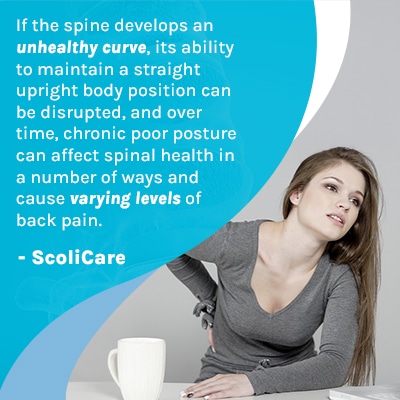
If the spine develops an unhealthy curve, its ability to maintain a straight upright body position can be disrupted, and over time, chronic poor posture can affect spinal health in a number of ways and cause varying levels of back pain (1, 2).
Disrupting the Spine’s Healthy Curves
Proper posture supports proper alignment of the body and spine; it supports healthy curves in the neck, middle/upper back, and the lower back (cervical spine, thoracic spine, and the lumbar spine) (1).
Poor posture can introduce adverse spinal tension that affects the spine’s ability to maintain its strength, balance, and natural curves, but as scoliosis doesn’t just cause the spine to bend unnaturally but also rotate, poor posture alone can’t account for the structural changes that characterize scoliosis (2).
Disc Health
Poor posture can also impact the health of intervertebral discs that sit between adjacent vertebrae by exposing them to uneven pressure, and the health of the spinal discs are key to overall spinal health (3).
The spinal discs combine forces to facilitate flexibility and strength, act as the spine’s shock absorbers, and provide structural support (3).
If a disc is exposed to uneven pressure that, over time, causes it to degenerate and change shape, this can affect the position of vertebrae that attach to the disc in between, causing the spine to shift out of alignment (3).
If left unaddressed, a degenerative disc can become a bulging and/or herniated disc, known to cause pain and mobility challenges (3).
Muscle Strength and Balance
Spinal health also shapes the health of its surrounding muscles, and over time, chronic poor posture can cause weak and/or unbalanced muscles and ligaments.
Weak and unbalanced muscles can also cause back and muscle pain (1).
The core muscles provide the spine with support and stability, so if poor posture has impacted the spine’s surrounding muscle strength and balance, this can further affect spinal health (2).
Unhealthy Movement Patterns
A number of factors shape the way a person moves and posture is an important one (4).
I can tell a lot about the health of a person’s spine by their body position and gait, and there are many factors that shape a person’s gait and mobility: muscle strength and balance, age, skeletal structure, joint health, neurological and psychological factors (2, 4).
A spine that’s straight and aligned is one that can evenly distribute and absorb stress from daily activity, and if the spine and upper body are straight, upright, and balanced, the upper body’s weight is evenly distributed over the pelvis and lower body (2, 4).
A spine that’s not aligned is not balanced, and this lack of balance and stability transfers to the rest of the body and can have a number of effects, including back and muscle pain (1, 2).
If upper body weight isn’t evenly distributed over the lower body, it can cause an uneconomical gait to develop, which can further disrupt posture and spinal biomechanics.
So now that we’ve discussed the connection between spinal health and posture, let’s talk specifically about scoliosis and posture.
Scoliosis and Poor Posture
If scoliosis develops, an unnatural lateral spinal curvature that rotates has developed, and this introduces uneven forces to the spine, its immediate surroundings, and the entire body, and because scoliosis is progressive, its effects are likely to become more overt over time.
While poor posture alone won’t cause scoliosis, scoliosis can cause poor posture, and when it comes to childhood scoliosis, a parent or caregivers’s ability to recognize the early signs of scoliosis can lead to early detection, and while there are never treatment guarantees, early intervention is associated with positive treatment outcomes (5).
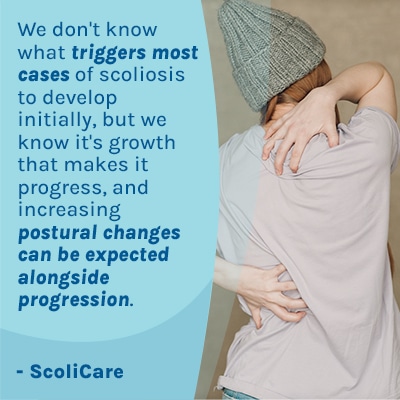
We don’t know what triggers most cases of scoliosis to develop initially, but we know it’s growth that makes it progress, and increasing postural changes can be expected alongside progression.
Postural Changes
While scoliosis affects all ages, it’s most often diagnosed during childhood, and as growth spurts increase the size and rotation of the scoliosis, being proactive with treatment is key, and this is achieved through early detection and intervention (5).
Early detection means diagnosing scoliosis while mild, and this isn’t always easy as the symptoms of mild scoliosis are subtle and can be difficult to recognize, particularly without awareness (5).
In most cases, the earliest telltale signs of scoliosis in children are postural changes, and these are caused by the uneven forces of the unnatural spinal curve disrupting the body’s overall symmetry, and these changes usually start in the shoulders and hips (5, 6).
Uneven shoulders are generally the earliest indicators, and as scoliosis progresses, uneven shoulder blades, the development of a rib cage arch, an uneven waist line, pelvic obliquity, and arm and leg length discrepancies are also common (6).
The more progression occurs, the more overt its effects are likely to be, including disruptions to balance and coordination, but being aware of what to look for can help, particularly when there are risk factors in place.
Addressing Postural Changes Caused By Scoliosis
Diagnosing scoliosis while mild means treatment can be started early when the curve will be smaller, more flexible and responsive to treatment (5).
The more posture is affected and the longer the changes are in place, the more it can disrupt movement, and the more challenging it can be to work towards improving and/or reversing the postural changes.
In most cases of postural deviation, it’s more effective to proactively work towards preventing increasing postural changes than it is to attempt to reverse the asymmetries once established.
Although it’s progressive, scoliosis can be highly treatable, and the best way to restore healthy posture is to proactively treat the scoliosis.
Proactive treatment prioritizes prevention, so if a scoliosis diagnosis is reached, a treatment plan is customized to address the specifics of a patient’s scoliosis and is started as soon as possible.
In addition to increasing postural changes, progression also causes increasing spinal rigidity, and the more rigid a spine becomes, the harder it can be to increase its flexibility and improve its position.
Nonsurgical Scoliosis Treatment Plan
Nonsurgical treatment is proactive, and here at ScoliCare, treatment plans are innovative and integrative: combining the power of scoliosis-specific exercise, chiropractic adjustments, and corrective bracing.
The goal of nonsurgical scoliosis treatment is to restore the spine’s healthy curves and alignment by reducing the size of the unnatural spinal curvature, improving the spine’s surrounding muscle balance and strength, and restoring healthy posture.
ScoliBalance®
Improvements to the spine’s structural position need to be supported, and the ScoliBalance® program combines the best of what chiropractic care and scoliosis-specific exercise has to offer.
ScoliBalance® involves the customization of a scoliosis-specific exercise treatment plan that addresses a patient’s specific type and severity of scoliosis, body type, and posture.
ScoliBalance® uses scoliosis-specific a combination of the scoliosis specific program methods, including Mirror Image® exercises, corrective breathing based on Schroth methods, as well as other methods to teach patients how to position their body and spine for optimal postural awareness and curvature correction (7, 8).
Corrective scoliosis-specific exercises can help correct poor posture, restore the spine’s surrounding muscle balance and strength, reduce curve size, slow/stop progression, and increase spinal flexibility for pain relief (8, 9).
Once patients can confidently perform the exercises without assistance, they can continue them from home and incorporate them into daily activity to further heal and stabilize the spine, and to sustain long-term treatment results.
ScoliBrace®
When corrective bracing is integrated into a patient’s treatment plan, there are fewer limitations to nonsurgical treatment; the ScoliBrace® was designed to work with exercise so complements ScoliBalance® by placing the spine in an overcorrective position and strengthening the neurological connection between the brain and body positioning (8, 9).
As growing spines are more flexible, they can respond well to corrective bracing, which has become a focus of childhood scoliosis treatment.
Conclusion
The importance of optimal posture can’t be overstated; it supports spinal health, muscle balance and strength, and healthy movement patterns.
Developing scoliosis means an abnormal sideways curvature of the spine has developed, and while scoliosis development isn’t caused by poor posture, it can affect spinal health in a number of ways, and poor posture is one of the main effects of scoliosis.
Postural imbalances are the earliest signs of scoliosis in children, and while back and radiating pain is what brings most adults in for assessment and diagnosis, adult scoliosis patients also experience postural changes and a noticeable lean to one side.
Improving a patient’s posture with treatment doesn’t just improve physical health, but also mental health, particularly in adolescent patients who can be self-conscious and want to look and move the same as their peers.
Maintaining proper posture can help preserve spinal health and function, so postural restoration is a focus of nonsurgical scoliosis treatment with potential to restore the spine and body’s balance and stability.
References:
- Du SH, Zhang YH, Yang QH, Wang YC, Fang Y, Wang XQ. Spinal posture assessment and low back pain. EFORT Open Rev. 2023 Sep 1;8(9):708-718. doi: 10.1530/EOR-23-0025. PMID: 37655847; PMCID: PMC10548303
- Abelin-Genevois K. Sagittal balance of the spine. Orthop Traumatol Surg Res. 2021 Feb;107(1S):102769. doi: 10.1016/j.otsr.2020.102769. Epub 2020 Dec 13. PMID: 33321235.
- Waxenbaum JA, Reddy V, Futterman B. Anatomy, Back, Intervertebral Discs. [Updated 2023 Dec 9]. In: StatPearls [Internet]. Treasure Island (FL): StatPearls Publishing; 2025 Jan-. Available from: https://www.ncbi.nlm.nih.gov/books/NBK470583/
- Eun IS, Cho YJ, Goh TS, Jeong JY, Lee JS. Association between gait profile and spinal alignment in patients with adolescent idiopathic scoliosis. J Clin Neurosci. 2024 Dec;130:110915. doi: 10.1016/j.jocn.2024.110915. Epub 2024 Nov 10. PMID: 39522306.
- de Groot C, Heemskerk JL, Willigenburg NW, Altena MC, Kempen DHR. Educating Parents Improves Their Ability to Recognize Adolescent Idiopathic Scoliosis: A Diagnostic Accuracy Study. Children (Basel). 2022 Apr 15;9(4):563. doi: 10.3390/children9040563. PMID: 35455607; PMCID: PMC9025014Cramer H, Mehling WE, Saha FJ, Dobos G, Lauche R.
- Yan B, Lu X, Qiu Q, Nie G, Huang Y. Association Between Incorrect Posture and Adolescent Idiopathic Scoliosis Among Chinese Adolescents: Findings From a Large-Scale Population-Based Study. Front Pediatr. 2020 Sep 15;8:548. doi: 10.3389/fped.2020.00548. PMID: 33042909; PMCID: PMC7522343.
- Postural awareness and its relation to pain: validation of an innovative instrument measuring awareness of body posture in patients with chronic pain. BMC Musculoskelet Disord. 2018 Apr 6;19(1):109. doi: 10.1186/s12891-018-2031-9. PMID: 29625603; PMCID: PMC5889545
- Kim D, Cho M, Park Y, Yang Y. Effect of an exercise program for posture correction on musculoskeletal pain. J Phys Ther Sci. 2015 Jun;27(6):1791-4. doi: 10.1589/jpts.27.1791. Epub 2015 Jun 30. PMID: 26180322; PMCID: PMC4499985
- Marchese R, Du Plessis J, Pooke T, McAviney J. The Improvement of Trunk Muscle Endurance in Adolescents with Idiopathic Scoliosis Treated with ScoliBrace and the ScoliBalance Exercise Approach. J Clin Med. 2024 Jan 23;13(3):653. doi: 10.3390/jcm13030653. PMID: 38337346; PMCID: PMC10856658