
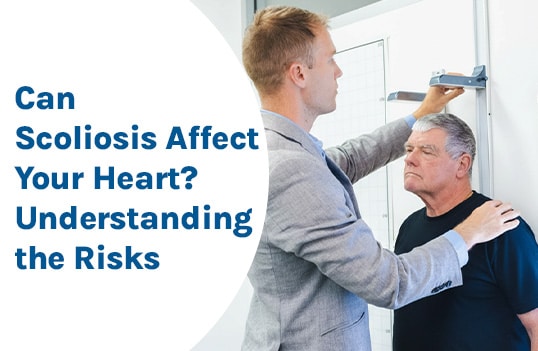
The most common symptoms of scoliosis include asymmetrical posture and back pain. Postural changes are the earliest signs of childhood scoliosis, and it’s most often back and radiating pain that leads to an adult’s diagnosis. Cases most likely to impact cardiac function are severe and/or atypical types of scoliosis.
Scoliosis mainly affects the spine, but it can also affect other parts and areas of the body. While symptoms involving the heart aren’t considered primary scoliosis effects, in cases that are severe and/or atypical, cardiac function can be impacted.
As it’s progressive, the risks of scoliosis increase the longer it’s left untreated.
Cardiac Function
The main role of the heart is to pump blood throughout the body, delivering oxygen and nutrients needed to keep structures and systems functioning optimally and eliminating waste (1).
The circulatory system is a complex network of blood vessels that reach all parts of the body, and the heart is its primary organ (1).
Cardiac function refers to the heart’s ability to fulfill its roles: pumping blood throughout the body, delivering oxygen, nutrients, removing waste (carbon dioxide), and maintaining healthy blood flow and blood pressure (1).
Many recently-diagnosed scoliosis patients want to understand the full potential effects of scoliosis, including whether or not cardiac function can be impacted, so let’s talk generally about scoliosis, and then focus on scoliosis cases that are most likely to affect heart function.
Scoliosis
Scoliosis causes an abnormal curvature of the spine, with rotation, to develop, and the spine’s main roles are structural support for upright posture, protecting the spinal cord, and facilitating movement (2).
In addition, the spine works with the brain to form the body’s central nervous system: a vast communication network that sends and receives input to and from the brain (2).
Scoliosis is progressive, so its nature is to increase in severity over time, and as progression occurs, its effects become more overt and established; progression is triggered by growth spurts so how scoliosis is managed during periods of growth is key (3).
The main symptoms of childhood scoliosis are postural changes like uneven shoulders, uneven shoulder blades, a rib cage arch, and arm- and leg-length discrepancies (4).
The rib cage protects the heart and lungs, and the more the rib cage is affected, the more likely it is that the heart will experience some effects.
It’s important to understand that scoliosis effects can change over time, so it’s optimal to start treatment while scoliosis is still mild: to work towards preventing progression and minimizing its potential effects (3).
When it comes to cardiac abnormalities related to scoliosis, these are most likely in severe and/or atypical cases.
Scoliosis Severity
Scoliosis severity ranges widely, and the main measurement used to classify scoliosis as mild, moderate, or severe is a patient’s Cobb angle (5).
While other factors also determine severity such as angle of rotation and curvature location, the Cobb angle determines the size of the unnatural spinal curve and measures it in degrees (5).
The higher a patient’s Cobb angle, the more unnaturally-tilted the spine’s vertebrae are, and the more the spine’s alignment and balance are disrupted (5).
When scoliosis is mild, its effects can be subtle, which is why most cases of scoliosis are diagnosed while moderate, after progression has increased its symptoms.
As scoliosis also causes the spine to rotate, how much the spine rotates is another key severity factor, along with curvature location.
The three main spinal sections include the cervical spine, thoracic spine, and the lumbar spine, and curves that develop in the spine’s largest section, the thoracic spine, are the most prone to rapid advancement (6).
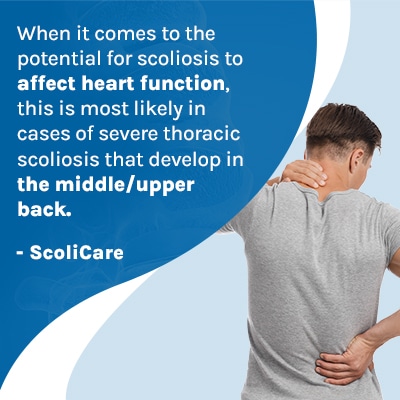
When it comes to the potential for scoliosis to affect heart function, this is most likely in cases of severe thoracic scoliosis that develop in the middle/upper back (7).
Severe Thoracic Scoliosis
Because the rib cage protects the heart, if the rib cage is affected by scoliosis, it can affect the space used by the heart.
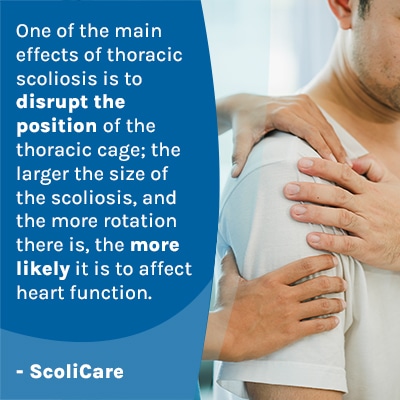
One of the main effects of thoracic scoliosis is to disrupt the position of the thoracic cage, and the larger the size of the scoliosis, and the more rotation there is, the more likely it is to affect heart function (7).
So in severe cases that involve large curves and a lot of rotation, changes to the position of the rib cage can involve the development of a rib cage arch where one side protrudes noticeably more than the other side, and this can compress the heart and lungs (7).
Compression is excessive pressure, and if introduced to the heart, it can disrupt its ability to pump blood efficiently, causing reduced cardiac function and output (7, 8).
A heart that’s not pumping blood efficiently can mean low blood flow throughout the body and increases the risk of heart failure and developing cardiac conditions like mitral valve prolapse (7, 8).
A severely curved spine doesn’t just affect the spine, but also its surroundings, and as a role of the thoracic spine is to anchor the rib cage, changes to its shape can impact important organs within (heart and lungs), but this is most commonly associated with severe cases of thoracic scoliosis (7).
Atypical Scoliosis
 There are also atypical types of scoliosis that tend to be more severe so can also affect the heart, and this includes neuromuscular scoliosis and congenital scoliosis (9, 10).
Most cases of typical scoliosis are idiopathic and involve right-bending curves, but in some atypical forms, severe left-bending curves can develop.
Neuromuscular scoliosis tends to be severe because the scoliosis develops as a secondary complication of a neurological or muscular condition (9).
Because neuromuscular scoliosis cases can be severe, it can compress the chest cavity, reduce blood flow, cause an irregular heartbeat, and if left untreated can lead to serious complications like heart failure or pulmonary hypertension (9).
Congenital scoliosis is another rare type that can involve cardiac issues. Babies are born with congenital scoliosis due to a malformed spine that develops in utero; this can involve vertebrae being misshapen and/or failing to form into distinct bones and instead fusing together (10).
If congenital scoliosis is severe, the spine’s unnatural position can compress the heart, and there is an increased incidence of congenital heart abnormalities such as atrial and ventricular septal defects and mitral valve prolapse in congenital scoliosis patients (10).
It is important to note, however, that related cardiac issues aren’t necessarily caused by the scoliosis, but develop alongside the scoliosis due to developmental issues with the fetus itself(10).
Conclusion
So can scoliosis affect the heart? While scoliosis can affect the heart and cause altered cardiac function, this is most closely associated with severe and/or atypical cases of thoracic scoliosis.
When scoliosis is treated proactively, early medical intervention can minimize the potential effects of scoliosis, including cardiac issues.
There are no treatment guarantees, but there are links between early detection, intervention, and a successful treatment outcome, and because scoliosis is progressive, it can become more severe over time, and if left untreated, complications, such as disruptions to cardiac function, become more likely.
Here at ScoliCare, patients are given a comprehensive initial assessment so treatment plans can be customized accordingly.
Find Your Nearest Clinic
ScoliCare Clinics, affiliates and product providers are in over 200 locations around the world. Find your nearest ScoliCare location here.


References:
- Buckberg GD, Nanda NC, Nguyen C, Kocica MJ. What Is the Heart? Anatomy, Function, Pathophysiology, and Misconceptions. J Cardiovasc Dev Dis. 2018 Jun 4;5(2):33. doi: 10.3390/jcdd5020033. PMID: 29867011; PMCID: PMC6023278
- DeSai C, Reddy V, Agarwal A. Anatomy, Back, Vertebral Column. [Updated 2023 Aug 8]. In: StatPearls [Internet]. Treasure Island (FL): StatPearls Publishing; 2025 Jan-. Available from: https://www.ncbi.nlm.nih.gov/books/NBK525969/
- Negrini S, Donzelli S, Aulisa AG, Czaprowski D, Schreiber S, de Mauroy JC, Diers H, Grivas TB, Knott P, Kotwicki T, Lebel A, Marti C, Maruyama T, O’Brien J, Price N, Parent E, Rigo M, Romano M, Stikeleather L, Wynne J, Zaina F. 2016 SOSORT guidelines: orthopaedic and rehabilitation treatment of idiopathic scoliosis during growth. Scoliosis Spinal Disord. 2018 Jan 10;13:3. doi: 10.1186/s13013-017-0145-8. PMID: 29435499; PMCID: PMC5795289
- Hong KS, Van Minh P, Nguyen HT, Phan MH, Nguyen HN, Pham TP. Re-evaluation of Incorrect Posture as a Diagnostic Criterion for Scoliosis in School Screenings: A Cross-Sectional Study in Vietnam. Cureus. 2025 Mar 31;17(3):e81535. doi: 10.7759/cureus.81535. PMID: 40314041; PMCID: PMC12043434.
- Horng MH, Kuok CP, Fu MJ, Lin CJ, Sun YN. Cobb Angle Measurement of Spine from X-Ray Images Using Convolutional Neural Network. Comput Math Methods Med. 2019 Feb 19;2019:6357171. doi: 10.1155/2019/6357171. PMID: 30996731; PMCID: PMC6399566
- Weinstein SL, Ponseti IV. Curve progression in idiopathic scoliosis. J Bone Joint Surg Am. 1983 Apr;65(4):447-55. PMID: 6833318
- Xiao J, Li T, Wang Y, Zhao Z, Xie J, Zhou J. Effects of severe scoliosis on cardiac structure and function in resting patients: a retrospective study. J Orthop Surg Res. 2025 Jul 19;20(1):681. doi: 10.1186/s13018-025-06113-3. PMID: 40684229; PMCID: PMC12276671.
- Quintero Santofimio V, Clement A, O’Regan DP, Ware JS, McGurk KA. Identification of an increased lifetime risk of major adverse cardiovascular events in UK Biobank participants with scoliosis. Open Heart. 2023 May;10(1):e002224. doi: 10.1136/openhrt-2022-002224. PMID: 37137668; PMCID: PMC10163590
- Allam AM, Schwabe AL. Neuromuscular scoliosis. PM R. 2013 Nov;5(11):957-63. doi: 10.1016/j.pmrj.2013.05.015. PMID: 24247014
- Arlet V, Odent T, Aebi M. Congenital scoliosis. Eur Spine J. 2003 Oct;12(5):456-63. doi: 10.1007/s00586-003-0555-6. Epub 2003 Jun 14. PMID: 14618384; PMCID: PMC3468011
More news
-
 24 March 2026
Scoliosis is progressive, but early detection and proactive care can help prevent complications—untreated scoliosis may worsen and impact health.
-
 8 August 2024
Receiving a scoliosis diagnosis often brings a flood of questions and concerns about the future. How did this happen? What are the scoliosis treatment options? Is scoliosis surgery necessary? Navigating…
-
 17 July 2024
Receiving a scoliosis diagnosis as an adult can be daunting. Many people wonder how it happened, what the future holds, and whether it can be treated. Understanding scoliosis in adults…