
There are a number of conditions that affect the spine by causing an unnatural spinal curve to develop, but scoliosis has a number of unique characteristics. In order to be diagnosed as structural scoliosis, the spine has to bend unnaturally to the side and rotate, making it 3-dimensional. If the spine’s unnatural curve is nonstructural and responds to a change in position, it’s considered a functional scoliosis.
There are key differences between structural vs functional scoliosis. A true scoliosis involves structural abnormalities within the spine: unnaturally tilted vertebrae with a rotational component. Functional scoliosis is caused by external factors such as poor posture, muscular imbalance, or a leg length discrepancy.
When scoliosis is diagnosed, the process involves a comprehensive assessment in a number of areas, from severity to curvature location and type.
What is Structural Scoliosis?
Scoliosis is a condition that affects the spine by causing an unnatural lateral spinal curvature to develop, and in addition to the spine’s unnatural curvature, it also rotates, making scoliosis 3-dimensional.
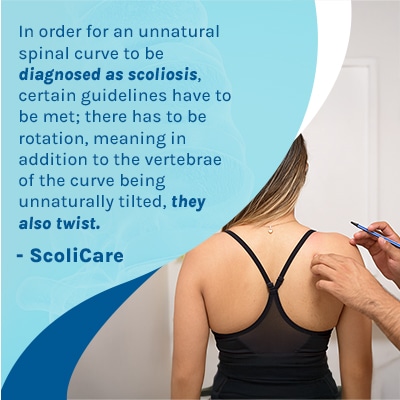 In order for an unnatural spinal curve to be diagnosed as scoliosis, certain guidelines have to be met; there has to be rotation, meaning in addition to the vertebrae of the curve being unnaturally tilted, they also twist (1).
Vertebrae are the bones of the spine, and if they are unnaturally tilted out of alignment with the rest of the spine and rotate, these are structural abnormalities, and this is considered a true structural scoliosis.
With structural scoliosis, no chance in body position or posture will alter the curve.
In addition to the lateral spinal curve, plus rotation, the size of the unnatural spinal curvature has to be a minimum of 10 degrees, and this is determined by a patient’s Cobb angle measurement (1, 2).
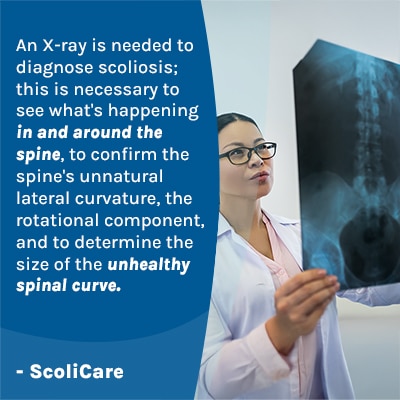
An X-ray is needed to diagnose scoliosis; this is necessary to see what’s happening in and around the spine, to confirm the spine’s unnatural lateral curvature, the rotational component, and to determine the size of the unhealthy spinal curve (1, 2).
Cobb Angle Measurement
Being diagnosed with scoliosis means an unnatural lateral sideways spinal curve with rotation and a Cobb angle of more than 10 degrees with rotation is confirmed (1, 2).
A patient’s Cobb angle measurement is a key piece of information that treatment plans are shaped around; this initial measurement is referred to throughout the course of treatment to gauge responsiveness to treatment and/or growth (2).
Scoliosis severity is determined by the Cobb angle and classifies conditions as mild scoliosis, moderate scoliosis, or severe scoliosis, and the more severe, the more likely continued progression is, the more noticeable its effects are going to be, and the more complex it can be to treat (1, 2).
Different Types of Structural Scoliosis
Most cases of scoliosis are classified as idiopathic scoliosis with no single-known cause, but there is also more than one type (1).
Idiopathic scoliosis is the most common type to affect all ages, but there is also neuromuscular scoliosis caused by the presence of an underlying neuromuscular disease, and degenerative scoliosis affecting older adults and is caused by degenerative instability (1).
While we don’t know what causes idiopathic scoliosis to develop initially, we know scoliosis is progressive, and we know it’s growth that triggers progression, so childhood scoliosis, in particular, needs to be treated proactively (3).
While not all patients with a neuromuscular disease (cerebral palsy and muscular dystrophy) will develop neuromuscular scoliosis, it is a common complication.
Neuromuscular scoliosis is caused by the larger neuromuscular condition disrupting communication between the muscles and nerves that support the spine and healthy posture (1).
In most typical cases of scoliosis, curves will bend to the right, away from the heart, but in some atypical cases, curves can bend towards the heart, and left-bending curves are known as levoscoliosis and indicate an underlying pathology.
Degenerative scoliosis affects older adults experiencing degenerative instability, and this type is almost always progressive and painful because the spine is off-balance, and once the spine shifts out of alignment, its unstable, and the more degenerative changes that occur over time, the more increasingly unstable the spine can become, making fall prevention a focus of degenerative scoliosis treatment (1).
So when it comes to scoliosis, true scoliosis is always structural, but what about an unnatural lateral curve that’s flexible and responds to changes in position?
Functional Scoliosis
Functional scoliosis is considered temporary because it has a temporary cause and is nonstructural.
 Functional scoliosis is caused by an external factor that, once addressed, can restore the spine’s alignment and body posture. However, if the patient is growing fast, there can be some risk of a functional scoliosis turning structural.
Common causes of functional scoliosis include chronic poor posture, muscular imbalance, and/or a leg length discrepancy (4).
Over time, chronic bad posture can affect the muscles and ligaments that support the spine by stretching them and/or exposing them to uneven forces. Constant slouching, looking down at devices, and not being mindful of body position during movement can lead to a lack of spinal support that, over time, can lead to an unnatural temporary spinal curve.
A muscle imbalance can also contribute to the development of functional scoliosis if the spine’s surrounding muscles aren’t supporting the spine evenly from both sides (5).
A leg length discrepancy means the legs are different lengths, and this can be structural or functional; if the legs are uneven, the body can attempt to counteract the asymmetry with the development of an unnatural spinal curve (4).
In most cases of functional scoliosis, if the cause is addressed, the unnatural spinal curve, because it’s nonstructural, can be reduced or corrected (4).
If poor posture is the cause, physical therapy and lifestyle guidance are common treatment options, and if a muscular imbalance is the cause, physical therapy that improves the spine’s surrounding muscles strength and balance can improve the spine’s support and stability (5).
If a leg length discrepancy is the cause, the leg lengths need to be equalized and common treatment includes custom orthotics (4).
As functional scoliosis is caused by an irregularity elsewhere in the body, the cause needs to be determined and addressed to restore symmetry to the spine and body.
Conclusion
A true scoliosis is structural because it involves a number of the spine’s vertebrae becoming unnaturally tilted and rotating, and functional scoliosis is considered a temporary curvature of the spine caused by an external factor.
Most cases of scoliosis have no known cause and are classified as idiopathic, and known causes include neuromuscular diseases and age-related spinal degeneration.
When it comes to treating scoliosis, an integrative approach combining the potential of multiple treatment disciplines has proven results.
Here at ScoliCare, scoliosis treatment plans are customized around key variables such as the type of scoliosis, its severity, angle of trunk rotation, curvature location, and patient age.
Through the power of customized scoliosis-specific exercise rehabilitation programs and corrective bracing, many cases of scoliosis are highly treatable, but it’s important to understand that as a structural condition, the position and health of the spine needs to be improved for long-term treatment results.
References:
- Janicki JA, Alman B. Scoliosis: Review of diagnosis and treatment. Paediatr Child Health. 2007 Nov;12(9):771-6. doi: 10.1093/pch/12.9.771. PMID: 19030463; PMCID: PMC2532872
- Langensiepen S, Semler O, Sobottke R, Fricke O, Franklin J, Schönau E, Eysel P. Measuring procedures to determine the Cobb angle in idiopathic scoliosis: a systematic review. Eur Spine J. 2013 Nov;22(11):2360-71. doi: 10.1007/s00586-013-2693-9. Epub 2013 Feb 27. PMID: 23443679; PMCID: PMC3886494
- Negrini, S., Donzelli, S., Aulisa, A. G., Czaprowski, D., Schreiber, S., de Mauroy, J. C., … & Zaina, F. (2018). 2016 SOSORT guidelines: orthopaedic and rehabilitation treatment of idiopathic scoliosis during growth. Scoliosis and spinal disorders, 13(1), 3
- Raczkowski JW, Daniszewska B, Zolynski K. Functional scoliosis caused by leg length discrepancy. Arch Med Sci. 2010 Jun 30;6(3):393-8. doi: 10.5114/aoms.2010.14262. PMID: 22371777; PMCID: PMC3282518
- Fidler MW, Jowett RL. Muscle imbalance in the aetiology of scoliosis. J Bone Joint Surg Br. 1976 May;58(2):200-1. doi: 10.1302/0301-620X.58B2.932082. PMID: 932082