Scoliosis is progressive, so its nature is to get more severe over time, but in many cases, it’s highly treatable. When it comes to the timing of treatment, early detection and proactive treatment has a number of benefits.
The dangers of leaving scoliosis untreated include progression, increasing effects, and developing potential complications such as breathing problems. In addition, the sooner treatment is started, the more potential there is for a successful nonsurgical treatment outcome.
Before getting to the potential consequences of leaving scoliosis untreated, let’s talk generally about scoliosis.
Understanding Scoliosis
There are a number of spinal conditions that involve the development of unhealthy spinal curves, but scoliosis has some characteristics that set it apart.
Scoliosis doesn’t just cause the spine to bend unnaturally to the side, it also rotates, making scoliosis 3-dimensional.
Scoliosis can also range widely in severity, there are different types, and it affects all ages.
All cases of scoliosis can benefit from proper care; leaving it untreated means it will likely get worse over time, and being proactive means working towards preventing progression.
Scoliosis is Progressive
Scoliosis is progressive, meaning its nature is to get worse over time, and as growth is a main trigger for progression, childhood scoliosis, in particular, can involve rapid progression and can benefit from a proactive treatment plan (1).
Scoliosis severity ranges from mild scoliosis to moderate scoliosis and severe cases, and even cases initially diagnosed as mild can progress to become moderate and/or severe.
In fact, the majority of scoliosis cases are diagnosed as moderate; the signs of mild scoliosis can be subtle and difficult to recognize, and in many cases, it’s not until mild scoliosis becomes moderate that its signs are noticeable enough to lead to an assessment and diagnosis (1).
As scoliosis progresses, the size and rotation of the unnatural spinal curve is increasing, making it more complex to treat, and condition effects become more noticeable.
Scoliosis Effects
In addition to progression making scoliosis more difficult to treat, the symptoms of scoliosis can also increase, becoming more noticeable and disruptive.
As an asymmetrical condition, scoliosis causes postural changes, and in many cases of childhood scoliosis, uneven shoulders and hips are the earliest signs to watch for (2).
Additional postural changes to be aware of can include:
- Uneven shoulder blades
- The head not aligning over the torso
- A tilted eye line
- Development of rib cage arch
- Pelvic obliquity
- Arm- and leg-length discrepancies
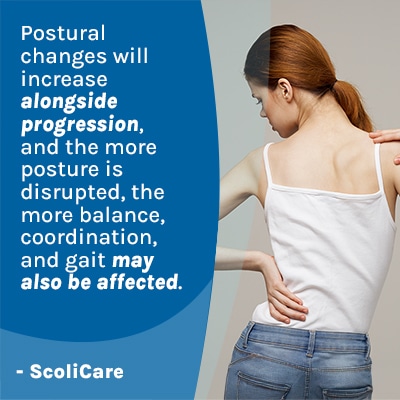
Postural changes will increase alongside progression, and the more posture is disrupted, the more balance, coordination, and gait may also be affected (2, 3).
Muscular imbalance is another common effect of scoliosis as the muscles that surround the spine provide it with crucial balance, support, and stability. A muscular imbalance can cause muscle tension, weakness, and contributes to mobility issues (4).
Scoliosis can also have psychological effects, particularly in children who want to fit in with their peers. They don’t want to look or walk differently, and if activity restrictions are in place, this can further affect the emotional well being of young patients (5).
The more scoliosis progresses, the more noticeable it becomes, the more likely activity restrictions are, and the more likely it is that young patients will face negative self image and body issues (5).
When it comes to scoliosis pain, it’s not considered a common effect in patients who are still growing, and while there are different factors that shape how painful a condition is or isn’t, the stage of skeletal growth is key as a spine that’s no longer growing becomes vulnerable to the compressive force of the scoliosis (6).
Pain is the main symptom of adult scoliosis, so the more scoliosis progresses, the more likely it is to become increasingly painful, and with older adults for whom age-related spinal degeneration is occurring, increasing effects can include degenerative instability and the risk of injury through a fall (7).
Potential Complications
While there are no treatment guarantees, there are a number of benefits to diagnosing and treating scoliosis early, and it’s important to understand that many potential complications may be avoidable with a proactive customized treatment plan (8).
Curve progression makes the spine more rigid and less responsive to treatment, and the longer scoliosis is left untreated, the more likely it is that potential complications will develop.
Because it’s progressive, scoliosis is likely to get worse over time, if left untreated, and the more severe scoliosis becomes, the more out of balance and misaligned the spine is.
Potential complications of severe and untreated scoliosis include breathing problems, cardiovascular issues, nerve damage, and increased pain (1, 8, 9).
Breathing problems aren’t considered a common effect of scoliosis and are more closely associated with thoracic scoliosis, when severe, and/or in atypical cases of scoliosis (9).
The thoracic spine attaches to the rib cage, and the unnatural curve and rotation in the spinal section can pull on one side of the rib cage, causing the development of a rib cage arch, and this can decrease the space used by the lungs to function optimally within (8).
In most cases of scoliosis, curves bend to the right, away from the heart, but in atypical cases, curves can bend to the left, and these cases, in particular, if left untreated, are associated with complications such as cardiovascular issues as the scoliosis can put pressure on the heart (9, 10).
Nerve damage is another rare, but possible complication, and nerves can be difficult to repair, so if nerve compression is left untreated for long periods of time, nerve damage can become a long-term complication.
If the spinal cord is compressed and/or a nerve root is compressed where it exits the spine, nerves can become irritated, inflamed, impinged, and dam
aged. This may lead to the need for surgery in severe cases.
Additional complications include increasing rates of spinal degeneration. A misaligned spine means its vertebrae aren’t stacked on top of one another in a straight and neutral alignment, making the spine off balance and unstable (10).
A misaligned spine can’t function optimally and disrupts its ability to evenly absorb and distribute mechanical stress; this can lead to uneven weight distribution, the development of unhealthy movement patterns, increasing postural changes, disc degeneration, and chronic back pain (10).
Conclusion
Proactive treatment options for scoliosis have the goal of preventing progression, increasing effects, potential complications, and the need for invasive surgical treatment.
Scoliosis screening can lead to early detection, which is why a focus of ScoliCare is Education: we want to bring patients into our clinics sooner so a late diagnosis can be avoided, and we want them to know that the best time to start treatment is while scoliosis is still mild.
As adolescent idiopathic scoliosis is the most common type, children approaching adolescence, with known risk factors such as family history, should be undergoing regular screening.
Many condition effects may be avoidable with a proactive treatment plan that includes a comprehensive initial assessment, a customized treatment plan, and a proactive nonsurgical approach with corrective potential.
While the most common type of scoliosis (idiopathic scoliosis) has no known cause, we know how to treat it effectively, and we know how to respond to a diagnosis with a customized treatment plan.
Conservative scoliosis treatment has the ultimate goal of securing the best possible treatment outcome, and quality of life, for every patient, and when it comes to minimizing the potential effects of scoliosis, the sooner proactive treatment is started, the better.
References:
- Negrini, S., Donzelli, S., Aulisa, A. G., Czaprowski, D., Schreiber, S., de Mauroy, J. C., … & Zaina, F. (2018). 2016 SOSORT guidelines: orthopaedic and rehabilitation treatment of idiopathic scoliosis during growth. Scoliosis and spinal disorders, 13(1), 3
- Hong KS, Van Minh P, Nguyen HT, Phan MH, Nguyen HN, Pham TP. Re-evaluation of Incorrect Posture as a Diagnostic Criterion for Scoliosis in School Screenings: A Cross-Sectional Study in Vietnam. Cureus. 2025 Mar 31;17(3):e81535. doi: 10.7759/cureus.81535. PMID: 40314041; PMCID: PMC12043434
- Xu J, Chen M, Wang X, Luo X. Biomechanical changes in adolescent idiopathic scoliosis during walking: A protocol for systematic review and meta-analysis. Medicine (Baltimore). 2023 Dec 8;102(49):e36528. doi: 10.1097/MD.0000000000036528. PMID: 38065886; PMCID: PMC10713143
- Fidler MW, Jowett RL. Muscle imbalance in the aetiology of scoliosis. J Bone Joint Surg Br. 1976 May;58(2):200-1. doi: 10.1302/0301-620X.58B2.932082. PMID: 932082
- Sanders AE, Andras LM, Iantorno SE, Hamilton A, Choi PD, Skaggs DL. Clinically Significant Psychological and Emotional Distress in 32% of Adolescent Idiopathic Scoliosis Patients. Spine Deform. 2018 Jul-Aug;6(4):435-440. doi: 10.1016/j.jspd.2017.12.014. PMID: 29886916
- Ilharreborde B, Simon AL, Shadi M, Kotwicki T. Is scoliosis a source of pain? J Child Orthop. 2023 Nov 28;17(6):527-534. doi: 10.1177/18632521231215861. PMID: 38050593; PMCID: PMC10693849
- Zaina, F., Marchese, R., Donzelli, S., Cordani, C., Pulici, C., McAviney, J., & Negrini, S. (2023). Current knowledge on the different characteristics of back pain in adults with and without scoliosis: a systematic review. Journal of Clinical Medicine, 12(16), 5182
- Qiabi M, Chagnon K, Beaupré A, Hercun J, Rakovich G. Scoliosis and bronchial obstruction. Can Respir J. 2015 Jul-Aug;22(4):206-8. doi: 10.1155/2015/640573. Epub 2015 Jun 17. PMID: 26083538; PMCID: PMC4530852
- Huh S, Eun LY, Kim NK, Jung JW, Choi JY, Kim HS. Cardiopulmonary function and scoliosis severity in idiopathic scoliosis children. Korean J Pediatr. 2015 Jun;58(6):218-23. doi: 10.3345/kjp.2015.58.6.218. Epub 2015 Jun 22. PMID: 26213550; PMCID: PMC4510355
- Challier V, Nassar JE, Castelain JE, Campana M, Jacquemin C, Ghailane S. Alignment considerations in degenerative spinal conditions: A narrative review. N Am Spine Soc J. 2024 Oct 1;20:100562. doi: 10.1016/j.xnsj.2024.100562. PMID: 39554214; PMCID: PMC11565030