
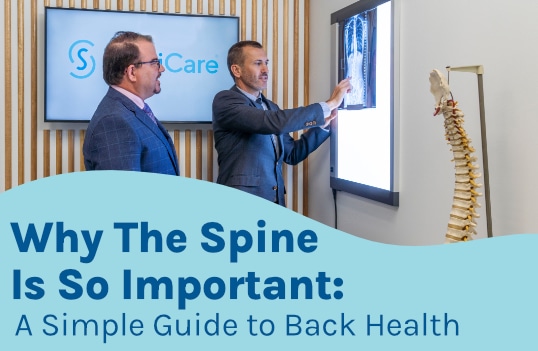
Spinal health can be shaped by a number of lifestyle choices and factors; preserving its health and function involves maintaining a healthy weight, activity level, and strong supportive muscles. A spine-friendly lifestyle can slow age-related degenerative changes in the spine. Maintaining core strength is key.
Spinal health is important for quality of life. A healthy spine is needed for structural support, proper posture, a healthy central nervous system, the maintenance of economical movement patterns, and pain-free activity.
The spine is the body’s main source of structural support.
Structure
The spine stabilizes the body by acting as a flexible central support structure (1).
The spine supports body weight (head, torso, pelvis) and serves as an attachment point for important muscles. and
The spine’s structure also protects important organs inside the thoracic cage; the thoracic spine is the largest section and attaches to the rib cage, protecting the heart, lungs, and a number of digestive organs within (1).
The spine distributes body weight and connects the limbs to the upper body.
Each spinal section has roles to play in spinal biomechanics, and the lumbar spine (lower back) has to support the most weight (spinal sections above and the torso).
A healthy spine is essential for stable body structure.
Brain-Body Communication
A primary function of the spine is connecting the brain to the rest of the body. The spinal cord and brain form the central nervous system, facilitating brain-body communication (2).
A healthy spine can protect the spinal cord’s 31 pairs of spinal nerves that exit the spine and branch off to different areas of the body (2).
The spinal cord sends vital signals and information between the brain and the rest of the body, and clear nerve communication is necessary for strength, sensation, and organ function (2).
If the spinal nerves are exposed to uneven pressure due to an unhealthy spinal curve or loss of space within the spine, they can become irritated, inflamed, and painful.
If nerve damage is left unaddressed, it can become permanent.
Mobility
The spine also facilitates a wide range of movement. Healthy spines are balanced, strong, and flexible. If spinal rigidity is an issue, it can disrupt the spine’s range of motion which transfers to the rest of the body and can disrupt healthy movement patterns (4).
Uneconomical movement patterns can further strain the spine and cause muscle, back, and nerve pain.
A healthy spine facilitates complex movements such as deep bends, lifts, and twists, and the spine’s natural curves help the spine absorb shock evenly.
If a healthy spinal curve is lost, the entire biomechanics and balance of the spine can be disrupted, and disruptions to balance, coordination, and gait are common effects (5).
Posture
Postural health and spinal health are closely linked. The spine’s natural curves balance the head and trunk, align the body from the head to the feet, and allow us to maintain a straight, balanced, and upright posture (6).
Proper posture is necessary for stable, healthy, and pain-free movement.
Healthy posture is facilitated by the body’s balanced alignment, strong and balanced muscle engagement, and shock absorption: factors shaped by spinal health (6).
Supporting Spinal Health
A healthy spine can shape quality of life through movement, posture, nerve health, organ protection, and preventing back and nerve pain.
While some spinal conditions can’t be prevented, there are a number of factors that can preserve spinal health and minimize degenerative changes associated with increasing age.
Supporting spinal health involves cultivating a healthy lifestyle, activity level, nutrition, and mindful movement.
Lifestyle Habits
A person’s lifestyle shapes spinal health over time.
Posture and ergonomics are important for spinal health and function, particularly in the modern world (6).
Back problems have steadily been increasing over the years, due largely to the rise of technology and the amount of time people are spending looking down at screens or sitting in front of a computer (7).
Being mindful of posture during screen time is important. Taking frequent movement breaks for circulation and keeping screens at eye level is beneficial for avoiding the development of what’s known as tech neck (7).
Healthy sleep routines are also important, and being mindful of the best sleep positions for spinal alignment can help; sleeping on the back is the best, followed by side sleeping, and sleeping on the stomach is not recommended for spinal health (8).
Managing stress is also key to overall health and spinal health; too much cortisol (main stress hormone) is associated with muscle weakness, bone loss, weight gain, and high blood pressure (9).
Excessive consumption of alcohol and/or smoking can harm spinal health by causing dehydration, inflammation, and contributing to poor circulation.
Staying Active
Cultivating a healthy activity level is key to spinal health.
The spine’s natural design is movement-based, and engaging in regular low-impact aerobic exercise and stretches promotes healthy blood flow, circulation, flexibility, strength, and provides pain relief (3).
Strengthening exercises that target the abdominal and back muscles increase spinal support and stability; in fact, a focus of nonsurgical treatment for a number of spinal conditions/issues focuses on strengthening the spine’s surrounding muscles for optimal support.
Staying active is also important for spinal-disc health. An intervertebral disc sits between vertebral bodies providing cushioning, flexibility, structural support, and shock absorption (10).
Over time, the discs lose fluid, and too much fluid loss can cause degenerative disc disease (10).
The discs don’t have their own vascular supply so need healthy blood flow to absorb oxygen and nutrients needed for repair (10).
Staying active also helps with weight management; carrying too much weight, particularly around the midsection, means more pressure and strain on the spine and its individual structures.
Best Practices
There is a certain amount of spinal degeneration to be expected with age, but the cumulative effect of lifestyle choices and factors can’t be underestimated.
Being mindful of how the spine and body are positioned during movement and rest is important, and employing the best practices for lifting heavy objects and complex movement is important for preserving spinal health over time (6).
Bending at the knees and hips, rather than the back, for repeated lifting is important, and keeping the load close to the body is also important for drawing on core strength, not straining the spine, and preventing back pain.
Nutrition
Nutrition can benefit spinal health in a number of ways from maintaining a healthy weight to a diet high in calcium and Vitamin D for strong bones (11).
Staying hydrated is also important for disc and muscle health, and a diet rich in anti-inflammatory foods can aid pain relief and healing after injury (11).
A healthy diet helps create an internal environment that’s conducive to healing and recovery.
Conclusion
So why is the spine so important? Spinal health shapes posture, mobility, nerve health, and provides the body’s framework for stability.
Poor spinal health can cause pain, discomfort, poor posture, unhealthy movement patterns, and stress.
If the spine is unhealthy, the effects can be felt during movement and rest, so quality of life can be impacted, along with mental health.
Practicing a spine-friendly lifestyle includes staying active, hydrated, practicing mindful movement, posture, and maintaining a healthy weight and diet.
Find Your Nearest Clinic
ScoliCare Clinics, affiliates and product providers are in over 200 locations around the world. Find your nearest ScoliCare location here.


References:
- DeSai C, Jozsa F, Agarwal A. Neuroanatomy, Spine. 2025 May 4. In: StatPearls [Internet]. Treasure Island (FL): StatPearls Publishing; 2025 Jan–. PMID: 30252389
- Thau L, Reddy V, Singh P. Anatomy, Central Nervous System. [Updated 2022 Oct 10]. In: StatPearls [Internet]. Treasure Island (FL): StatPearls Publishing; 2025 Jan-. Available from: https://www.ncbi.nlm.nih.gov/books/NBK542179
- InformedHealth.org [Internet]. Cologne, Germany: Institute for Quality and Efficiency in Health Care (IQWiG); 2006-. Low back pain: Learn More – Why movement is so important for back pain. [Updated 2025 Dec 16]. Available from: https://www.ncbi.nlm.nih.gov/books/NBK284944/
- Laird RA, Kent P, Keating JL. Modifying patterns of movement in people with low back pain -does it help? A systematic review. BMC Musculoskelet Disord. 2012 Sep 7;13:169. doi: 10.1186/1471-2474-13-169. PMID: 22958597; PMCID: PMC3466154
- Eyvazov K, Samartzis D, Cheung JP. The association of lumbar curve magnitude and spinal range of motion in adolescent idiopathic scoliosis: a cross-sectional study. BMC Musculoskelet Disord. 2017 Jan 31;18(1):51. doi: 10.1186/s12891-017-1423-6. PMID: 28143455; PMCID: PMC5282845
- Du SH, Zhang YH, Yang QH, Wang YC, Fang Y, Wang XQ. Spinal posture assessment and low back pain. EFORT Open Rev. 2023 Sep 1;8(9):708-718. doi: 10.1530/EOR-23-0025. PMID: 37655847; PMCID: PMC10548303
- Tsantili AR, Chrysikos D, Troupis T. Text Neck Syndrome: Disentangling a New Epidemic. Acta Med Acad. 2022 Aug;51(2):123-127. doi: 10.5644/ama2006-124.380. PMID: 36318004; PMCID: PMC9982850
- Cary D, Jacques A, Briffa K. Examining relationships between sleep posture, waking spinal symptoms and quality of sleep: A cross sectional study. PLoS One. 2021 Nov 30;16(11):e0260582. doi: 10.1371/journal.pone.0260582. Erratum in: PLoS One. 2024 Jul 2;19(7):e0306662. doi: 10.1371/journal.pone.0306662. PMID: 34847195; PMCID: PMC8631621
- Abdallah CG, Geha P. Chronic Pain and Chronic Stress: Two Sides of the Same Coin? Chronic Stress (Thousand Oaks). 2017 Feb;1:2470547017704763. doi: 10.1177/2470547017704763. Epub 2017 Jun 8. PMID: 28795169; PMCID: PMC5546756
- Abdallah CG, Geha P. Chronic Pain and Chronic Stress: Two Sides of the Same Coin? Chronic Stress (Thousand Oaks). 2017 Feb;1:2470547017704763. doi: 10.1177/2470547017704763. Epub 2017 Jun 8. PMID: 28795169; PMCID: PMC5546756
- Keeler CE, Oguguo E, Goodwin CR, Goertz C. The Role of Nutrition in Low Back Pain: A Narrative Review and Clinical Implications. Am J Lifestyle Med. 2025 Sep 2:15598276251375398. doi: 10.1177/15598276251375398. Epub ahead of print. PMID: 40908980; PMCID: PMC12405202
More news
-
 6 February 2024
As students head back to school, a trusty backpack becomes an essential companion. However, the convenience of carrying books, laptops, and supplies on your back comes with a responsibility to…
-
 10 August 2026
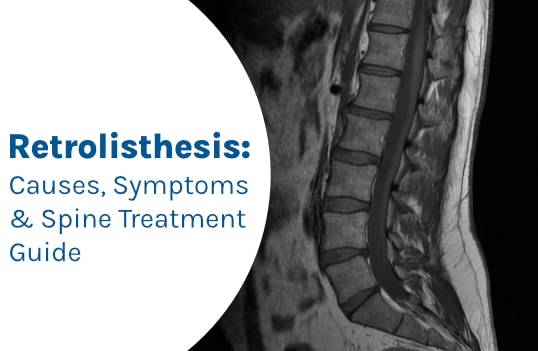
Retrolisthesis is a backward vertebral slip that can affect posture, stability, and nerves. Early diagnosis helps guide effective treatment and symptom relief.
-
 31 January 2022
We Know That There is no one Size Fits all Approach for Treating Scoliosis. We Think Learning Should be the Same. We are excited to launch our online ‘Essentials of…