

Current estimates have close to seven million people living with scoliosis in the United States alone. While there are no treatment guarantees, many cases are highly treatable, and early detection and intervention increases the scope of nonsurgical treatment.
There are a number of conditions that affect the spine, but scoliosis has some interesting characteristics that set it apart. From its prevalence to causation and how it shapes spinal health and function, awareness is important.
Following are 15 facts about scoliosis that parents and patients should know.
1) Scoliosis has been around since ancient times.
Scoliosis was first described by Greek physician Hippocrates (460 – 377 BC), and the name scoliosis comes from the Greek word scolios, meaning bent or crooked (1).
In the ancient world, early treatment options for scoliosis included tying patients to sticks.
2) Scoliosis doesn’t just involve an unnatural spinal curvature.
Scoliosis causes the spine to develop an unnatural lateral curvature, but in addition, the spine also rotates (2).
A rotational component is necessary to be considered a true scoliosis, making it 3-dimensional and setting it apart from a number of other conditions causing a loss of healthy spinal curves (2).
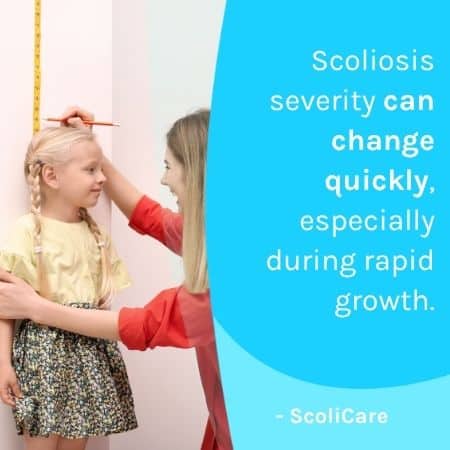
3)Scoliosis is progressive.
The nature of scoliosis is to increase in severity over time, necessitating a proactive treatment approach.
Growth is the main trigger for progression so children having growth spurts are the most at risk for rapid advancement (3).
4) Scoliosis ranges widely in severity.
Scoliosis can be mild, moderate, severe, or very severe, and because it’s progressive, a patient’s severity level at the time of diagnosis can change quickly, particularly during periods of rapid growth (3).
Proactive treatment is needed to prevent progression and scoliosis severity increasing over time (3).
5) Early detection is crucial.
There are no treatment guarantees, but early diagnosis and intervention are directly linked with successful nonsurgical treatment outcomes (4).
Mild curves are smaller and simpler to treat. Progression causes the spine to become more rigid, making it less responsive to treatment. A diagnosis of mild doesn’t mean treatment is less urgent; in fact, the best time to start treatment is while scoliosis is mild, curves are small, and the spine is flexible and responsive (4).
Early diagnosis is only beneficial if coupled with early intervention.
6) Most types of scoliosis don’t have a known cause.
There are different types of scoliosis, and the most common type overall is idiopathic scoliosis: no single-known cause (5).
Approximately 80 percent of diagnosed scoliosis cases are classified as idiopathic scoliosis, and the remaining types include neuromuscular scoliosis, degenerative scoliosis, and congenital scoliosis with known causes.
Although the cause of idiopathic scoliosis isn’t fully understood, what’s more important is how idiopathic scoliosis is addressed with treatment.
How a diagnosis is responded to can shape the spine’s long-term health.
7) Scoliosis is most often diagnosed during adolescence.
The most common type of scoliosis overall is adolescent idiopathic scoliosis, commonly diagnosed at the onset of puberty and into young adulthood (6).
Adolescents are the most at risk for rapid advancement because of the unpredictable growth spurts of puberty (6).
It’s estimated that between 2 and 4 percent of adolescents are affected by scoliosis (6).
8) Female adolescents are more likely to progress.
Female adolescents are typically diagnosed around the age of 10 or 11, and males are diagnosed a little later (7); this could be due to the earlier onset of puberty in females.
Female adolescents are also significantly more likely to progress and require treatment than males of the same age (7).
9) Scoliosis affects all ages.
While scoliosis is more often diagnosed during childhood, adults are also affected.
The most common type to affect adults is adolescent scoliosis in adults (ASA); these cases are pre-existing from adolescence, but adults can also develop scoliosis later in life with no prior history as degenerative de-novo scoliosis (8).
Babies can also be born with congenital scoliosis.
10) Scoliosis is highly prevalent.
It’s estimated that approximately 2 – 3 percent of the population has scoliosis in the United States.
Scoliosis is one of the leading spinal conditions to affect school-aged children.
11) Scoliosis screening used to be offered in schools across the United States.
Because of the potential benefits of early detection and the prevalence of scoliosis in school-aged children, mandatory school screenings used to be performed by school nurses, but that has since changed, making it more important for parents to be aware of the early signs of scoliosis in children (9, 6).
12) Scoliosis screening is recommended when there is a family history.
Awareness of scoliosis risk factors is important; when risk factors are in place, early screening to facilitate early intervention is highly recommended (9).
While scoliosis screening should be part of all children’s periodic check ups, when there is a family history and/or additional risk factors in place, early scoliosis screening is crucial and should be started prior to the onset of puberty (9).
13) Postural changes are the earliest indicators of scoliosis in children.
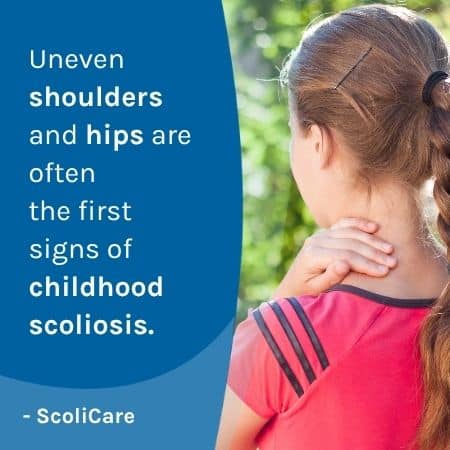
In most cases of childhood scoliosis, the development of asymmetrical posture is the first sign of scoliosis: uneven shoulders and hips (10).
Additional postural changes to watch for include an arch in the rib cage, pelvic obliquity, arm- and leg-length discrepancies, and related changes to balance, coordination, and gait (10).
14) Scoliosis isn’t always painful.
Although scoliosis causes the spine to curve and twist unnaturally, not all patients experience severe pain.
Scoliosis pain can involve the back, muscle pain, and/or nerve pain, but mild cases can have subtle effects, and because scoliosis doesn’t become compressive until skeletal maturity is reached, severe pain is more closely associated with adult scoliosis (11).
While compression is a primary cause of scoliosis pain, curvature pattern and location is also important; thoracic curves, for example, are the most prone to progression.
15) Modern nonsurgical scoliosis treatment options are customized and evidence-based
While traditional scoliosis treatment can involve a spinal fusion surgical recommendation, innovation and integration have supported the development of nonsurgical treatment options.
Customizing treatment plans with a combination of scoliosis-specific rehabilitative exercise and corrective bracing is a patient-centered approach with proven results (12).
Conclusion
Most people have heard of scoliosis and know it largely affects the back, but there is a lot more to know about scoliosis, and awareness can lead to early detection and intervention.
The most important scoliosis fact to understand is the importance of diagnosing scoliosis in its early stages. The goal of a proactive treatment approach is diagnosing scoliosis while mild so treatment plans can be started before significant progression has occurred.
There are no treatment guarantees, but there are a number of proven benefits to diagnosing and starting treatment early; as progression increases spinal rigidity, starting treatment early means while the spine is still flexible, so there is more potential for correction.
References:
- Vasiliadis ES, Grivas TB, Kaspiris A. Historical overview of spinal deformities in ancient Greece. Scoliosis. 2009 Feb 25;4:6. doi: 10.1186/1748-7161-4-6. PMID: 19243609; PMCID: PMC2654856
- Lam GC, Hill DL, Le LH, Raso JV, Lou EH. Vertebral rotation measurement: a summary and comparison of common radiographic and CT methods. Scoliosis. 2008 Nov 2;3:16. doi: 10.1186/1748-7161-3-16. PMID: 18976498; PMCID: PMC2587463
- Negrini, S., Donzelli, S., Aulisa, A. G., Czaprowski, D., Schreiber, S., de Mauroy, J. C., … & Zaina, F. (2018). 2016 SOSORT guidelines: orthopaedic and rehabilitation treatment of idiopathic scoliosis during growth. Scoliosis and spinal disorders, 13(1), 3
- Cuschieri S, Grech S. Public Health Awareness & Early Detection of Adolescent Idiopathic Scoliosis in Med Students. Eur J Public Health. 2025 Oct 27;35(Suppl 4):ckaf161.1172. doi: 10.1093/eurpub/ckaf161.1172. PMCID: PMC12555581.
- Trobisch P, Suess O, Schwab F. Idiopathic scoliosis. Dtsch Arztebl Int. 2010 Dec;107(49):875-83; quiz 884. doi: 10.3238/arztebl.2010.0875. Epub 2010 Dec 10. PMID: 21191550; PMCID: PMC3011182
- Weinstein SL. The Natural History of Adolescent Idiopathic Scoliosis. J Pediatr Orthop. 2019 Jul;39(Issue 6, Supplement 1 Suppl 1):S44-S46. doi: 10.1097/BPO.0000000000001350. PMID: 31169647
- Konieczny MR, Senyurt H, Krauspe R. Epidemiology of adolescent idiopathic scoliosis. J Child Orthop. 2013 Feb;7(1):3-9. doi: 10.1007/s11832-012-0457-4. Epub 2012 Dec 11. PMID: 24432052; PMCID: PMC3566258
- Aebi M. The adult scoliosis. Eur Spine J. 2005 Dec;14(10):925-48. doi: 10.1007/s00586-005-1053-9. Epub 2005 Nov 18. PMID: 16328223
- Grauers A, Danielsson A, Karlsson M, Ohlin A, Gerdhem P. Family history and its association to curve size and treatment in 1,463 patients with idiopathic scoliosis. Eur Spine J. 2013 Nov;22(11):2421-6. doi: 10.1007/s00586-013-2860-z. Epub 2013 Jun 26. PMID: 23801015; PMCID: PMC3886503
- Yan B, Lu X, Qiu Q, Nie G, Huang Y. Association Between Incorrect Posture and Adolescent Idiopathic Scoliosis Among Chinese Adolescents: Findings From a Large-Scale Population-Based Study. Front Pediatr. 2020 Sep 15;8:548. doi: 10.3389/fped.2020.00548. PMID: 33042909; PMCID: PMC7522343
- Zaina, F., Marchese, R., Donzelli, S., Cordani, C., Pulici, C., McAviney, J., & Negrini, S. (2023). Current knowledge on the different characteristics of back pain in adults with and without scoliosis: a systematic review. Journal of Clinical Medicine, 12(16), 5182
- Marchese R, Du Plessis J, Pooke T, McAviney J. The Improvement of Trunk Muscle Endurance in Adolescents with Idiopathic Scoliosis Treated with ScoliBrace® and the ScoliBalance® Exercise Approach. J Clin Med. 2024 Jan 23;13(3):653. doi: 10.3390/jcm13030653. PMID: 38337346; PMCID: PMC10856658
More news
-
 14 March 2021
Kurt Cobain and his Scoliosis Part of our series of famous people who have/had a Scoliosis. Next up is Kurt Cobain! Kurt Cobain is best known as the lead…
-
 15 July 2024
In recent years, patient-centred care has revolutionised the approach to scoliosis treatment by focusing on the unique needs, preferences and values of each patient. This approach places patients at the…
-
 1 November 2022
It is hard to believe that the fastest man on earth has scoliosis! Olympian Usain Bolt was born with scoliosis. His right leg is half an inch shorter than his…