
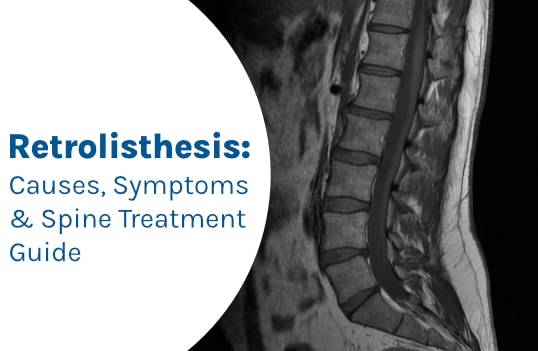
Retrolisthesis causes a vertebra to slip backwards onto the vertebral body below. Vertebrae that aren’t stacked on top of one another as they were designed interferes with neutral alignment, which disrupts the spine’s balance and stability. This can further disrupt healthy posture and movement patterns.
Retrolisthesis affects the spine by causing a vertebral body to slip backwards onto the vertebra below; this is most common in the cervical and lumbar spinal sections and exposes the disc, vertebral body, and nearby nerves to uneven pressure.
Retrolisthesis is classified as a partial retrolisthesis, a complete retrolisthesis, or a stair-stepped retrolisthesis, and common causes include degenerative disc disease, injury, and weak core muscles.
What is Retrolisthesis?
The spine consists of vertebrae (bones) that are stacked on top of one another and separated by an intervertebral disc, and in order for the spine to function optimally, its natural curves and alignment need to be in place (1).
The spinal column protects the spinal cord containing 31 pairs of spinal nerves (1).
The spine is divided into three main sections, each with its own unique characteristics and roles: cervical spine (neck), thoracic spine (middle/upper back), and the lumbar spine (lower back).
All spinal sections protect the spinal cord, and additional key roles of the cervical spine include supporting the weight of the head and acting as the bridge between the brain, the spine, and the rest of the body (2).
The thoracic spine is the largest spinal section and as the only section attached to the rib cage, it provides structural support for the torso and protects important organs inside the thoracic cage (1).
The lumbar spine has to support the weight of the spinal sections above, the torso, and its vertebrae feels the effects of strenuous movement (lifts, bends, and twists) (3).
The ability of each spinal section to perform optimally is shaped by the alignment of its vertebral bodies.
If a vertebra experiences backward slippage, this is retrolisthesis, and while its direct effects will mainly be felt in its immediate surroundings, it can also disrupt the alignment and biomechanics of the entire spine (4).
When a retrolisthesis is diagnosed, it’s further specified as a partial retrolisthesis or a complete retrolisthesis.
A partial retrolisthesis occurs when a vertebra slips backward in relation to the vertebra above or below it, and a complete retrolisthesis involves a vertebral body slipping between the vertebra above and below.
A less-common third type is known as a stair-stepped retrolisthesis which occurs when a vertebra slips backward in relation to the spinal segment above and ahead of the one below.
Retrolisthesis Causes
There are a number of factors that can contribute to retrolisthesis; the most common include spinal degeneration, trauma, and weak core muscles (5, 6).
Most spinal degeneration starts with the spine’s intervertebral discs (5).
Intervertebral disc degeneration (degenerative disc disease) is a common contributor to a number of spinal conditions, retrolisthesis included (5).
Degenerative Changes
Adjacent vertebral bodies are separated by an intervertebral disc, and the discs provide structural support, cushioning between vertebrae to prevent friction during movement, flexibility, and act as the spine’s shock absorbers.
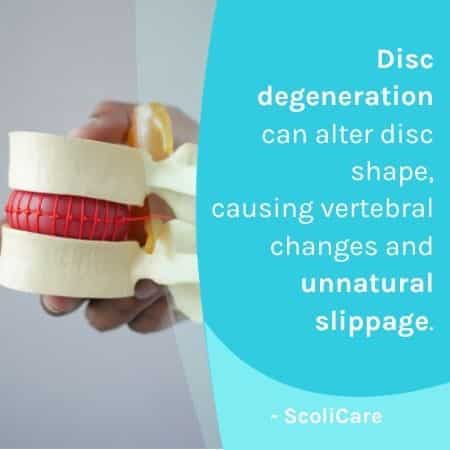
When disc degeneration is occurring, it often involves disc desiccation and changes to the disc’s shape as a result; as adjacent vertebrae attach to the disc in between, changes to disc shape and position can also affect the position of vertebral bodies attached and be the cause of unnatural slippage (5).
Trauma/Injury
Spinal degeneration is also caused by conditions such as osteoporosis: a bone disease that weakens bones, making them vulnerable to injury (6).
If vertebrae in the spine have become weak, thin, and brittle, their ability to remain aligned with the rest of the spine can be disrupted, causing them to slip into an unnatural position and cause further uneven wear and tear in the area (6).
When more bone loss is occurring than bone regeneration, low bone density can cause a number of spinal issues, making it vulnerable to fractures (6).
A vertebral fracture occurs when there is a break in the bone and can range from mild to severe; vertebral fractures can be stable, unstable, and occur anywhere in the spine.
A spinal fracture can cause retrolisthesis by making the spine unstable, damaging supportive ligaments, and disrupting its alignment (6).
Weak Core Muscles
It’s not just the spine that maintains its healthy alignment, but also the spine’s surrounding muscles that support and stabilize it (7).
The spine’s design is movement-based, but if there is too much movement within the spine, this can be problematic.
If the muscles that surround the spine are weak and/or unbalanced, they can contribute to spinal instability and the lack of support can cause too much movement between the spine’s vertebrae (7, 8).
When the core muscles are weak, it disrupts the spine’s stability and can cause an unnatural vertebral shift to occur (7, 8).
Retrolisthesis Symptoms
Symptoms of retrolisthesis can vary widely based on a number of factors including cause, severity, and location of the slippage.
Retrolisthesis is associated with localized back pain, spinal rigidity, reduced range of motion, and neurological symptoms including tingling, numbness, and weakness in the extremities (4, 6, 7, 8).
Cervical retrolisthesis in particular is associated with headaches, neck pain, and disruptions to balance.
Retrolisthesis in the thoracic spine can cause middle/upper back pain, postural disruption, nerve compression, and loss of spinal flexibility.
Lumbar retrolisthesis commonly causes lower back pain, sciatic nerve pain, and changes to gait.
Retrolisthesis Treatment Options
The first line of retrolisthesis treatment is nonsurgical and focuses on the potential of customized physical therapy to increase core strength and specialized chiropractic treatment to improve the spine’s structural alignment (9, 10).
Physical therapy targets weak core and back muscles with strengthening exercise and stretches to improve spinal flexibility. Corrective exercises not only strengthen the back and core muscles and improve spinal flexibility, they can also improve posture; posture and spinal health are closely linked (9, 10).
A brace can also be recommended to improve spinal stability and reduce the amount of movement occurring within the spine (9, 10).
Condition-specific chiropractic care can include a variety of techniques: precise and gentle manual adjustments, flexion-distraction, decompression therapy, and Chiropractic BioPhysics® (CBP) that combines the corrective potential of specific rehabilitative exercises with specialized chiropractic care (9, 10).
CBP works towards improving the spine’s alignment, balance, and stability through adjustments and the use of Mirror Image® exercise for postural awareness and restoration (9, 10).
Improving the spine’s alignment means improving its balance, stability, strength, and reducing pressure on compressed nerves.
Lifestyle guidance is also important when excess weight and/or low activity levels are contributing factors.
When less-invasive conservative treatment is unsuccessful, and in cases of severe spinal instability, surgical intervention may be recommended to realign the spine.
Conclusion
The design of the spine is based on movement, but if the spine shifts out of alignment, it can become unstable and experience too much movement between the bones of the spine.
If a vertebra slips backward onto the vertebral body below, this is known as retrolisthesis and can develop in any spinal section.
A partial retrolisthesis means a vertebra has slipped backward in relation to the vertebral bodies above and below, and a complete retrolisthesis occurs when a vertebral body slips between the vertebral bodies above and below.
Common causes of retrolisthesis include degenerative disc disease, osteoporosis, fractures, and lack of spinal support/stability due to weak core muscles.
Symptoms are shaped by a number of factors including location within the spine. Retrolisthesis that occurs in the cervical spine will cause symptoms largely felt in the neck and upper back/shoulder area including neck pain and headaches.
Thoracic retrolisthesis is associated with middle/upper back pain and increasing spinal rigidity, and retrolisthesis in the lumbar spine will largely affect the lower back and body through back pain, sciatic nerve pain, and disruptions to gait and balance.
Treatment plans need to be customized around important factors such as severity and location, but are centered around muscle strengthening exercises tailored to the specific area affected to increase the spine’s support and stability.
Chiropractic BioPhysics® also works towards improving the spine’s alignment, balance, and body posture.
Bracing can also be recommended to relieve pain, improve the spine’s stability, and prevent too much movement within the spine.
Find Your Nearest Clinic
ScoliCare Clinics, affiliates and product providers are in over 200 locations around the world. Find your nearest ScoliCare location here.


References:
- DeSai C, Reddy V, Agarwal A. Anatomy, Back, Vertebral Column. [Updated 2023 Aug 8]. In: StatPearls [Internet]. Treasure Island (FL): StatPearls Publishing; 2025 Jan-. Available from: https://www.ncbi.nlm.nih.gov/books/NBK525969/
- Rahman S, Das JM. Anatomy, Head and Neck: Cervical Spine. [Updated 2023 Aug 28]. In: StatPearls [Internet]. Treasure Island (FL): StatPearls Publishing; 2025 Jan-. Available from: https://www.ncbi.nlm.nih.gov/books/NBK557516/
- Sassack B, Carrier JD. Anatomy, Back, Lumbar Spine. [Updated 2023 Aug 14]. In: StatPearls [Internet]. Treasure Island (FL): StatPearls Publishing; 2025 Jan-. Available from: https://www.ncbi.nlm.nih.gov/books/NBK557616/
- Margetis K, Gillis CC. Spondylolisthesis. 2025 Mar 28. In: StatPearls [Internet]. Treasure Island (FL): StatPearls Publishing; 2025 Jan–. PMID: 28613518.
- Jeon I, Kim SW. Retrolisthesis as a compensatory mechanism in degenerative lumbar spine. J Korean Neurosurg Soc. 2015 Mar;57(3):178-84. doi: 10.3340/jkns.2015.57.3.178. Epub 2015 Mar 20. PMID: 25810857; PMCID: PMC4373046.
- Andersen T, Christensen FB, Langdahl BL, Ernst C, Fruensgaard S, Østergaard J, Andersen JL, Rasmussen S, Niedermann B, Høy K, Helmig P, Holm R, Egund N, Bünger C. Degenerative spondylolisthesis is associated with low spinal bone density: a comparative study between spinal stenosis and degenerative spondylolisthesis. Biomed Res Int. 2013;2013:123847. doi: 10.1155/2013/123847. Epub 2013 Aug 19. PMID: 24024179; PMCID: PMC3760191
- Rui Zhu a b, Wen-xin Niu a, Zhi-li Zeng a, Jian-hua Tong c, Zhi-wei Zhen b, Shuang Zhou b, Yan Yu a, Li-ming Cheng ScienceDirect Clinical Biomechanics, Volume 41, January 2017, Pages 34-38. The Effects of Muscle Weakness on Degenerative Spondylolisthesis: A Finite Element Study
- Izzo R, Guarnieri G, Guglielmi G, Muto M. Biomechanics of the spine. Part I: spinal stability. Eur J Radiol. 2013 Jan;82(1):118-26. doi: 10.1016/j.ejrad.2012.07.024. Epub 2012 Oct 22. PMID: 23088879
- Fedorchuk CA, Lightstone DF, Oakley PA, Harrison DE. Correction of a double spondylolisthesis of the lumbar spine utilizing Chiropractic BioPhysics®® technique: a case report with 1 year follow-up. J Phys Ther Sci. 2021 Jan;33(1):89-93. doi: 10.1589/jpts.33.89. Epub 2021 Jan 5. PMID: 33519081; PMCID: PMC7829569.
- Chu EC. Reducing Cervical Retrolisthesis With Long-Term Monthly Chiropractic Maintenance Care: A Case Report. J Med Cases. 2022 Jul;13(7):359-364. doi: 10.14740/jmc3960. Epub 2022 Jul 20. PMID: 35949943; PMCID: PMC9332823
More news
-
 12 September 2025
The spine’s natural curves enhance strength and flexibility—but when curves become excessive, like in hyperkyphosis, problems can arise. Early detection is key.
-
 3 July 2026
Healthy lordosis and kyphosis keep the spine strong and balanced. Too much or too little of either curve can affect posture, movement, and function.
-
 17 February 2026
The thoracic spine's natural kyphosis supports posture and function—but when excessive, it leads to hyperkyphosis, causing rounded shoulders and imbalance.