
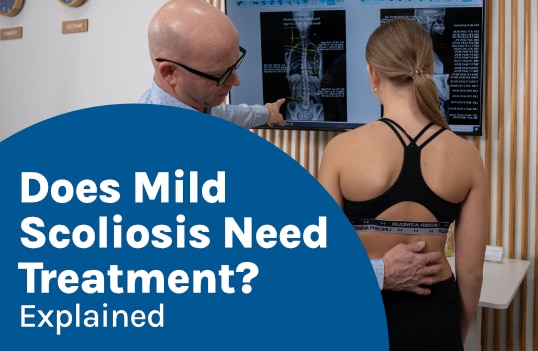
Mild scoliosis does not always need the same level of treatment, but it should be assessed and monitored carefully. For children and teens who are still growing, early treatment may help reduce the risk of the curve getting worse. At the mild level, scoliosis can be highly treatable.
Scoliosis curves can range in size from mild to severe, but all cases of scoliosis benefit from an individualized plan, which may include monitoring, scoliosis-specific exercises, bracing, or other care depending on the patient’s age, curve size, and risk of progression. A proactive, individualized plan can help families understand the level of risk and decide on the best next step.
Because scoliosis can progress during growth, observation alone may not be enough for some children. A scoliosis-specific assessment can help determine whether monitoring, exercises, or bracing is appropriate.
Understanding Mild Scoliosis
Scoliosis means the spine has developed a sideways curve with rotation, or twisting. The size of the curve helps clinicians understand how mild or severe it is. When it comes to treatment, curve size is an important factor, but it’s not the only important factor.
Some cases of mild scoliosis require monitoring, while others require treatment. In addition to curve size, where a patient is in terms of growth and risk of curve progression are also important (1, 2).
A diagnosis of mild scoliosis means the curve is small and flexible, but because scoliosis is progressive, mild curves can become severe curves if left untreated (1).
Because the effects of mild scoliosis can be subtle and difficult to notice, it’s important for parents to be aware of the early changes to watch for in a child’s body (1).
The spine allows us to stand straight and upright, so if it’s not straight and aligned, it can impact the body’s overall symmetry, and uneven shoulders, hips, and an arch in the rib cage are early signs of scoliosis (1).
Mild scoliosis involves smaller flexible curves, and a patient’s Cobb angle measurement is taken during X-ray to determine if a curve is mild, moderate, or severe (1). Treatment planning is shaped around details like patient age, curve size, flexibility, remaining growth and risk of curve progression (1, 2).
Growth and Progression
For parents, it’s important to understand the progressive nature of scoliosis, the early signs of scoliosis, how a child’s age can shape how fast the scoliosis changes, and what the best treatment options are (1, 2).
In children, it’s growth that causes the scoliosis to increase, so when children are growing quickly, mild scoliosis can advance rapidly, and how scoliosis is managed during these stages is crucial (2).
Adolescent idiopathic scoliosis is the most common type of scoliosis and is most often diagnosed at the beginning of puberty in females and a little later in males, so parents of children approaching adolescence should know what to look for, particularly if there is a family history of scoliosis (3).
If another member of the family has already been diagnosed with scoliosis, this increases the likelihood of another family member being diagnosed, so if one child has scoliosis, all siblings should be undergoing regular and early scoliosis screening so scoliosis can be diagnosed and addressed while mild (1).
Scoliosis in females is also more likely to progress, so a mild curve in an adolescent female is more likely to increase in size than a mild curve in a male of the same age. An adolescent female can experience a mild curve quickly becoming a larger curve (3).
Because adolescents are growing so rapidly, scoliosis can change quickly, increasing in severity, but what happens when growth stops?
Can Mild Scoliosis Progress in Adults?
In adults, even though growth has stopped, mild scoliosis can advance because of changes to the spine’s overall health. The changes can be lifestyle-related, age-related, or a combination.
Older adults with degenerative scoliosis can go from small flexible curves to rigid larger curves quickly because the uneven forces of scoliosis can cause parts of the spine to wear unevenly. The discs that sit between vertebrae (bones of the spine) can dry out, change shape, and make the spine unstable, and joints connecting the vertebrae can lose cartilage and wear out due to the bones rubbing together during movement (4).
Adults should watch for changes in posture such as leaning too far forward or too far to the side, but lower back pain is usually the most noticeable symptom of adult scoliosis (4).
When degenerative scoliosis is diagnosed in the early stages, it’s easier to interrupt the cycle of poor posture, uneven wear, and degeneration, and this is important because once the cycle is in place, it can be difficult to stop (4).
Diagnosing scoliosis early can ease a child or adult’s journey by allowing more time to process the news, learn what to expect from daily life, monitor for changes, and start planning treatment.
Early Detection and Intervention
Early detection is a focus of scoliosis education and treatment for good reason. Diagnosing scoliosis early means that treatment can be started while scoliosis is still mild (2).
Mild curves are more flexible and responsive to treatment than moderate and severe curves, and while some may hear mild and think it means that treatment isn’t necessary, professional guidance is needed to determine what the next step should be, and the goal is always preventing the scoliosis from increasing (1).
Because scoliosis can progress during growth, observation alone may not be enough for some children. A scoliosis-specific assessment can help determine whether monitoring, exercises, or bracing is appropriate (2).
In children who are growing quickly, there is also potential for the curve to increase rapidly, and the more a curve advances, the more noticeable its effects, and the more likely more progression is, so being proactive can help manage scoliosis during growth (2).
If a patient’s scoliosis is diagnosed while mild, responding with a proactive treatment plan is the best way to benefit from the early diagnosis.
Mild Scoliosis Treatment Options
The potential benefits of early detection depend on the type of treatment chosen, and when personalized around important factors such as patient age, amount of growth remaining, and curve size, small curves may stay small and patients won’t have to experience symptoms becoming more noticeable (1, 2).
Not treating a small curve can lead to a larger curve developing, and because the spine gets more rigid with progression, its position can get harder to improve.
Symptoms of mild scoliosis can be subtle and difficult to notice, but with awareness, parents and caregivers can learn what to look for and are more likely to recognize the signs of mild scoliosis. Uneven shoulder height and uneven hips are often the earliest signs, along with uneven shoulder blades and the development of an arch in the rib cage (1, 3).
Treating mild scoliosis in children with small curves can include a scoliosis-specific rehabilitative exercise plan or part-time scoliosis bracing (5).
A child’s spine is always growing, and this makes it more flexible and responsive to bracing as early intervention; it’s easier to improve the spine’s position when the correction doesn’t need to be as large and the curve is more flexible (5).
For larger or higher-risk curves, more structured bracing may be recommended, depending on growth, curve size, and clinical assessment (5).
With severe curves, surgical treatment may be recommended, but this isn’t always the best for long-term spinal health (6), and in cases that are diagnosed and treated early, progression from mild to severe may be preventable (2).
Conclusion
There are a lot of factors that shape how a patient’s scoliosis responds to treatment, and while all levels of scoliosis can benefit from treatment, when it comes to childhood scoliosis, the timing of treatment is crucial.
Mild scoliosis can change quickly if growth spurts are occurring, so parents need to understand the value of diagnosing and treating scoliosis early, and this can’t happen without awareness.
While mild scoliosis can cause subtle effects that aren’t easy to notice, knowing what to look for can help parents and caregivers recognize the early postural changes scoliosis causes, and the need for assessment.
For patients recently diagnosed with mild scoliosis, the next step is deciding how to respond with treatment, and an experienced scoliosis clinician can provide guidance so patients are confident and informed in their treatment choices.
References:
- Janicki JA, Alman B. Scoliosis: Review of diagnosis and treatment. Paediatr Child Health. 2007 Nov;12(9):771-6. doi: 10.1093/pch/12.9.771. PMID: 19030463; PMCID: PMC2532872
- Negrini, S., Donzelli, S., Aulisa, A. G., Czaprowski, D., Schreiber, S., de Mauroy, J. C., … & Zaina, F. (2018). 2016 SOSORT guidelines: orthopaedic and rehabilitation treatment of idiopathic scoliosis during growth. Scoliosis and spinal disorders, 13(1), 3
- Weinstein SL. The Natural History of Adolescent Idiopathic Scoliosis. J Pediatr Orthop. 2019 Jul;39(Issue 6, Supplement 1 Suppl 1):S44-S46. doi: 10.1097/BPO.0000000000001350. PMID: 31169647
- Kotwal S, Pumberger M, Hughes A, Girardi F. Degenerative scoliosis: a review. HSS J. 2011 Oct;7(3):257-64. doi: 10.1007/s11420-011-9204-5. Epub 2011 Jun 11. PMID: 23024623; PMCID: PMC3192887
- Marchese R, Du Plessis J, Pooke T, McAviney J. The Improvement of Trunk Muscle Endurance in Adolescents with Idiopathic Scoliosis Treated with ScoliBrace® and the ScoliBalance® Exercise Approach. J Clin Med. 2024 Jan 23;13(3):653. doi: 10.3390/jcm13030653. PMID: 38337346; PMCID: PMC10856658
- Fan H, Wang Q, Huang Z, Sui W, Yang J, Deng Y, Yang J. Comparison of Functional Outcome and Quality of Life in Patients With Idiopathic Scoliosis Treated by Spinal Fusion. Medicine (Baltimore). 2016 May;95(19):e3289. doi: 10.1097/MD.0000000000003289. PMID: 27175629; PMCID: PMC4902471
More news
-
 15 July 2024
In recent years, patient-centred care has revolutionised the approach to scoliosis treatment by focusing on the unique needs, preferences and values of each patient. This approach places patients at the…
-
 29 July 2025
The most important thing to understand about mild scoliosis is that in most cases, proactive treatment efforts have to be made to keep the condition mild and prevent it from…
-
 23 September 2026
Scoliosis pain varies by age and severity. Mild childhood cases may cause little pain, while adult scoliosis is more often linked to pain and compression.