

Diagnosing scoliosis should include a comprehensive assessment that determines a number of key scoliosis/patient variables. Scoliosis pain can involve the back, radiating pain, the spine’s surrounding muscles and supportive structures. Mild scoliosis is less likely to be painful than cases of moderate and severe scoliosis.
Not all scoliosis patients experience pain, especially in mild cases of childhood scoliosis. Scoliosis pain is shaped by a number of factors, including severity and compression. Mild scoliosis involves small curves, so is less likely to be painful, and because scoliosis becomes compressive in adulthood, adult scoliosis is more closely associated with pain than childhood scoliosis.
When it comes to scoliosis pain, condition severity is a key factor, but there are additional variables that shape whether a patient’s scoliosis will be painful or not.
Understanding Mild Scoliosis
It’s important for scoliosis patients recently diagnosed to fully understand what their diagnosis means in terms of daily life, symptoms, and treatment needs.
A diagnosis of mild scoliosis means a small unhealthy lateral spinal curve has developed, and in order to be considered a true scoliosis, the spine also has to rotate (1).
A diagnosis of mild scoliosis is reached through determining the size of the unnatural spinal curve, and curve size is measured in degrees and classifies scoliosis as mild, moderate, or severe.
The larger an unnatural spinal curve is, the more likely it is to cause noticeable symptoms and be painful.
What’s most important for scoliosis patients to understand is the importance of treatment. Because scoliosis is progressive, even cases diagnosed as mild can quickly become moderate or severe, and the more severe a patient’s scoliosis becomes, the more comprehensive their treatment plan needs to be (2).
Scoliosis can be treated with conservative treatment or surgical treatment, and while there are no guaranteed treatment outcomes, with early diagnosis and intervention, the scope of nonsurgical treatment options widens (2).
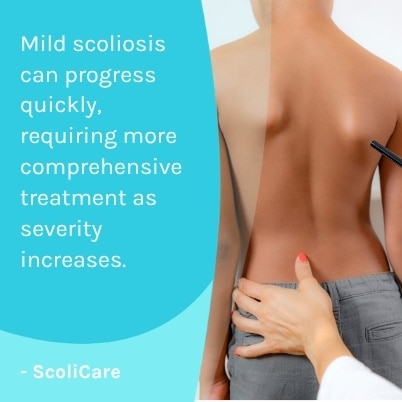
The main trigger for progression in children is growth, so how scoliosis is managed during periods of rapid growth is essential, and in adults, age-related degenerative changes in the spine can trigger the onset/progression of scoliosis (3).
Mild scoliosis symptoms are going to be more subtle than symptoms of moderate and severe scoliosis, and in addition to curve size, there are a number of other factors that shape a patient’s level of scoliosis pain (4, 5).
Patient Age and Mild Scoliosis Pain
When it comes to customizing potentially-effective scoliosis treatment plans, patient age is a key factor that indicates a patient’s potential rate of progression and level of pain
When growth stops and skeletal maturity is reached, scoliosis becomes compressive; compression is uneven and/or excessive pressure.
Compression isn’t the only cause of scoliosis pain, but it is a primary cause that’s more likely to affect adults for whom scoliosis is progressive (5); a child’s spine is constantly being lengthened through growth, and the lengthening motion of growth counteracts the curve’s compressive force (4).
While mild cases of childhood scoliosis are unlikely to be painful, mild back and muscle pain can develop, and mild scoliosis in adults can cause pain, particularly if nerve compression is occurring (4).
The spine works with the brain to form the body’s central nervous system, and if the spine has an unnatural curve and rotates, the spinal cord may be exposed to uneven pressure and cause a loss of space for the nerves to function optimally within.
Nerve compression can cause nerve damage, and a spinal nerve that’s compressed can become irritated, inflamed, and/or impinged. Nerve compression can disrupt a nerve’s health, function, and ability to properly send and receive signals from the brain.
The main symptom of adult scoliosis is nerve pain that radiates into the arms and hands, legs and feet, and as adult scoliosis progresses, nerve compression can increase, along with its effects, including pain (5).
The two main types of scoliosis to affect adults are adolescent idiopathic scoliosis in adulthood (ASA) and degenerative de novo scoliosis. Most cases of idiopathic scoliosis in adults are pre-existing from adolescence, and most cases of degenerative scoliosis are progressive and painful because the cause is increasing degenerative instability (5).
While compression is likely to be mild at the mild level of adult scoliosis, it may still cause pain, and there are also the spine’s surrounding muscles and supportive structures to consider.
Muscle Health and Mild Scoliosis Pain
The more advanced scoliosis becomes, the more widespread the effects of scoliosis can become (6).
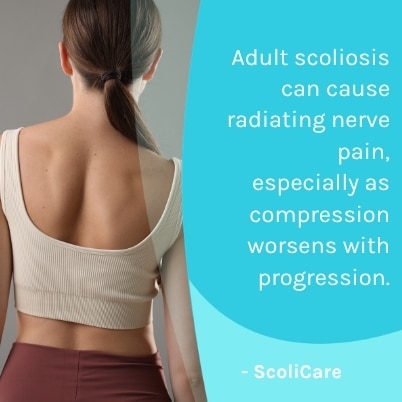
Scoliosis largely affects the spine and its immediate surroundings, including the spine’s surrounding muscles.
In order for the spine to maintain its healthy curves and straight alignment, it needs support and stability from strong and balanced surrounding muscles.
In fact, a key focus of nonsurgical scoliosis treatment is the power of scoliosis-specific rehabilitative exercise to improve back and core-muscle strength and balance (7).
Scoliosis introduces uneven forces to the spine and body, and a common scoliosis symptom is muscular imbalance that can cause varying degrees of muscle tension and pain.
If the spine has an unnatural curve and twist, it’s surrounding muscles are working harder to counteract the uneven forces of scoliosis, which can lead to muscle fatigue, and if the muscles on one side of the spine become stronger due to overuse while muscles on the opposite side weaken due to lack of use, a muscular imbalance can cause sore and tense muscles (7).
While some adults with mild scoliosis don’t experience back, nerve, and muscle pain until progression increases curve size and severity, others will, and pain indicates the need for a proactive treatment plan that works towards restoring the spine and body’s alignment, balance, and symmetry.
Additional Causes of Scoliosis Pain
In addition to curve size, compression, and muscular imbalance, a patient’s level of mild scoliosis pain can also be shaped by the location of the spine’s unnatural curve (4, 5).
The spine has three main sections, and the section most commonly affected by scoliosis is the largest and only section that attaches to the rib cage: the thoracic spine (middle/upper back).
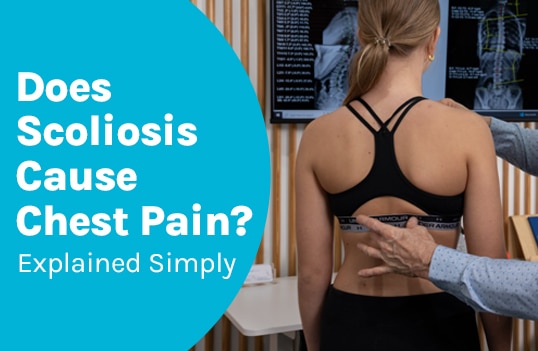
Because scoliosis causes the spine to develop an unhealthy side to side curve that also rotates, in cases of thoracic scoliosis, the spine’s unnatural curve and twist can pull on one side of the rib cage, causing what’s known as a rib flare that can cause chest pain (4, 5).
Thoracic scoliosis is the most prone to rapid advancement, so even mild curves that develop in the thoracic spine have the potential to become severe and cause overt symptoms and increasing pain, particularly in adults (4, 5).
In addition, cases of scoliosis with more rotation can also be more painful, and the facet joints that connect vertebral bodies are also vulnerable to the uneven forces of scoliosis and can weaken, causing joint pain.
Conclusion
So does mild scoliosis cause pain? Mild scoliosis patients are less likely to experience scoliosis pain than patients with moderate or severe scoliosis. Adults are also more likely to experience mild scoliosis pain than children, but varying degrees of back and muscle pain can still develop in young scoliosis patients.
Pain increases alongside progression, and mild curves that are the most likely to advance quickly and cause increasing pain are those that develop in the thoracic region of the spine during adolescence.
Adolescent idiopathic scoliosis is the most common type of scoliosis and the most closely associated with rapid progression due to pubescent growth spurts.
Mild cases of scoliosis tend to have subtle symptoms, but mild scoliosis is unlikely to stay mild without treatment. Scoliosis pain can be an indicator that progression is occurring and treatment needs are becoming more urgent and complex.
It’s ideal to start treating scoliosis while curves are mild and effects aren’t well established, but when mild cases aren’t painful, this can be a barrier to early diagnosis, which is why awareness of scoliosis risk factors and the early signs to look for are crucial and can be so beneficial.
The earliest signs of scoliosis in children are postural changes such as uneven shoulders and uneven hips, and in adults, the earliest sign of scoliosis is often pain.
Regardless of age or severity, all cases of scoliosis can benefit from treatment, and most cases of untreated scoliosis will continue to get worse over time, with increasing postural changes and pain.
Here at ScoliCare, we value a proactive nonsurgical treatment approach that works towards preventing progression and increasing scoliosis effects. Many cases of scoliosis involve pain, but they don’t have to with the help of a comprehensive customized treatment plan that’s proven to minimize symptoms.
Find Your Nearest Clinic
ScoliCare Clinics, affiliates and product providers are in over 200 locations around the world. Find your nearest ScoliCare location here.


References:
- Janicki JA, Alman B. Scoliosis: Review of diagnosis and treatment. Paediatr Child Health. 2007 Nov;12(9):771-6. doi: 10.1093/pch/12.9.771. PMID: 19030463; PMCID: PMC2532872
- McCarthy RE. Prevention of the complications of scoliosis by early detection. Clin Orthop Relat Res. 1987 Sep;(222):73-8. PMID: 2957138
- Negrini, S., Donzelli, S., Aulisa, A. G., Czaprowski, D., Schreiber, S., de Mauroy, J. C., … & Zaina, F. (2018). 2016 SOSORT guidelines: orthopaedic and rehabilitation treatment of idiopathic scoliosis during growth. Scoliosis and spinal disorders, 13(1), 3
- Theroux, J., Stomski, N., Hodgetts, C. J., Ballard, A., Khadra, C., Le May, S., & Labelle, H. (2017). Prevalence of low back pain in adolescents with idiopathic scoliosis: a systematic review. Chiropractic & manual therapies, 25(1), 10
- Zaina, F., Marchese, R., Donzelli, S., Cordani, C., Pulici, C., McAviney, J., & Negrini, S. (2023). Current knowledge on the different characteristics of back pain in adults with and without scoliosis: a systematic review. Journal of Clinical Medicine, 12(16), 5182
- Negrini, S., Grivas, T. B., Kotwicki, T., Maruyama, T., Rigo, M., Weiss, H. R., & members of the Scientific society On Scoliosis Orthopaedic and Rehabilitation Treatment (SOSORT) stefano. negrini@ isico. it. (2006). Why do we treat adolescent idiopathic scoliosis? What we want to obtain and to avoid for our patients. SOSORT 2005 Consensus paper. Scoliosis, 1(1), 4
- Marchese R, Du Plessis J, Pooke T, McAviney J. The Improvement of Trunk Muscle Endurance in Adolescents with Idiopathic Scoliosis Treated with ScoliBrace® and the ScoliBalance® Exercise Approach. J Clin Med. 2024 Jan 23;13(3):653. doi: 10.3390/jcm13030653. PMID: 38337346; PMCID: PMC10856658
More news
-
 5 August 2026
Adult scoliosis can develop from adolescent scoliosis, aging, or neuromuscular conditions. Early care helps manage progression and maintain spinal function.
-
 28 August 2026
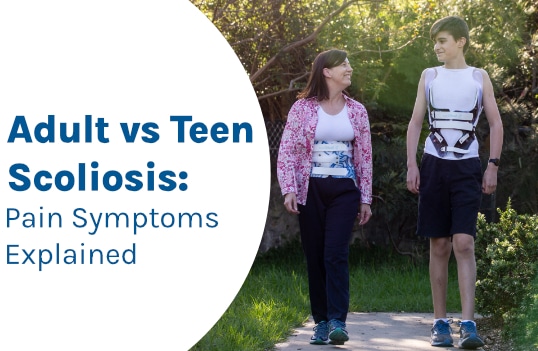
Scoliosis pain varies by age and severity. Adults are more likely to experience back and nerve pain, while early treatment can help limit progression and symptoms.
-
 28 November 2025
Thoracic scoliosis can cause chest pain from muscle imbalance, rib compression, or nerve irritation—managing scoliosis is key to reducing these effects.