
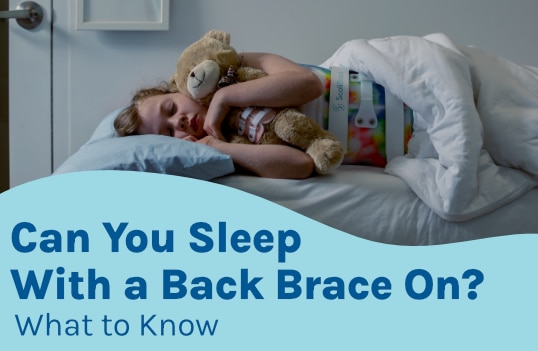
Scoliosis bracing can play a key role in the treatment of early childhood, adolescent, and adult scoliosis, and when combined with the power of a scoliosis-specific rehabilitative exercise plan, the corrective potential of bracing increases.
No two cases of scoliosis are the same, which is why the customization of treatment plans is so important. The ScoliBrace® is a modern custom brace designed for compliance and correction; it can be prescribed for full-time wear, including nighttime, and the ScoliNight is specifically designed for nighttime wear.
It can be difficult for patients to get accustomed to wearing a back brace, particularly those recommended for full-time wear.
Scoliosis Bracing as Treatment
Scoliosis is a complex 3-dimensional lateral spinal curve with rotation, and because it’s progressive, it’s likely to increase in severity over time.
Scoliosis can range from mild to severe, but many cases are highly treatable, particularly with early diagnosis and intervention (1).
Scoliosis bracing is a common facet of nonsurgical scoliosis treatment for all ages, but it has more corrective potential in patients whose spines are still growing; a growing spine is more flexible, so it’s easier to improve its position and alignment (2).
A significant difference between traditional scoliosis bracing and modern corrective bracing is movement. Traditional braces immobilize the spine, limiting its movement and having negative effects of the spine’s surrounding muscle strength, while modern corrective bracing is designed to work with movement (3, 4, 5).
When corrective bracing is combined with the power of a customized scoliosis-specific rehabilitative exercise program, there is more potential for correction and improvements to quality of life (3, 4, 5).
ScoliBrace®
The ScoliBrace® is a truly advanced custom scoliosis brace with potential for 3-dimensional correction. It uses the most advanced computer aided design and manufacture (CAD and CAM) to comprehensively scan and measure the body and a patient’s scoliosis for the most customized fit (3, 4, 5).
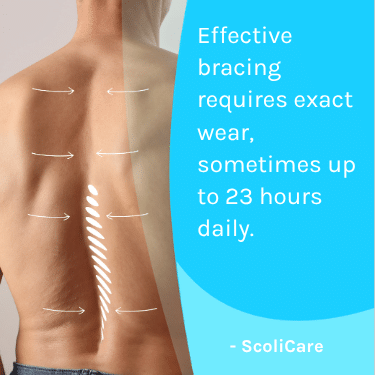
A brace that fits better is one that’s going to be more comfortable, and particularly when it comes to full-time wear, comfort and compliance are key. In order for a brace to be effective, it has to be worn exactly as prescribed, and full-time wear can mean up to 23 hours a day, including during sleep (3, 4, 5).
Sleeping with a ScoliBrace®
For patients wearing a back brace full time, it can be a difficult adjustment, particularly for adolescents who don’t want to stand out from their peers, and when it comes to sleeping with a back brace, there may be an adjustment period.
In most cases, patients get used to their ScoliBrace®, particularly as the complete customization and comprehensive fitting/adjustments made throughout makes the brace more comfortable to move and sleep in (4).
When it comes to sleeping with a ScoliBrace®, the following tips can help:
Wear comfortable breathable clothing underneath the brace to prevent skin irritation, and opt for fitted clothing, rather than tight clothing to prevent fabric bunching up under the brace.
Use a comfortable supportive mattress and/or a memory foam mattress topper to provide extra support for the spine, cushioning around the brace, help evenly distribute the body’s weight, and reduce pressure points.
Sleep Position is also important when it comes to sleeping with a ScoliBrace® and preventing morning stiffness (6), and the best sleeping position for spinal alignment and comfort is flat on the back; back sleeping reduces pressure on the spine, pressure points, and promotes healthy spinal alignment through even support.
When it comes to side sleeping, placing a thin pillow between the knees can increase comfort by improving the spine’s alignment and reducing pressure from the brace (6).
Stomach sleeping is the worst position for spinal health and comfort as it places the spine and neck under additional strain and causes morning stiffness and discomfort.
Be mindful of temperature. Wear cool breathable fabrics for maximum air flow to prevent overheating in the brace.
It’s generally recommended for patients to gradually increase time spent wearing the brace until they reach a level of comfort during movement and sleep that supports full-time wear.
There are also back braces specifically designed as nighttime bracing that are worn only at night.
ScoliNight
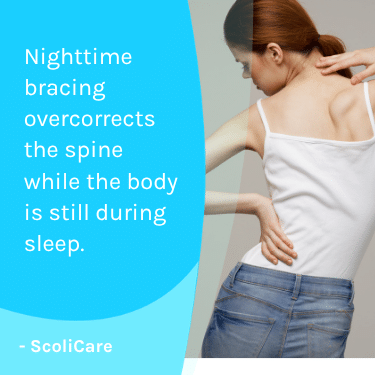
Nighttime bracing is designed for overcorrection during sleep; these braces don’t have to account for movement while in the brace, so they can hold the spine in a hyper-corrective position (7).
Typically, the ScoliNight is used as early intervention with mild cases of scoliosis affecting younger children.
Because mild curves in young children have a higher degree of flexibility, wearing a back brace to bed during peak growth hours can provide the additional support needed to maintain the spine’s neutral position and alignment (7).
ScoliNight is ideal for mild single thoracic, lumbar, or thoracolumbar curves measuring less than 25 degrees that are flexible and simpler to correct, and because the spine is held in a hyper-corrective position, standing and sitting in the brace isn’t possible (7).
There are a number of benefits to diagnosing scoliosis early and starting treatment prior to the first pubescent growth spurt; growth triggers progression (8). ScoliNight may prevent further progression and the need for full-time bracing (7).
It’s important to understand, however, that because scoliosis is progressive, mild curves don’t always stay mild, and if the ScoliNight doesn’t prevent further progression, patients may be recommended for full-time ScoliBrace® wear and/or the addition of a scoliosis-specific rehabilitative exercise program (5).
Conclusion
The ScoliBrace® represents a new era of scoliosis bracing: one that works with the spine’s natural movement-based design, rather than immobilizing the spine as traditional scoliosis bracing does.
ScoliBrace® is at the heart of ScoliCare’s patient-centered approach that individualizes each correction to improve a patient’s spinal and postural alignment by supporting the spine while in an over-corrective position.
The ScoliBrace®’s over-corrective approach works by placing the spine and body in a position opposite of the scoliosis for 3-dimensional correction of the spine and body posture.
For braces prescribed as full-time, this can mean worn for up to 23 hours a day, including during sleep, and in some instances, braces are specifically designed to hold the spine in a hyper-corrective position without having to account for mobility.
When successful, scoliosis bracing has the potential to slow/stop progression, reduce curve size, retrain the brain to support the spine and body’s healthy alignment, improve posture, and reduce pain.
References:
- McCarthy RE. Prevention of the complications of scoliosis by early detection. Clin Orthop Relat Res. 1987 Sep;(222):73-8. PMID: 2957138
- Heary RF, Bono CM, Kumar S. Bracing for scoliosis. Neurosurgery. 2008 Sep;63(3 Suppl):125-30. doi: 10.1227/01.NEU.0000320387.93907.97. PMID: 18812914
- Marchese R, Du Plessis J, Pooke T, McAviney J. The Improvement of Trunk Muscle Endurance in Adolescents with Idiopathic Scoliosis Treated with ScoliBrace®® and the ScoliBalance Exercise Approach. J Clin Med. 2024 Jan 23;13(3):653. doi: 10.3390/jcm13030653. PMID: 38337346; PMCID: PMC10856658
- Nalda A, Mirenzi R, Doueihi NL, McAviney J. A Non-Surgical Multimodal Approach to Severe Thoracic Adolescent Idiopathic Scoliosis Combining ScoliBrace® and Scoliosis-Specific Rehabilitation Therapies: A Case Series. Healthcare (Basel). 2025 Jun 26;13(13):1522. doi: 10.3390/healthcare13131522. PMID: 40648546; PMCID: PMC12249254
- Improvement of trunk muscle endurance in Adolescent Idiopathic Scoliosis (AIS) patients undergoing ScoliBrace® and Scientific Exercise Approach to Scoliosis (SEAS) treatment, SOSORT Book of Abstracts, SOSORT Lyon 2017. Paper here
- Cary D, Briffa K, McKenna L. Identifying relationships between sleep posture and non-specific spinal symptoms in adults: A scoping review. BMJ Open. 2019 Jun 28;9(6):e027633. doi: 10.1136/bmjopen-2018-027633. PMID: 31256029; PMCID: PMC6609073
- Grivas TB, Rodopoulos GI, Bardakos NV. Night-time braces for treatment of adolescent idiopathic scoliosis. Disabil Rehabil Assist Technol. 2008 May;3(3):120-9. doi: 10.1080/17483100801903954. PMID: 18465394
- Negrini, S., Donzelli, S., Aulisa, A. G., Czaprowski, D., Schreiber, S., de Mauroy, J. C., … & Zaina, F. (2018). 2016 SOSORT guidelines: orthopaedic and rehabilitation treatment of idiopathic scoliosis during growth. Scoliosis and spinal disorders, 13(1), 3
More news
-
 1 June 2022
Long trips can be a little difficult for brace wearers, especially if sitting for hours at a time. Here are some tips for scoliosis brace wearers that may help make…
-
 31 January 2024
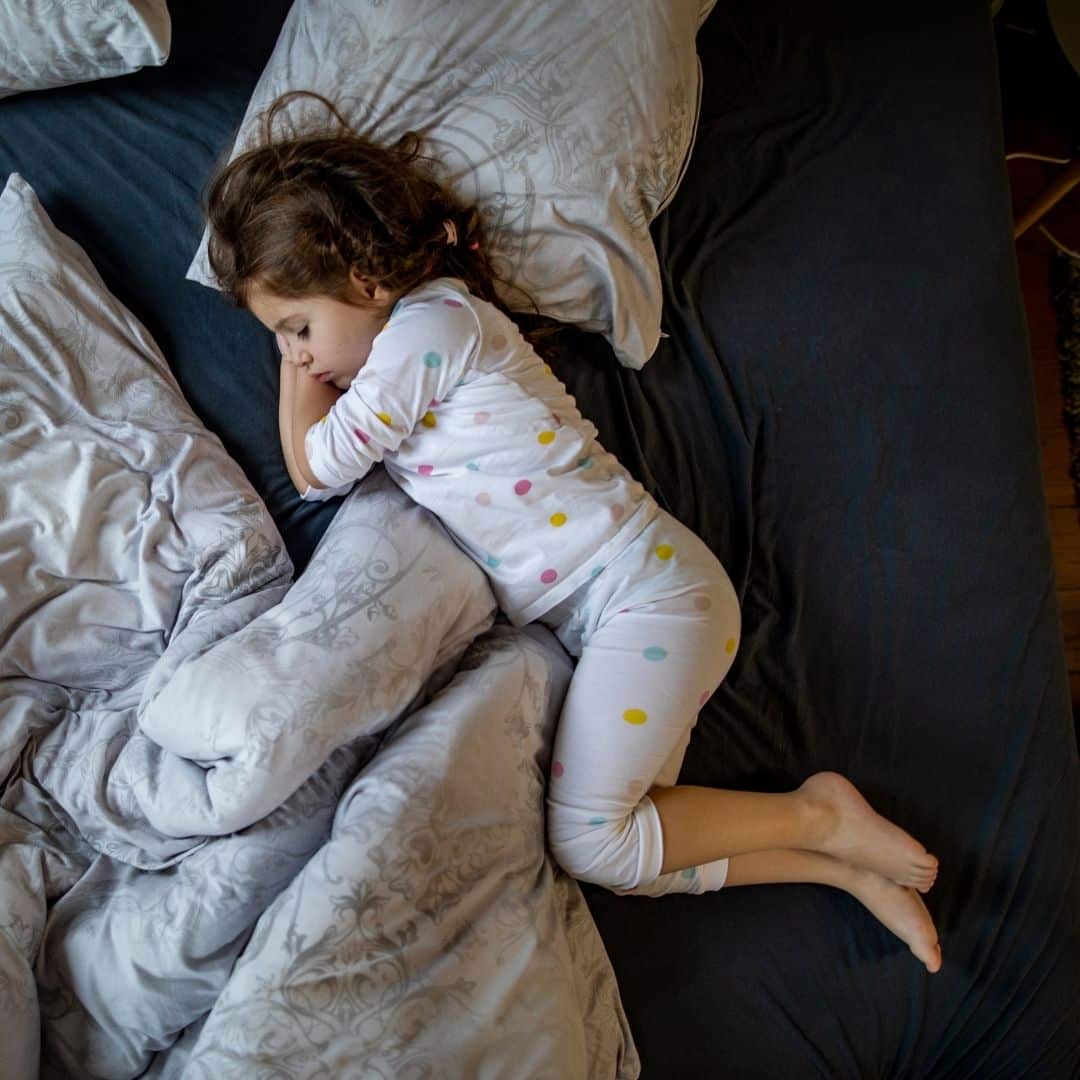
A good night’s sleep is extremely important but if you have scoliosis, finding the perfect sleeping position can at times be a little difficult. Whether you wear a brace or…
-
 14 March 2021
Are you Looking After Your Scoliosis Brace or Kyphosis Brace Properly? Whether you are wearing your brace part-time, or nearly all day, it is important to keep your brace as…