
The spine’s natural and healthy curves are key to its overall health. A healthy spine should have its curves and vertebrae (bones) in a natural position. Each of the spine’s main sections has a specific curve type, and the curves work together to keep the spine strong, balanced, and stable.
Treatment for loss of lumbar lordosis depends on why the curve has flattened, how severe the change is, and whether symptoms such as back pain, stiffness, postural change, or nerve irritation are present. Also known as flatback syndrome and/or hypolordosis, a loss of lumbar lordosis means the lower spine has lost its healthy curve and become excessively straight. Common treatment options include lordosis-specific physical therapy, chiropractic care, and bracing.
A loss of lumbar lordosis can benefit from a customized treatment plan that improves the lower spine’s natural and healthy position.
Loss of Lumbar Lordosis Treatment Options
When the spine loses one or more of its healthy curves, the goal of treatment is usually to improve spinal alignment where possible, support healthier posture and movement, reduce symptoms, and address the underlying cause.
The two main types of spinal curves are lordosis and kyphosis; these are opposite curve types so they balance each other out. Lordosis makes the spine curve inward, towards the center of the body, and kyphosis causes the thoracic spine to curve outward (1).
Not everyone will have the same degree of lordosis, and a number of factors shape an individual’s lordosis angle (1), but it needs to fall within a typical and healthy range, or there is too much lordosis (hyperlordosis), or too little lordosis (hypolordosis) (1).
Improving alignment means helping the spine, pelvis, and surrounding muscles work together in a more balanced position (1).
It can be difficult to know when to see a clinician for loss of lumbar curve, but if signs are noticed, professional assessment is needed to evaluate the symptoms, monitor for changes, and decide on the best treatment response.
Working to restore the spine’s healthy curves is also important for symptom relief, and flatback treatment options may include targeted exercise or physical therapy, postural and lifestyle guidance, pain management, and in selected cases, bracing or other specialist care.
Physical Therapy and Targeted Exercise
Physical therapy for restoring lumbar lordosis can involve a number of corrective exercises that focus on strengthening and balancing abdominal and back muscles; this increases support for the lower back and pelvis and can stabilize the pelvis so it doesn’t tilt forward unnaturally (3).
Exercises may include carefully selected mobility, strengthening, and postural exercises, depending on the patient’s symptoms, flexibility, strength, and underlying cause (3).
Core strengthening and strengthening the glutes and hamstrings means the healthy position of the lumbar spine and the pelvis are better supported and stabilized by the muscles above and below the lumbar spine (3).
If the lumbar spine loses its natural lordosis, the spine straightens out, and this change can impact the position of the pelvis, how upper body weight is distributed over the pelvis and lower body, lower body mobility, muscle strength and balance, and the spinal sections above because the spine’s healthy curves work together for balance and stability (2).
Because body posture shapes spinal health and vice versa, physical therapy can involve the use of mirrors so patients are educated on how to practice proper posture. As they’re taught how to hold their bodies during targeted exercise, they can integrate the changes into daily activity so the lumbar spine’s straight and upright position is supported by the body’s neutral upright posture (3).
Targeted therapy for a loss of lumbar lordosis may address core strength, hip and pelvic control, spinal mobility, and posture habits.
Bracing
In some cases, bracing may help support spinal position, posture, and comfort, particularly when it is part of a broader treatment plan (4, 3).
Bracing may be considered more often in children or adolescents because a growing spine can be more responsive to guided support, but suitability depends on the diagnosis and assessment findings (4).
Bracing can also reduce pain by increasing spinal support, stability, and improving posture (4).
Pain and anti-inflammatory medications can further help with chronic pain and inflammation caused by a loss of lordosis, but addressing the cause of the loss is necessary for long-term pain relief.
Chiropractic Care
Chiropractic care can involve a number of techniques including manual adjustments, traction therapy, and corrective exercise/stretches as part of Chiropractic BioPhysics® (5).
Chiropractic care for a loss of lordosis focuses on realigning the lumbar spine, improving the position of the pelvis, and strengthening core and gluteal muscles (5).
Manual therapy may help improve joint movement, reduce discomfort, and support function as part of a broader care plan (5).
Core and gluteal muscle strengthening can support structural improvements within the spine by providing uniform support for the lower back and pelvis (4, 5).
Some clinicians may use traction-based approaches with the aim of improving lumbar extension and posture, but this should be guided by assessment and monitored for symptom response (5).
Postural improvement is also a goal of chiropractic care for hypolordosis.
Lifestyle Guidance
Lifestyle modifications can include posture correction, increasing activity levels, and weight loss to reduce adverse spinal tension and strain.
Posture and spinal health are closely linked, so improving movement habits and support can often help reduce strain on the lower back (7).
Cultivating a healthy activity level with consistent exercise is key to maintaining balanced muscle strength, spinal flexibility, bone and disc health (8).
Weight loss in the abdominal area reduces tension and strain on the vertebrae of the lumbar spine and the pelvis.
Treatment options for restoring healthy lordosis depend largely on the cause, and common causes include degenerative disc disease, ankylosing spondylitis, lifestyle factors, and surgical complications.
Loss of Lumbar Lordosis Causes
A comprehensive assessment is the first step in developing an individualized hypolordosis treatment plan.
Common causes for a loss of lumbar lordosis include degenerating intervertebral discs, ankylosing spondylitis, lifestyle factors, and post-surgical complications.
Degenerative Disc Disease
The spine’s vertebrae are separated by an intervertebral disc, and disc health is a key factor when it comes to the spine’s overall health.
The discs provide cushioning between adjacent vertebrae to prevent friction during movement; this is important because if the discs are being unevenly compressed, this causes uneven loading, wear, and degeneration (7).
Healthy discs are also needed for shock absorption. If the discs aren’t properly absorbing shock from impact and movement, discs, joints and nerves can suffer from uneven pressure, and this can also make the spine degenerate faster due to the connection between posture, uneven loading, wear, and degeneration (8).
The discs also work together to make the spine more flexible and provide structural support as adjacent vertebral bodies attach to the disc in between (8).
As the largest structures in the body without their own vascular supply, it’s harder for the discs to stay hydrated and healthy and makes them slow to heal; this is also why the discs are often the first parts of the spine to degenerate (8).
Degenerative disc disease is a contributing factor in a number of spinal issues/conditions. When one or more spinal discs in the lumbar spine are degenerating, they lose fluid and height, and can disrupt the position of attached vertebrae and cause the curve to flatten out (8).
Ankylosing Spondylitis
Ankylosing spondylitis can also cause a loss of lumbar lordosis by causing chronic inflammation in the joints of the lumbar spine and its supportive ligaments (9).
The spine’s facet joints connect vertebrae and provide structure by connecting the bones of the spine. Healthy facet joints make sure the spine can support healthy movement (bending, twisting, and arching the back) and that the vertebrae are stable and don’t move too much (10).
While the spine’s natural design is based on movement, too much movement means instability, and if the vertebrae of the lumbar spine are becoming unstable because they’re not getting the support needed from inflamed facet joints and ligaments, the lumbar spine won’t be able to keep its healthy position (9, 10).
Severe inflammation in the facet joints can also cause the formation of new bone, and this can cause the vertebrae attached to the inflamed facet joint to become fused into one solid bone, increasing the lower back’s rigidity and flattening the curve (9).
Lifestyle Factors
Lifestyle factors such as chronic poor posture, low activity levels, prolonged sitting, and carrying excess abdominal weight can strain the lumbar area, causing an unnatural shift in posture and the spine’s position (7, 11).
Low activity levels also contribute to poor disc health and weak muscles. If the lumbar spine isn’t surrounded by strong and balanced muscles, the position of the pelvis can be disrupted, which can cause the lumbar spine to flatten out in an attempt to counteract the unnatural position of the pelvis (8, 11).
Surgical Complications
Flatback syndrome can occur after some lumbar spinal fusion surgeries, particularly when sagittal alignment or disc height is not adequately restored (6).
Lumbar spinal fusion can involve the removal of the disc that sits between adjacent vertebrae so they can be permanently connected as one solid bone; this can be done to eliminate movement in a particularly unstable area of the lumbar spine and increase its stability and/or to correct an unnatural spinal curve.
While lumbar spinal fusion surgery has advanced over the years, hypolordosis is a common complication so should be considered carefully (6).
Treatment for a loss of lordosis isn’t just about improving the health and structure of the spine; it’s about symptom relief for a better quality of life, so a patient’s treatment plan is also based on the types of symptoms they are experiencing.
Symptoms of a Loss of Lumbar Lordosis
Spinal health shapes posture, mobility, and nerve health. If the spine loses a healthy curve, the loss can disrupt the spine and body’s alignment and health in a number of ways.
If the lumbar spine becomes excessively straight and flattens out, the main symptom is pain. A chronic ache in the lower back is common as muscles and ligaments that support the spine are straining to maintain proper posture and balance (12).
Muscle tension, fatigue, and stiffness are common in the thigh and groin, and when severe, numbness/weakness in the legs can also develop due to spinal nerves being compressed (13).
If nerves in the lumbar spine are exposed to uneven pressure due to its straightening, radiating nerve pain may be felt throughout the lower body.
The main visual symptom of hypolordosis is the lower back’s flat appearance and the changes to posture it can cause, and because healthy posture is needed for healthy movement, unhealthy movement patterns can cause fatigue as the body is trying to counteract changes to gait, balance, and stability (7, 13).

Poor posture is a common effect because the loss of lordosis makes it harder to stand fully upright, and this can cause a pitched-forward posture that becomes worse throughout the day. Difficulty standing for long periods of time is an issue for people with hypolordosis (13).
If the lumbar spine loses its natural lordosis, postural changes, pain, and mobility issues are common symptoms, and in severe cases, compressed nerves can cause tingling sensations and/or numbness in the legs and feet (13).
If you notice a flatter lower back, increasing difficulty standing upright, ongoing lower back pain, or symptoms in the legs, a professional assessment can help identify the cause and guide the most appropriate next step.
Conclusion
When the lumbar spine loses its natural inward curve and becomes excessively straight, this is a loss of lumbar lordosis, also known as flatback syndrome and/or hypolordosis.
As one long structure, the spine’s overall health is shaped by what’s happening in each of the spine’s main sections, and the curves work together to keep the spine balanced and stable.
If the lumbar spine loses its lordosis, it can make it difficult to stand upright for extended periods and cause back pain, muscle pain and tension, mobility issues, poor posture, and fatigue.
Treatment options for restoring a healthy degree of lordosis to the lumbar spine can include physical therapy, corrective exercise, bracing, chiropractic care, lifestyle modifications, and in severe cases, lordosis surgery.
Early assessment can make it easier to understand what is causing the change, whether treatment is needed, and which options may help preserve comfort, posture, and function over time.
References:
- Hey HWD, Lin S, Tay HW, Tay YJ, Liu GK, Wong HK. Understanding “Kyphosis” and “Lordosis” for Sagittal Balancing in Two Common Standing Postures. Spine (Phila Pa 1976). 2021 Dec 1;46(23):1603-1611. doi: 10.1097/BRS.0000000000004106. PMID: 34747908
- Been E, Kalichman L. Lumbar lordosis. Spine J. 2014 Jan;14(1):87-97. doi: 10.1016/j.spinee.2013.07.464. Epub 2013 Oct 2. PMID: 24095099
- Kim WM, Seo YG, Park YJ, Cho HS, Lee CH. Effect of Different Exercise Types on the Cross-Sectional Area and Lumbar Lordosis Angle in Patients with Flat Back Syndrome. Int J Environ Res Public Health. 2021 Oct 17;18(20):10923. doi: 10.3390/ijerph182010923. PMID: 34682669; PMCID: PMC8535726
- Park HS, Park SW, Oh JK. Effect of adding abdominal bracing to spinal stabilization exercise on lumbar lordosis angle, extensor strength, pain, and function in patients with non-specific chronic low back pain: A prospective randomized pilot study. Medicine (Baltimore). 2023 Oct 13;102(41):e35476. doi: 10.1097/MD.0000000000035476. PMID: 37832063; PMCID: PMC10578739
- Harrison DE, Oakley PA. Non-operative correction of flat back syndrome using lumbar extension traction: a CBP® case series of two. J Phys Ther Sci. 2018 Aug;30(8):1131-1137. doi: 10.1589/jpts.30.1131. Epub 2018 Aug 7. PMID: 30154615; PMCID: PMC6110233
- Boody BS, Rosenthal BD, Jenkins TJ, Patel AA, Savage JW, Hsu WK. Iatrogenic Flatback and Flatback Syndrome: Evaluation, Management, and Prevention. Clin Spine Surg. 2017 May;30(4):142-149. doi: 10.1097/BSD.0000000000000522. PMID: 28266956
- Fasser MR, Furrer PR, Fisler L, Urbanschitz L, Snedeker JG, Farshad M, Widmer J. The triadic relationship between spinal posture, loading, and degeneration. Front Bioeng Biotechnol. 2025 Mar 18;13:1444540. doi: 10.3389/fbioe.2025.1444540. PMID: 40171041; PMCID: PMC11959076
- Donnally III CJ, Hanna A, Varacallo MA. Lumbar Degenerative Disk Disease. [Updated 2023 Aug 4]. In: StatPearls [Internet]. Treasure Island (FL): StatPearls Publishing; 2026 Jan-. Available from: https://www.ncbi.nlm.nih.gov/books/NBK448134/
- Wenker KJ, Quint JM. Ankylosing Spondylitis. [Updated 2023 Jun 20]. In: StatPearls [Internet]. Treasure Island (FL): StatPearls Publishing; 2026 Jan-. Available from: https://www.ncbi.nlm.nih.gov/books/NBK470173/
- Waxenbaum JA, Reddy V, Williams C, et al. Anatomy, Back, Lumbar Vertebrae. [Updated 2026 Jan 31]. In: StatPearls [Internet]. Treasure Island (FL): StatPearls Publishing; 2026 Jan-. Available from: https://www.ncbi.nlm.nih.gov/sites/books/NBK459278/
- Buckland AJ, Abotsi EJ, Vasquez-Montes D, Ayres EW, Varlotta CG, Vigdorchik JM. Lumbar Spine Degeneration and Flatback Deformity Alter Sitting-Standing Spinopelvic Mechanics-Implications for Total Hip Arthroplasty. J Arthroplasty. 2020 Apr;35(4):1036-1041. doi: 10.1016/j.arth.2019.11.020. Epub 2019 Nov 22. PMID: 31839349
- Chun SW, Lim CY, Kim K, Hwang J, Chung SG. The relationships between low back pain and lumbar lordosis: a systematic review and meta-analysis. Spine J. 2017 Aug;17(8):1180-1191. doi: 10.1016/j.spinee.2017.04.034. Epub 2017 May 2. PMID: 28476690
- Lu DC, Chou D. Flatback syndrome. Neurosurg Clin N Am. 2007 Apr;18(2):289-94. doi: 10.1016/j.nec.2007.01.007. PMID: 17556130
More news
-
 8 July 2026
The spine's healthy curves, when viewed from the side, increase its strength, flexibility, and ability to handle mechanical stress. The spine naturally has an inward curve in the neck (cervical…
-
 5 August 2025
The spine's healthy curves are key to its overall health and function, and the spine has three main sections including the cervical spine, thoracic spine, and the lumbar spine. The…
-
 3 July 2026
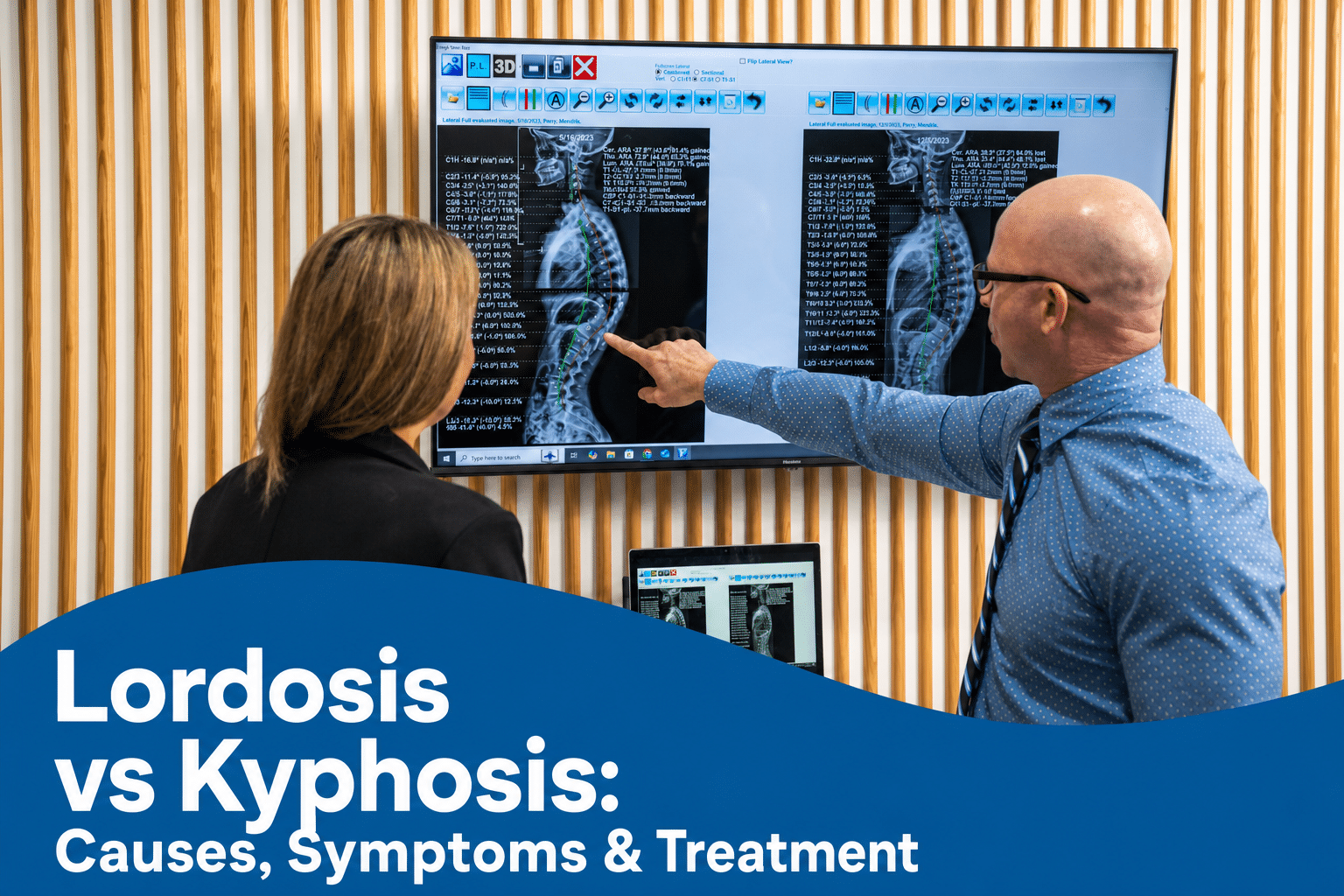
Healthy lordosis and kyphosis keep the spine strong and balanced. Too much or too little of either curve can affect posture, movement, and function.