
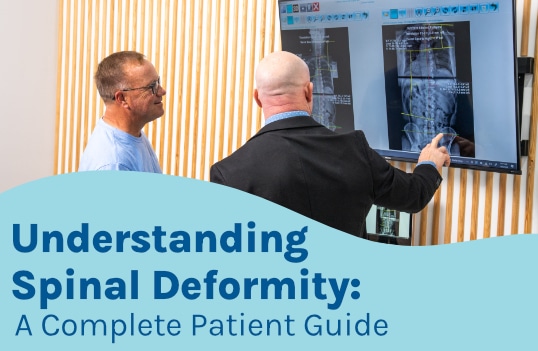
A healthy spine has its vertebrae aligned and its natural curves in place. If the spine’s alignment changes and deviates from its straight position, it can become problematic and considered a spinal deformity.
A typical healthy spine has a soft ‘S’ shape when viewed from either side: maintained by each spinal section’s curve. If the spine develops an unhealthy curve or misalignment, its balance and function can be disrupted. Common spinal conditions that disrupt the spine’s healthy position include scoliosis, lordosis, and kyphosis.
For a better understanding of what’s considered atypical and problematic, it’s helpful to understand the basics of spinal anatomy and biomechanics.
A Healthy Spine
A healthy spine will have its natural curves in place and its vertebrae (bones) stacked on top of one another in a straight and neutral alignment; this facilitates spinal strength, flexibility, and function (1).
The spine is curved at each of its main sections: the cervical spine (neck), thoracic spine (middle/upper back), and the lumbar spine (lower back).
Adjacent vertebrae are separated by an intervertebral disc, and disc health is key to overall spinal health. If one or more discs are exposed to uneven pressure due to an abnormal curve and/or abnormality, disruptions to disc health can make the spine more vulnerable to injury, developing an unhealthy spinal curve, and related functional deficits (1).
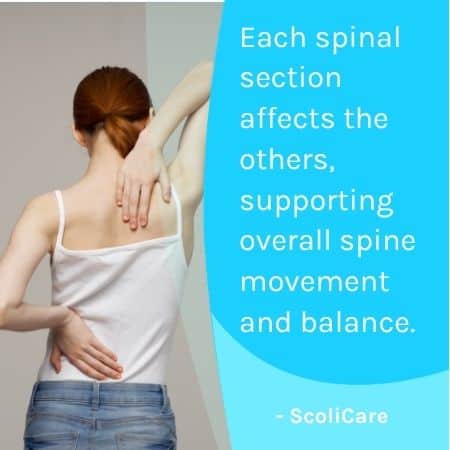
The health of each spinal section is affected by the health of the others, and each section has its own unique role to play in overall spinal biomechanics.
The cervical spine, for example, has to support the weight of the head and enable a wide range of motion; it also protects the spinal cord and connects the brain and spine.
The thoracic spine is the largest spinal section, containing 12 vertebral bodies, and attaching to the rib cage. The thoracic spine anchors the rib cage and torso, protects the spinal cord, and important organs within the thoracic cage (1).
The lumbar spine has to support the spinal sections above, the weight of the upper body, and feels the effects of strenuous twists, bends, and lifts.
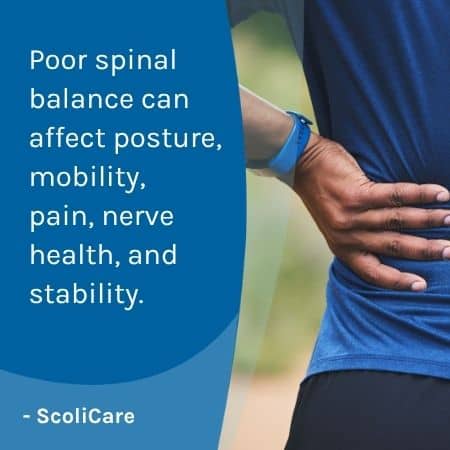
As one long structure, if a single section loses a healthy curve or becomes misaligned, it can disrupt the balance and stability of the entire spine, and if the loss involves a problematic structural abnormality, this is considered a structural spinal deformity.
We know the spine needs to have its vertebrae aligned and healthy curves in place for optimal spinal health, and when it comes to a progressive spinal deformity, the timing of diagnosis and treatment are key (1).
Scoliosis
The Scoliosis Research Society has current estimates at close to seven million people living with scoliosis in the United States alone, and as the most prevalent spinal condition among school-aged children, awareness is important (2).
Scoliosis is considered a structural spinal deformity because it involves structural abnormalities; scoliosis causes the spine to curve unnaturally to the side and rotate (1).
There are a number of spinal conditions that cause a loss of healthy spinal curves, but scoliosis has some characteristics that set it apart (1).
To be considered a true scoliosis, there has to be a rotational component that makes scoliosis 3-dimensional, and because it’s progressive, its nature is to become more severe over time.
In the most typical form of scoliosis, idiopathic scoliosis, we don’t know what triggers its onset, but we know that growth triggers progression, making how scoliosis is managed during periods of rapid growth crucial (3).
Scoliosis disrupts the position of the spine by causing an unnatural curvature, misalignment, and twisting of vertebral bodies (1).
Scoliosis can affect the health of the spine, its surroundings, and the entire body. If the spine is not balanced and stable, its effects can be felt throughout the body: from postural and mobility changes to back and nerve pain and increasing instability.
Scoliosis ranges widely in severity from mild scoliosis to moderate and severe cases, and symptoms are shaped by a number of factors including patient age, scoliosis type, severity, location, and curve pattern.
There are no treatment guarantees, but when diagnosed early and treated proactively, scoliosis can be highly treatable (3).
Lordosis
As mentioned, the spine is curved at each of its main sections, and these curves work together to make the spine stronger, more flexible, and better able to handle mechanical stress.
Lordosis refers to a type of spinal curve that curves inward, towards the center of the body, and the spine’s natural lordosis is found in the cervical and lumbar spinal sections (4).
If the spine’s lordosis falls within a normal range, the curve is considered healthy, but if lordosis becomes unhealthy, causing the spine to curve inward excessively, the curve can become problematic (4).
Hyperlordosis mainly affects the lumbar spine and is commonly known as swayback due to the postural changes it causes: the buttocks and abdomen protrude excessively (4).
Common symptoms of lumbar hyperlordosis include a swayback appearance, back pain, spinal rigidity, and muscle pain; severe cases can include leg pain and numbness and issues with bladder control (4).
Cervical hyperlordosis interferes with the neck’s ability to support the weight of the head and commonly causes neck, shoulder, and upper back pain, stiffness, headaches, dizziness, and nerve compression can cause pain in the extremities.
So while some spinal deformities like scoliosis cause an unnatural lateral spinal curve with rotation and can develop in any spinal section, lordosis causes the spine to bend excessively inward at the cervical and lumbar spinal sections.
Kyphosis
Kyphosis, when excessive, is an additional common spinal deformity that involves a disruption to the spine’s healthy position, but it differs from scoliosis and lordosis by causing the thoracic spine to curve excessively outward, causing a roundback appearance (5).
There are different types of kyphosis from postural kyphosis to Scheuermann’s kyphosis; while postural kyphosis disrupts the spine’s position due to chronic poor posture, the abnormality isn’t structural, so it’s simpler to treat (5).
Scheuermann’s kyphosis often develops during adolescence and is caused by structural abnormalities such as misshapen vertebrae: more wedge-shaped than healthy rectangular-shaped vertebrae (5).
The wedge-shaped vertebrae disrupt the spine’s ability to stay aligned and straight, causing it to develop an excessive outward curvature that may become more severe over time (5).
Hyperkyphosis can cause an excessively rounded forward upper back and shoulders, tight chest muscles, back pain, spinal rigidity, fatigue and balance problems, and the more severe, the more potential there is for nerve involvement and increasing symptoms (5).
Conclusion
Regardless of the type of spinal deformity, in order to restore the spine’s balance and stability, it needs to be addressed proactively, particularly when progressive.
A healthy spine facilitates the ability to stand up straight, practice healthy posture, maintain healthy movement patterns and nervous system communication, and engage in a wide range of motion.
A spinal deformity can impact the spine’s ability to function optionally. A spine that’s not aligned is one that’s going to be weaker and more vulnerable to injury, stiffer and not as flexible, and one that can cause postural changes and varying levels of pain and nerve issues.
So while there is a significant difference, when it comes to treatment, between addressing a structural or nonstructural abnormal curvature of the spine, the importance of the spine’s alignment is key to its strength, flexibility, and function.
When the spine deviates from its natural and healthy position and alignment, it doesn’t just affect the spine, but also the spine’s surrounding muscles, nerves, and the entire body; if the spine is misaligned, the body’s overall symmetry can be disrupted.
Leaving a spinal deformity untreated can lead to progression, increasing effects, and the need for invasive surgical treatment in the future; the most important thing to understand about spinal conditions like scoliosis, lordosis, and kyphosis is the importance of proactive and customized treatment, and the sooner treatment is started, the better.
Find Your Nearest Clinic
ScoliCare Clinics, affiliates and product providers are in over 200 locations around the world. Find your nearest ScoliCare location here.

References:
- DeSai C, Reddy V, Agarwal A. Anatomy, Back, Vertebral Column. [Updated 2023 Aug 8]. In: StatPearls [Internet]. Treasure Island (FL): StatPearls Publishing; 2025 Jan-. Available from: https://www.ncbi.nlm.nih.gov/books/NBK525969/
- Li M, Nie Q, Liu J, Jiang Z. Prevalence of scoliosis in children and adolescents: a systematic review and meta-analysis. Front Pediatr. 2024 Jul 23;12:1399049. doi: 10.3389/fped.2024.1399049. PMID: 39108696; PMCID: PMC11300313
- Negrini, S., Donzelli, S., Aulisa, A. G., Czaprowski, D., Schreiber, S., de Mauroy, J. C., … & Zaina, F. (2018). 2016 SOSORT guidelines: orthopaedic and rehabilitation treatment of idiopathic scoliosis during growth. Scoliosis and spinal disorders, 13(1), 3.
- Been E, Kalichman L. Lumbar lordosis. Spine J. 2014 Jan;14(1):87-97. doi: 10.1016/j.spinee.2013.07.464. Epub 2013 Oct 2. PMID: 24095099
- Lonner, B., Yoo, A., Terran, J. S., Sponseller, P., Samdani, A., Betz, R., … & Newton, P. (2013). Effect of spinal deformity on adolescent quality of life: comparison of operative scheuermann kyphosis, adolescent idiopathic scoliosis, and normal controls. Spine, 38(12), 1049-1055
More news
-
 12 June 2026
Scoliosis is a condition that affects the spine: an unnatural sideways-bending spinal curvature that rotates develops. As a progressive lateral curvature of the spine, the nature of scoliosis is to…
-
 15 July 2024
In recent years, patient-centred care has revolutionised the approach to scoliosis treatment by focusing on the unique needs, preferences and values of each patient. This approach places patients at the…
-
 21 January 2026
The Adam's forward bend test is key in scoliosis screening—by revealing spinal asymmetries early, it helps identify cases that need further X-ray evaluation.