
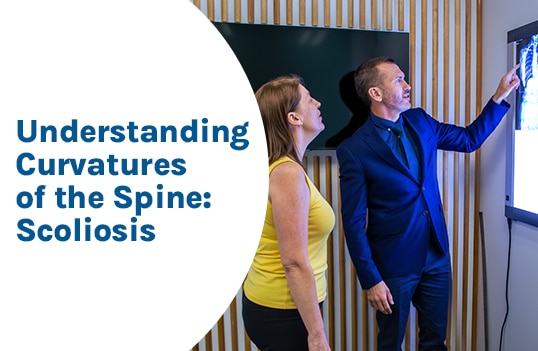
Scoliosis is a condition that affects the spine: an unnatural sideways-bending spinal curvature that rotates develops. As a progressive lateral curvature of the spine, the nature of scoliosis is to increase in severity over time, along with its effects.
As spinal health is key to overall health, it can be beneficial to understand how the spine functions, including the difference between healthy and unhealthy spinal curves. The spine’s natural curves work together to maintain the spine’s balance and alignment, and the development of scoliosis can disrupt its overall health and function.
For a better understanding of spinal curves, let’s discuss how the different spinal structures work together to preserve its health, strength, and function.
Anatomy of a Healthy Spine
A healthy spine helps us stand upright, practice good posture, provides the body’s main structural support, enables mobility and nerve function (1).
An unhealthy spine can have a number of effects including poor posture, instability, reduced mobility and neuropathy, and in order for the spine to function optimally, it has to have its healthy curves in place (1).
When viewed from either side, the spine should have curves, and while the size of these curves can vary from person to person, if they don’t fall within a healthy range, they can be deemed unhealthy and problematic.
Healthy Spinal Curves: Lordosis and Kyphosis
The spine has three main sections, and each has a characteristic curve type that helps maintain the spine’s overall balance and alignment.
The cervical spine refers to the neck, and if its healthy curve is in place, the spine curves forward, known as lordosis, and the thoracic spine is the largest spinal section and features a backward-bending spinal curve known as kyphosis, and the lumbar spine should also naturally curve forward as a lordotic curve (2, 3).
If there is too much lordosis, this is diagnosed as hyperlordosis, and too little lordosis is known as hypolordosis; too much kyphosis is known as hyperkyphosis and too little is hypokyphosis (2, 3).
As long as a patient’s lordosis and kyphosis fall within what’s considered a typical range, the spinal curves are healthy, but if a patient’s lordosis or kyphosis become over- or under-pronounced, the curves are unhealthy and can become problematic (2, 3).
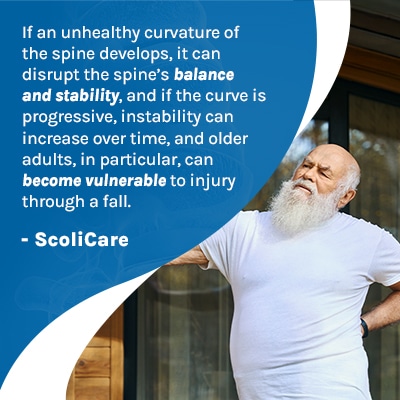
If an unhealthy curvature of the spine develops, it can disrupt its balance and stability, and if the curve is progressive, instability can increase over time, and older adults, in particular, can become vulnerable to injury through a fall (4).
The spine’s curves and structures work together to maintain the spine’s strength, flexibility, and balance, including its vertebrae (bones), facet joints, intervertebral discs, and the spinal cord.
Key Spinal Structures
If the spine’s healthy curves are in place, its vertebrae are aligned in a straight and neutral position, and adjacent vertebral bodies are separated by an intervertebral disc (1).
The spinal discs give the spine structural support, prevent friction during movement, act as the spine’s shock absorbers, and combine forces to facilitate flexibility, so disc health affects overall spinal health in a number of ways (1).
The vertebrae from a hollow tunnel containing the spinal cord, consisting of 31 pairs of spinal nerves that exit the spine and branch off throughout the body, sending and receiving input to and from the brain (1).
The vertebrae’s facet joints connect the bones and enable movement and flexibility; they are synovial joints so are surrounded by lubricating fluid and cartilage to facilitate smooth gliding motion of the joints during movement.
In addition, there are a number of tough ligaments and muscles that support the spine and its healthy curves and alignment.
As you can see, there are many structures working together to maintain the spine’s balance, stability, and alignment, and if a single unhealthy curve develops, it’s not only the spine’s structures that are affected, but also the spine’s surroundings (muscles and nerves), and overall body posture (1).
So what happens if the spine develops an unnatural spinal curve that bends to the side and rotates?
Understanding Scoliosis
There are a number of spinal conditions that cause a loss of healthy spinal curves, including scoliosis.
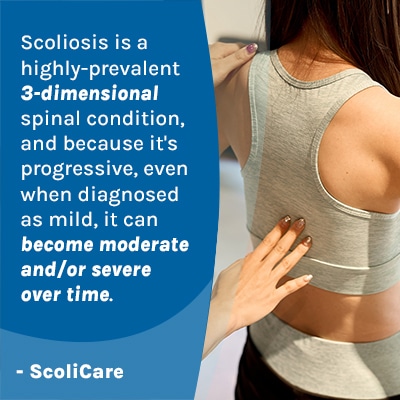
Scoliosis is a highly-prevalent 3-dimensional spinal condition, and because it’s progressive, even when diagnosed as mild, it can become moderate and/or severe over time.
We don’t always know why scoliosis develops initially (idiopathic scoliosis), but we do understand what makes it progress: growth (5).
Scoliosis can affect all ages, but it’s most commonly diagnosed during adolescence as adolescent idiopathic scoliosis, and this age group is the most at risk for rapid advancement, so counteracting progression is a focus of treatment (5, 6).
Scoliosis also affects adults; in fact, the rate of scoliosis increases among the aging population, and this is due to degenerative instability causing degenerative scoliosis (7).
Scoliosis progressing involves the size and rotation of the spine’s unnatural curve increasing, and this doesn’t just affect the spine, but also its surroundings, and the entire body, particularly if severe and/or if left untreated.
Scoliosis is Progressive
If the spine curves and rotates unnaturally, its vertebrae aren’t aligned, and this also affects discs in the area as they are exposed to uneven pressure and wear.
The more unnaturally tilted and rotated the spine’s vertebrae are, the more out of balance the spine is, and the more likely it is to continue progressing, becoming increasingly misaligned and unstable.
If the spine is unnaturally curved, it’s exposing its structures and surroundings to uneven pressure, and in patients who have stopped growing, compression can cause varying levels of pain and discomfort (8).
In adults, pain is the main symptom that leads to assessment and diagnosis. Scoliosis-related pain can involve the back muscles, spinal structures, and nerves, leading to radiating pain (8).
As scoliosis develops and progresses, the spinal discs are being exposed to uneven pressure, and uneven wear can cause them to become desiccated, change shape, and degenerate over time (9).
Disc degeneration is a contributing factor in the development of a number of spinal conditions/issues, and as the spinal discs don’t have their own vascular supply, damage can be difficult to reverse (9).
Nerve health can also be disrupted by the development of an unhealthy spinal curvature as the nerves within the spinal cord, or where they exit the spine, can experience compression, irritation, inflammation, and/or impingement (10).
So the spine’s healthy curves and alignment are also needed to ensure there is enough space for its structures to function optimally within.
Addressing Scoliosis with Treatment
Treatment results can never be guaranteed, but scoliosis can be highly treatable, particularly with early detection and intervention.
Here at ScoliCare, we focus on education, awareness, early detection, and proactive customized nonsurgical treatment plans.
Restoring the spine’s healthy curves and alignment may be within reach, and because scoliosis is progressive, the sooner treatment is started, the better.
Many cases of scoliosis respond to a combination of scoliosis-specific exercise rehabilitation, incorporating key aspects of Chiropractic BioPhysics®, Schroth and other scoliosis-specific exercise methods, and corrective 3D bracing, particularly when treatment is started early (11, 12).
Designed by chiropractor, Dr. Jeb McAviney, and physical therapist Rose Mirenzi, ScoliBalance® combines the best of what scoliosis-specific chiropractic care and established scoliosis-specific exercise-based treatment programs like the Schroth Method and the Scientific Exercise Approach to Scoliosis (SEAS) has to offer (11, 12).
The ScoliBrace® individualizes potential corrective results through the use of an overcorrective approach to improve spinal alignment and balance through spinal coupling, and as the spine is held in an overcorrective position in the brace, the brain and body are being retrained together to maintain this position out of the brace (11).
Conclusion
The most important thing to understand about the curvatures of the spine is that there are both healthy and unhealthy curves.
Some unhealthy spinal curves develop with no known cause, as is the case with many scoliosis patients, while others can develop due to poor posture, degenerative changes within the spine, and/or the presence of an underlying neuromuscular or spinal condition.
Scoliosis ranges widely from mild scoliosis to moderate and severe scoliosis, and being proactive with treatment is key, particularly during periods of rapid growth, and while there are no treatment guarantees, there are direct links between early detection, intervention, and a successful treatment outcome.
So understanding scoliosis means understanding its need for treatment and the importance of the spine’s healthy curves and alignment.
Find Your Nearest Clinic
ScoliCare Clinics, affiliates and product providers are in over 200 locations around the world. Find your nearest ScoliCare location here.


References:
- DeSai C, Reddy V, Agarwal A. Anatomy, Back, Vertebral Column. [Updated 2023 Aug 8]. In: StatPearls [Internet]. Treasure Island (FL): StatPearls Publishing; 2025 Jan-. Available from: https://www.ncbi.nlm.nih.gov/books/NBK525969/
- Been E, Kalichman L. Lumbar lordosis. Spine J. 2014 Jan;14(1):87-97. doi: 10.1016/j.spinee.2013.07.464. Epub 2013 Oct 2. PMID: 24095099
- Lam JC, Mukhdomi T. Kyphosis. [Updated 2023 Aug 8]. In: StatPearls [Internet]. Treasure Island (FL): StatPearls Publishing; 2025 Jan-. Available from: https://www.ncbi.nlm.nih.gov/books/NBK558945/
- Ailon T, Shaffrey CI, Lenke LG, Harrop JS, Smith JS. Progressive Spinal Kyphosis in the Aging Population. Neurosurgery. 2015 Oct;77 Suppl 4:S164-72. doi: 10.1227/NEU.0000000000000944. PMID: 26378354
- Negrini, S., Donzelli, S., Aulisa, A. G., Czaprowski, D., Schreiber, S., de Mauroy, J. C., … & Zaina, F. (2018). 2016 SOSORT guidelines: orthopaedic and rehabilitation treatment of idiopathic scoliosis during growth. Scoliosis and spinal disorders, 13(1), 3
- Weinstein SL. The Natural History of Adolescent Idiopathic Scoliosis. J Pediatr Orthop. 2019 Jul;39(Issue 6, Supplement 1 Suppl 1):S44-S46. doi: 10.1097/BPO.0000000000001350. PMID: 31169647
- Kotwal S, Pumberger M, Hughes A, Girardi F. Degenerative scoliosis: a review. HSS J. 2011 Oct;7(3):257-64. doi: 10.1007/s11420-011-9204-5. Epub 2011 Jun 11. PMID: 23024623; PMCID: PMC3192887.
- Zaina, F., Marchese, R., Donzelli, S., Cordani, C., Pulici, C., McAviney, J., & Negrini, S. (2023). Current Knowledge on the Different Characteristics of Back Pain in Adults with and without Scoliosis: A Systematic Review. Journal of Clinical Medicine, 12(16), 5182. https://doi.org/10.3390/jcm12165182
- Scarcia L, Pileggi M, Camilli A, Romi A, Bartolo A, Giubbolini F, Valente I, Garignano G, D’Argento F, Pedicelli A, Alexandre AM. Degenerative Disc Disease of the Spine: From Anatomy to Pathophysiology and Radiological Appearance, with Morphological and Functional Considerations. J Pers Med. 2022 Nov 1;12(11):1810. doi: 10.3390/jpm12111810. PMID: 36579533; PMCID: PMC9698646
- Ma J, Wang J, Yang Y, Wu J, Liu Z, Miao J, Yan X. Biomechanical study of spinal cord and nerve root in idiopathic scoliosis: based on finite element analysis. BMC Musculoskelet Disord. 2024 Sep 6;25(1):717. doi: 10.1186/s12891-024-07832-0. PMID: 39243084; PMCID: PMC11378384
- Marchese R, Du Plessis J, Pooke T, McAviney J. The Improvement of Trunk Muscle Endurance in Adolescents with Idiopathic Scoliosis Treated with ScoliBrace® and the ScoliBalance® Exercise Approach. J Clin Med. 2024 Jan 23;13(3):653. doi: 10.3390/jcm13030653. PMID: 38337346; PMCID: PMC10856658
- Haggard, J. S., Haggard, J. B., Oakley, P. A., & Harrison, D. E. (2017). Reduction of progressive thoracolumbar adolescent idiopathic scoliosis by chiropractic biophysics®(CBP®) mirror image® methods following failed traditional chiropractic treatment: a case report. Journal of Physical Therapy Science, 29(11), 2062-2067
More news
-
 8 August 2024
Receiving a scoliosis diagnosis often brings a flood of questions and concerns about the future. How did this happen? What are the scoliosis treatment options? Is scoliosis surgery necessary? Navigating…
-
 17 July 2024
Receiving a scoliosis diagnosis as an adult can be daunting. Many people wonder how it happened, what the future holds, and whether it can be treated. Understanding scoliosis in adults…
-
 25 November 2025
Scoliosis is complex but treatable—nonsurgical care like scoliosis-specific chiropractic can support spinal health and function when part of a proactive plan.