
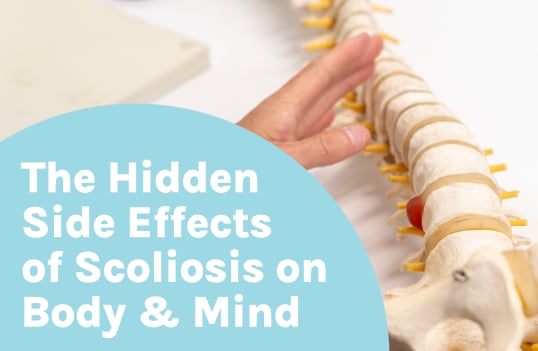
As scoliosis is progressive, its effects can increase over time, becoming more widespread. While many scoliosis effects are visual, less-obvious effects can also develop. It’s not just the spine that’s affected by scoliosis, but also its surrounding muscles and nerves. In addition, mental health can also be affected.
Scoliosis causes an unnatural lateral spinal curvature with rotation to develop, but its effects can extend beyond the spine. While the visual effects of scoliosis can include postural and mobility changes, particularly when severe, its hidden effects can include muscle, nerve, and organ involvement. Scoliosis also has the potential to affect mental health, particularly in adolescents.
Scoliosis can cause a number of visual effects, and when severe, it can also affect the function of muscles, nerves, and organs.
Visual Effects of Scoliosis
Scoliosis can affect all ages, but it’s most commonly diagnosed in children, and the most prevalent type of scoliosis overall is adolescent idiopathic scoliosis, diagnosed from the age of 10 and into young adulthood (1).
Adolescent idiopathic scoliosis commonly appears at the onset of puberty in females, and slightly later in boys (1).
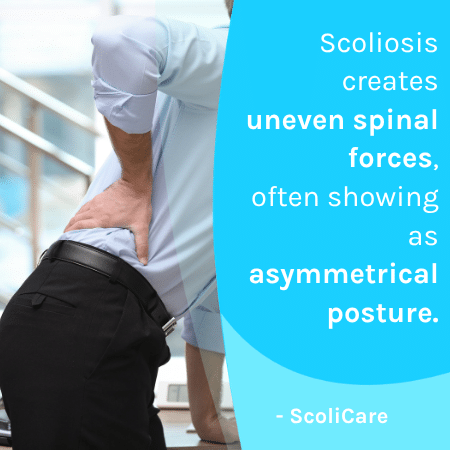
Because scoliosis causes the spine to bend and twist unnaturally, and spinal health facilitates healthy posture, the main visual effect of an unnatural spinal curve is asymmetrical posture.
Scoliosis introduces uneven forces to the spine and body, and its most noticeable visual effect is asymmetrical posture.
Postural Deviation
In many cases of childhood scoliosis, the earliest signs are uneven shoulders, uneven hips, and the development of an arch in the rib cage; while these changes can be subtle in mild cases, scoliosis ranges from mild to moderate and severe, and as progression occurs, effects can become more overt and disruptive (2, 3).
The more noticeably a patient’s posture is affected, the more likely unhealthy movement patterns become as it’s difficult for the body to counteract the spine’s unnatural bend and twist, and as posture and healthy movement patterns are linked, changes to gait, balance, and coordination are also common (1, 2).
Scoliosis is progressive, so its nature is to get worse over time, and scoliosis effects that started out as subtle can become overt quickly, particularly during periods of rapid growth (progression is triggered by growth) (3).
And while the condition’s uneven forces are disrupting the body’s overall symmetry and causing visual postural changes, what hidden effects may be occurring?
Scoliosis and Muscular Imbalance
As mentioned, the uneven forces of scoliosis don’t just affect the spine, but also its surrounding muscles.
It’s not just the spine that maintains its natural curves and alignment; it also relies on its surrounding muscles for support and stability, so they can also feel the effects of the spine’s unnatural curve and twist.
A less-obvious effect of scoliosis is the development of a muscular imbalance; this is common as the spine’s surrounding muscles are pulled in different directions (4).
The muscles on one side of the spine have to work harder to try and counteract the spine’s unnatural position and maintain balance and stability, while muscles on the opposite side can become weak from lack of use (4).
Postural and muscle asymmetry factors into how much a person’s mobility and gait are affected. Unhealthy posture can mean the body’s upper body weight isn’t evenly distributed over the lower body, and the development of unhealthy movement patterns are common (4).
A muscular imbalance can also cause pain as the muscles are being worked unevenly (4).
Scoliosis and Nerve Involvement
Scoliosis effects are shaped by a number of factors including patient age, scoliosis type, severity, location, and curve pattern.
Severe scoliosis often involves nerve involvement as the size and rotation of the spine’s unnatural curve is severe, and this can affect the nervous system (5).
As the brain and spinal cord work in tandem to form the central nervous system, spinal health can also affect the function of the spinal cord and/or where the nerves exit the spine and branch off to different areas of the body (5).
The degree of nerve involvement is largely determined by the severity of the curve, its rotation, and location; for example, a common side effect of lumbar scoliosis is sciatic nerve pain because the sciatic nerve starts in the lumbar spine (6).
While nerve involvement isn’t considered a primary symptom of scoliosis, it is associated with curve progression, and nerve pain is the most common symptom of adult scoliosis; scoliosis becomes compressive once skeletal maturity has been reached (6).
As the central nervous system is involved in multiple body systems, any disruption to spinal health that affects the spinal cord can cause hidden effects, and nerve-related pain can be difficult to diagnose because it can be felt far from its site of origin, anywhere along an affected nerve’s pathway.
Particularly in cases of thoracic scoliosis that develop in the largest spinal section, organ involvement can be another hidden effect.
Scoliosis and Organ Involvement
Organ involvement also isn’t considered a common effect of scoliosis, particularly in cases being treated proactively, but when severe, and/or if left untreated, scoliosis can cause related complications that involve important organs.
The thoracic spine is the largest spinal section and the only section attached to the rib cage, forming the thoracic cage.
The thoracic cage protects important organs such as the heart, lungs, and digestive organs. A common effect of thoracic scoliosis is the development of a rib cage arch, due to the spine’s unnatural curve and twist pulling on one side of the rib cage.
Lung Function
If the disruption to the position of the rib cage has changed the space available to the lungs, they may not be able to function optimally (7)
If the rib cage can’t expand fully, breathing issues can develop caused by restricted expansion of the rib cage, reduced lung volume, and restricted diaphragm movement (primary respiratory muscle) (7).
Cardiac Function
If the lungs are compressed, the heart can also be affected, potentially disrupting cardiac health and function.
Scoliosis can affect the heart by restricting its space, reducing cardiac output, altered blood flow, and hypertension (8).
Digestive System Function
Digestive organs can also be affected including the esophagus, stomach, small intestine, colon, and accessory organs (gall bladder, liver, pancreas) for similar reasons: loss of space to function optimally within (9).
So scoliosis can cause noticeable visual effects in terms of posture and movement changes, but there are also non-visual effects involving important organs that, although more common in severe and/or untreated cases, are associated with scoliosis.
And what about the mind?
Scoliosis and Mental Health
And what about the mind? Often, mental health effects aren’t given as much attention as visual and physical symptoms of scoliosis, but awareness is warranted, particularly considering the most common age group affected are the most vulnerable to body image concerns and social isolation: adolescents (10).
Typical teenage years are known for their formative power, but also their challenges, and a diagnosis of scoliosis can add another layer; adolescents can find it difficult to process the news of a progressive spinal condition that may change the way they look, walk, and feel.
Changes to body posture and gait can be the most concerning. Most adolescents don’t want to look or walk differently than their peers; they want to fit in (10).
Social media amplifies the pressure to have the perfect body and life, and the potential for negative self-image and social isolation are growing psychosocial issues (10).
In addition, moderate and severe scoliosis cases may come with activity restrictions, meaning an adolescent may not be able to continue participating in identify-shaping sports and/or once-loved activities: another challenge that can affect mental health.
While a diagnosis of adolescent scoliosis can be difficult to process, with proper treatment options, scoliosis can be highly treatable, and having an open dialogue with family members recently diagnosed is key (2).
Living with scoliosis can add challenges, but there have been amazing advancements in scoliosis-understanding and treatment options (2).
When speaking with an adolescent recently diagnosed, staying positive, but truthful and realistic, is paramount. Communicating the importance of proactive treatment is key; nothing is more motivating to a young patient than seeing positive treatment results.
Here at ScoliCare, the whole patient is treated, body and mind; each treatment plan is fully customized to address specifics of a patient’s body and scoliosis, including its visual and more-hidden effects.
Conclusion
Scoliosis can cause widespread effects, but it doesn’t always have to. When diagnosed early and treated proactively, scoliosis can be highly treatable, and many cases respond well to a nonsurgical treatment approach.
The most prevalent type of scoliosis overall is adolescent idiopathic scoliosis, diagnosed from the age of 10 into young adulthood.
Initial effects of adolescent scoliosis may be mild and subtle, but the potential effects of scoliosis can increase alongside curve progression.
It’s important for parents and young patients to understand that an initial diagnosis of mild scoliosis doesn’t indicate where its effects will stay, nor does it mean treatment is less urgent or necessary; in fact, addressing adolescent scoliosis while mild is the ideal time to start treatment.
Although there are no treatment guarantees, the milder scoliosis is at the onset of treatment, the more potential there is for treatment success.
Common visual effects of scoliosis include changes to posture and gait, and additional side effects can include muscle imbalance, nerve involvement and organ involvement (more common in severe cases), and mental health effects are most common in adolescents during progression.
Find Your Nearest Clinic
ScoliCare Clinics, affiliates and product providers are in over 200 locations around the world. Find your nearest ScoliCare location here.


References:
- Weinstein SL. The Natural History of Adolescent Idiopathic Scoliosis. J Pediatr Orthop. 2019 Jul;39(Issue 6, Supplement 1 Suppl 1):S44-S46. doi: 10.1097/BPO.0000000000001350. PMID: 31169647
- Negrini S, Grivas TB, Kotwicki T, Maruyama T, Rigo M, Weiss HR; Members of the Scientific society On Scoliosis Orthopaedic and Rehabilitation Treatment (SOSORT). Why do we treat adolescent idiopathic scoliosis? What we want to obtain and to avoid for our patients. SOSORT 2005 Consensus paper. Scoliosis. 2006 Apr 10;1:4. doi: 10.1186/1748-7161-1-4. PMID: 16759352; PMCID: PMC1475888
- Negrini, S., Donzelli, S., Aulisa, A. G., Czaprowski, D., Schreiber, S., de Mauroy, J. C., … & Zaina, F. (2018). 2016 SOSORT guidelines: orthopaedic and rehabilitation treatment of idiopathic scoliosis during growth. Scoliosis and spinal disorders, 13(1), 3
- Duncombe P, Dick T, Ng PTT, Izatt MT, Labrom RD, Tucker K. Beyond the Curve: The Muscle-Specific Asymmetries of Adolescent Idiopathic Scoliosis. JOR Spine. 2025 Nov 4;8(4):e70129. doi: 10.1002/jsp2.70129. PMID: 41194969; PMCID: PMC12585792
- Trobisch P, Suess O, Schwab F. Idiopathic scoliosis. Dtsch Arztebl Int. 2010 Dec;107(49):875-83; quiz 884. doi: 10.3238/arztebl.2010.0875. Epub 2010 Dec 10. PMID: 21191550; PMCID: PMC3011182.
- Zaina F, Marchese R, Donzelli S, Cordani C, Pulici C, McAviney J, Negrini S. Current Knowledge on the Different Characteristics of Back Pain in Adults with and without Scoliosis: A Systematic Review. J Clin Med. 2023 Aug 9;12(16):5182. doi: 10.3390/jcm12165182. PMID: 37629224; PMCID: PMC10455254.Menger RP, Sin AH.
- Koumbourlis AC. Scoliosis and the respiratory system. Paediatr Respir Rev. 2006 Jun;7(2):152-60. doi: 10.1016/j.prrv.2006.04.009. Epub 2006 Jun 2. PMID: 16765303.
- Xiao J, Li T, Wang Y, Zhao Z, Xie J, Zhou J. Effects of severe scoliosis on cardiac structure and function in resting patients: a retrospective study. J Orthop Surg Res. 2025 Jul 19;20(1):681. doi: 10.1186/s13018-025-06113-3. PMID: 40684229; PMCID: PMC12276671.
- Lee SB, Chae HW, Kwon JW, Sung S, Moon SH, Suk KS, Kim HS, Park SY, Lee BH. Association of Functional Gastrointestinal Disorders with Adolescent Idiopathic Scoliosis. Children (Basel). 2024 Jan 18;11(1):118. doi: 10.3390/children11010118. PMID: 38255431; PMCID: PMC10814149.
- Adolescent Idiopathic Scoliosis. [Updated 2023 Apr 3]. In: StatPearls [Internet]. Treasure Island (FL): StatPearls Publishing; 2025 Jan-. Available from: https://www.ncbi.nlm.nih.gov/books/NBK499908/
More news
-
 18 October 2021
What is the current evidence for bracing adolescents with idiopathic scoliosis (AIS)? Despite a somewhat controversial past of uncertainty, the evidence in support of bracing for AIS is increasing. One…
-
 10 March 2026
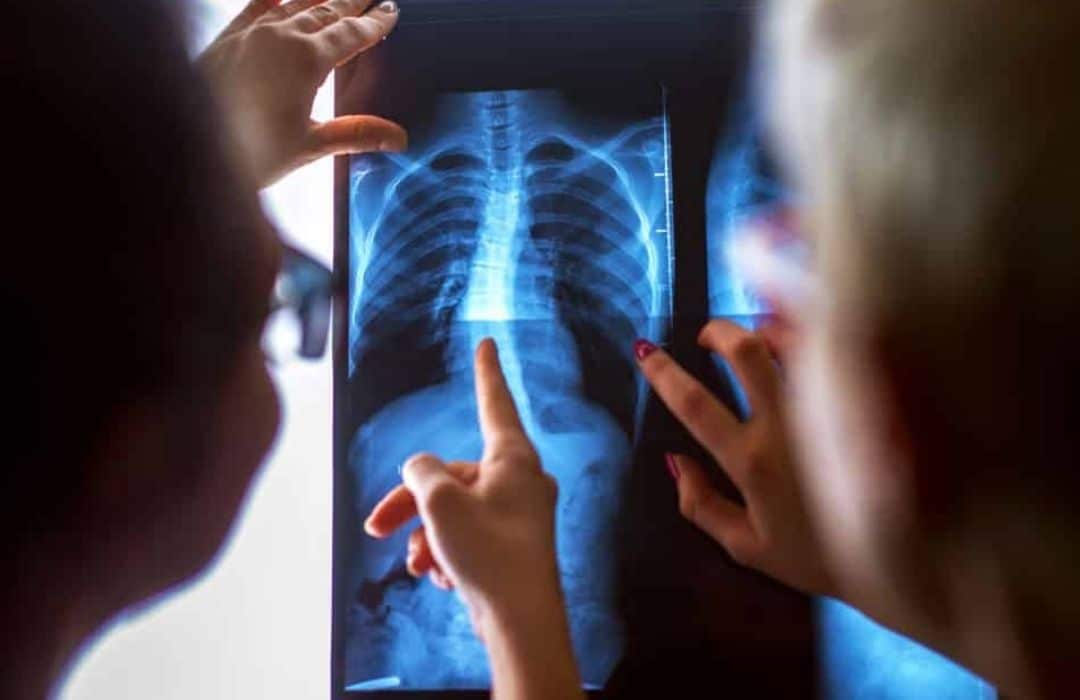
Scoliosis severity is measured by Cobb angle on X-ray—early, accurate assessment is key, as untreated curves can worsen and cause body-wide effects.
-
 14 March 2021
Kurt Cobain and his Scoliosis Part of our series of famous people who have/had a Scoliosis. Next up is Kurt Cobain! Kurt Cobain is best known as the lead…