
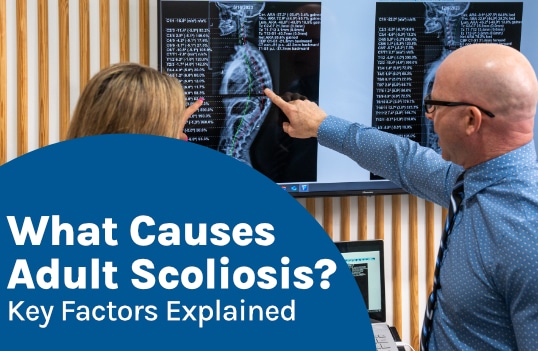
While childhood scoliosis is more commonly diagnosed, the rate of scoliosis increases among the aging population, and this is due to the development of degenerative scoliosis. As scoliosis progression is triggered by growth, it was once thought that progression stopped once skeletal maturity was reached, but years of observation have shown that adult scoliosis can also progress.
There is more than one type of adult scoliosis. Adolescent Scoliosis in Adults (ASA) develops earlier during adolescence with no known cause. Degenerative De-Novo scoliosis is caused by degenerative instability, and neuromuscular scoliosis in adults is caused by the presence of an underlying neurological or muscular condition.
Adult scoliosis causes are case-specific, ranging from cases that are pre-existing from adolescence to those caused by natural age-related spinal degeneration, or underlying conditions like muscular dystrophy.
Scoliosis in Adults
Scoliosis causes an unnatural lateral spinal curvature to develop, and a scoliotic spine doesn’t just curve to the side, but also rotates, making scoliosis 3-dimensional.
Scoliosis affects all ages, but is most often diagnosed during childhood, and because scoliosis is progressive, its nature is to increase in severity over time (1).
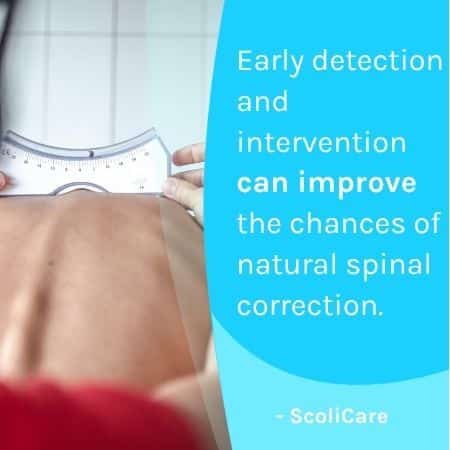
Scoliosis progression is triggered by growth and degenerative changes within the spine (2, 3).
A focus of childhood scoliosis is counteracting progression during periods of rapid growth (1), and while adults aren’t experiencing rapid and unpredictable growth spurts, once a spine is misaligned, it can become increasingly unstable and painful, particularly in older adults experiencing degenerative changes (2, 3).
Most people consider scoliosis to be a childhood condition, but the actual rate of scoliosis increases in older adults (45+), and an important difference between childhood scoliosis and adult scoliosis is pain (4); rates of progression is another key factor.
There are also different types of scoliosis to affect adults, so let’s start with the most common: Adolescent Scoliosis in Adults (ASA).
Adolescent Scoliosis in Adults
Adult scoliosis can be pre-existing or develop later in life.
As the most common type of scoliosis overall is adolescent idiopathic scoliosis, often diagnosed at the onset of puberty, this is also the most common type of scoliosis to affect adults (1, 2).
Idiopathic scoliosis is not clearly associated with a single-known cause, and this accounts for the majority of scoliosis cases.
Adolescent idiopathic scoliosis isn’t always easy to diagnose during adolescence; its earliest signs are postural changes such as uneven shoulders and hips, but these changes can be subtle, and adolescents aren’t exactly known for optimal posture (1).
Scoliosis ranges from mild to moderate and severe, and while there are a number of benefits associated with diagnosing and treating scoliosis while mild, early detection isn’t always easy to achieve, particularly in mild cases that aren’t painful.
There are multiple factors that shape how painful an individual’s scoliosis is, and compression is key. Compression is excessive and uneven pressure, and as scoliosis becomes compressive once growth has stopped, a patient’s level of pain can increase in adulthood (4, 5).
Adolescents are constantly growing, and the spine’s lengthening motion counteracts the compressive force of the unnatural spinal curve, but once skeletal maturity has been reached, muscle pain, back and nerve pain are common symptoms of scoliosis in adults that lead to assessment and diagnosis (4, 5).
So it’s not uncommon for an adult to be diagnosed with idiopathic scoliosis, despite its onset occurring years before during adolescence, and a key factor in an adult’s assessment is determining if the scoliosis is pre-existing, or it has developed in adulthood with no prior history (2).
Some cases of ASA are stable and some are progressive.
Degenerative De-Novo Scoliosis
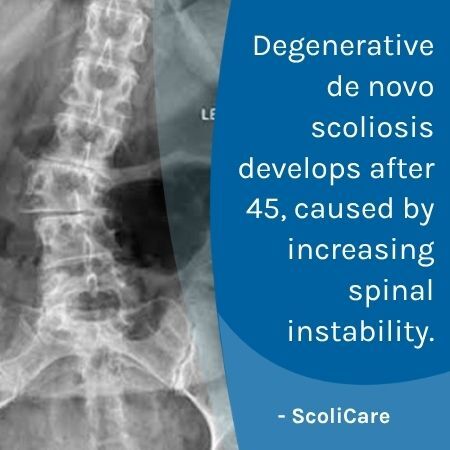
There are also cases of adult scoliosis that develop in later adulthood, commonly over 45 years of age, and these are caused by degenerative instability and diagnosed as degenerative de-novo scoliosis (3).
Because degenerative scoliosis develops later in life and involves degenerative changes within the spine, most cases are progressive and painful, with lower back pain a main complaint of patients (3, 4).
As scoliosis disrupts the spine’s alignment and balance, its stability is affected, and this puts older adults at risk of injury through a fall (3).
Degenerative scoliosis is more commonly diagnosed in females, and this may be due to changes in hormone levels and bone density related to menopause (3).
Degenerative Disc Disease
Most spinal degeneration starts in the discs that sit between adjacent vertebral bodies. The intervertebral discs facilitate spinal flexibility, its ability to evenly absorb and distribute mechanical stress, cushioning between vertebrae to prevent friction and wear, and provide the spine with structural support (6).
The health of the discs shape overall spinal health and function; disruptions to disc health can disrupt the spine’s biomechanics, causing uneven wear on the spine and its surroundings (6).
If a disc starts to degenerate, it can experience excessive fluid loss and change shape, affecting the position of adjacent vertebrae attached to the disc in between (6).
If the spine shifts out of alignment, it can become increasingly unstable over time, causing too much movement within the spine (3).
Osteoarthritis can also contribute to the development of degenerative scoliosis by weakening the vertebrae of the spine, making the spine vulnerable to injury and the development of an unnatural spinal curve (3).
While not as common, there is also neuromuscular scoliosis in adults that’s caused by the presence of a larger neuromuscular or muscular condition.
Neuromuscular Scoliosis in Adults
Neurological and muscular conditions such as muscular dystrophy, cerebral palsy, multiple sclerosis, and muscular atrophy can cause the development of neuromuscular scoliosis (NMS) as a related complication (7).
Unlike most cases of scoliosis, neuromuscular scoliosis has a clear cause: an underlying pre-existing neurological or muscular disorder disrupting communication between the brain, nerves, and muscles that support the spine and healthy posture (7).
NMS doesn’t just disrupt the spine’s healthy alignment, but also the spine’s surrounding muscle strength, mobility, overall balance, and quality of life (7).
In severe cases, patients can become wheelchair-bound, and leaving neuromuscular scoliosis untreated can lead to serious complications, including contributing to worsening of the curve and further loss of neuromuscular control.
While neuromuscular scoliosis is often diagnosed during adolescence, it can progress into adulthood and/or develop in adulthood, and these cases tend to be complex to treat because the underlying neurological or muscular condition has to be the focus of treatment.
Neuromuscular scoliosis patients can deal with pain, mobility challenges, disruptions to balance and quality of life (7).
Conclusion
Scoliosis is most commonly diagnosed during childhood, but it also affects adults.
The most common type of adult scoliosis is adolescent scoliosis in adults that involve cases of adolescent idiopathic scoliosis, with no known cause, developing years earlier and progressing into adulthood.
Degenerative scoliosis develops later in adulthood and is caused by degenerative instability capable of disrupting the spine’s alignment and balance.
Neuromuscular scoliosis cases tend to be severe; the scoliosis develops as a related complication of an underlying neurological or muscular condition disrupting communication between the brain, muscles, connective tissues, and nerves that support healthy posture and spinal alignment.
Regardless of the cause, adult scoliosis needs to be taken seriously and treated proactively. There are never treatment guarantees, but the sooner adult scoliosis is diagnosed and addressed, the more potential there is for nonsurgical treatment success through improving the spine’s balance and stability.
Find Your Nearest Clinic
ScoliCare Clinics, affiliates and product providers are in over 200 locations around the world. Find your nearest ScoliCare location here.


References:
- Weinstein SL. The Natural History of Adolescent Idiopathic Scoliosis. J Pediatr Orthop. 2019 Jul;39(Issue 6, Supplement 1 Suppl 1):S44-S46. doi: 10.1097/BPO.0000000000001350. PMID: 31169647
- Schwab FJ, Smith VA, Biserni M, Gamez L, Farcy JP, Pagala M. Adult scoliosis: a quantitative radiographic and clinical analysis. Spine (Phila Pa 1976). 2002 Feb 15;27(4):387-92. doi: 10.1097/00007632-200202150-00012. PMID: 11840105
- Kotwal S, Pumberger M, Hughes A, Girardi F. Degenerative scoliosis: a review. HSS J. 2011 Oct;7(3):257-64. doi: 10.1007/s11420-011-9204-5. Epub 2011 Jun 11. PMID: 23024623; PMCID: PMC3192887
- Zaina, F., Marchese, R., Donzelli, S., Cordani, C., Pulici, C., McAviney, J., & Negrini, S. (2023). Current knowledge on the different characteristics of back pain in adults with and without scoliosis: a systematic review. Journal of Clinical Medicine, 12(16), 5182
- Theroux, J., Stomski, N., Hodgetts, C. J., Ballard, A., Khadra, C., Le May, S., & Labelle, H. (2017). Prevalence of low back pain in adolescents with idiopathic scoliosis: a systematic review. Chiropractic & manual therapies, 25(1), 10
- Scarcia L, Pileggi M, Camilli A, Romi A, Bartolo A, Giubbolini F, Valente I, Garignano G, D’Argento F, Pedicelli A, Alexandre AM. Degenerative Disc Disease of the Spine: From Anatomy to Pathophysiology and Radiological Appearance, with Morphological and Functional Considerations. J Pers Med. 2022 Nov 1;12(11):1810. doi: 10.3390/jpm12111810. PMID: 36579533; PMCID: PMC9698646
- Allam AM, Schwabe AL. Neuromuscular scoliosis. PM R. 2013 Nov;5(11):957-63. doi: 10.1016/j.pmrj.2013.05.015. PMID: 24247014
More news
-
 17 July 2024
Receiving a scoliosis diagnosis as an adult can be daunting. Many people wonder how it happened, what the future holds, and whether it can be treated. Understanding scoliosis in adults…
-
 19 March 2025
Scoliosis in adults is often more complex than in adolescents, due to the interplay of spinal deformity with age-related changes in bone density, muscle strength, and overall balance. One concerning…
-
 24 February 2023
The short answer is yes, people with scoliosis can live normally. However, it is important to understand the condition and its impact on the individual's life. Scoliosis is a complex…