
Scoliosis causes the spine to develop an unnatural lateral spinal curvature that rotates, and while most people have heard of scoliosis, its prevalence may be surprising. Scoliosis is the leading spinal condition among school-aged children, but it also affects adults of all ages.
Current estimates have close to seven million people diagnosed with scoliosis in the United States alone, and the number of people living with undiagnosed scoliosis can’t be tracked. Approximately 2 to 3 percent of the population are affected by scoliosis; idiopathic scoliosis is the most common form.
It’s important to understand the prevalence of scoliosis, particularly among children, so its early signs aren’t missed.
Scoliosis Numbers
There are a number of spinal conditions/issues that cause a loss of its healthy curves, and as a progressive condition, diagnosing scoliosis early can mean early intervention (1).
There are never treatment guarantees, but as the nature of scoliosis is to increase in severity over time, when treatment is started can be a key factor in how a patient responds to treatment (1).
The Scoliosis Research Society has current estimates at between 6 and 9 million people (childhood and adult cases) currently living with scoliosis in the United States alone, and if the undiagnosed cases could also be tracked, that number could increase significantly (2).
The age group most commonly affected by scoliosis are adolescents, and most are diagnosed between 10 and 15 years of age, and while scoliosis ranges widely in severity from mild to moderate and severe cases, adolescent females are the most likely to experience progression into the severe classification (3).
In the States, 1 to 3 percent of adolescents are diagnosed with scoliosis, showing prevalence rates of 2 to 4 percent, and while adolescents are the most commonly diagnosed with scoliosis, the actual rate of scoliosis increases among the aging population (3, 4).
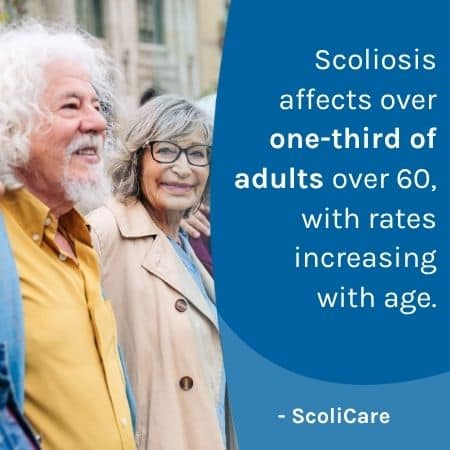
Estimates of 8 percent of adults over the age of 25 are affected, and rates increase as high as 68 percent over the age of 60 (4).
So let’s break down some characteristics of the most prevalent forms of scoliosis.
Idiopathic Scoliosis
When scoliosis is diagnosed, it’s further classified around a number of key patient/scoliosis variables, including patient age, scoliosis severity, curvature location, and the type of scoliosis.
The most prevalent type to affect all ages is idiopathic scoliosis (5), meaning no single-known cause, and the most prevalent type of scoliosis overall is adolescent idiopathic scoliosis, often diagnosed at the onset of puberty (4).
The majority of new scoliosis cases diagnosed each year in the United States involve idiopathic scoliosis.
Adolescent Idiopathic Scoliosis Numbers
Being diagnosed with adolescent idiopathic scoliosis at the onset of puberty is common, and while males and females are diagnosed at similar rates, progression into severe levels occurs more often in female adolescents (3).
In fact, it’s estimated that females are 8 to 10 times more likely to progress and require treatment; while some cases of scoliosis are stable and don’t progress, the majority are progressive, particularly when growth is occurring (3, 6).
The main trigger for scoliosis progression is growth: making how childhood scoliosis is managed during periods of rapid growth crucial (6).
While other factors such as curvature location and pattern influence a patient’s rate of progression, adolescents are the most at risk for rapid advancement due to the unpredictable nature of pubescent growth spurts (6).
It’s estimated that approximately 2 percent of adolescents between the ages of 10 and 16 have scoliosis in the United States, and of those 2 percent, 75 percent will be diagnosed with mild scoliosis, 15 percent with moderate scoliosis; 5 percent will develop severe scoliosis, and the last 5 percent will develop very-severe scoliosis (7).

Adolescents who are unaware they have scoliosis and don’t receive a diagnosis or treatment during adolescence can progress into adulthood, becoming what’s known as adolescent scoliosis in adult (ASA): the most prevalent type of scoliosis in adults (8).
Adult Scoliosis Numbers
Adult scoliosis can involve cases that are pre-existing (mainly from adolescence), or those that have developed later in life (8, 9).
In adults over the age of 60, it’s estimated that 35.5 percent will have scoliosis, and prevalence increases with age (4).
Adolescent scoliosis in adults is common because symptoms of adolescent idiopathic scoliosis can be subtle and difficult to recognize, particularly in cases of mild adolescent idiopathic scoliosis (8).
Another factor that affects early diagnosis is pain, and many cases of childhood scoliosis aren’t overly painful; scoliosis becomes compressive once skeletal maturity is reached (8).
While compression isn’t the only source of scoliosis pain (curvature location and pattern are also important), it is a primary cause of back and nerve pain; pain felt in the extremities is a common symptom that brings adults in for assessment, diagnosis, and treatment (8, 9).
So idiopathic scoliosis diagnosed in adults that’s determined to be pre-existing is the most common type to adult scoliosis, known as adolescent scoliosis in adult, and because these cases are pre-existing, it’s difficult to track numbers (8).
Although children are more often diagnosed, the actual rate of scoliosis in aging adults increases (4), and this is due to the next most-prevalent form of adult onset scoliosis: degenerative scoliosis (9).
Degenerative Scoliosis
Adults who develop scoliosis with no prior history later in adulthood involve cases of degenerative de-novo scoliosis (9).
Degenerative scoliosis is caused by degenerative instability in the spine, often due to degenerative disc disease and/or osteoporosis (9).
Degenerative scoliosis affects older adults over the age of 45 and is more common in females than males due, in part, to hormone and bone-density changes related to menopause (9).
Most degenerative scoliosis cases are progressive and painful, with lower back pain a common complaint (9).
In adults over the age of 60, it’s estimated that 35.5 have scoliosis and the rate increases with age (4).
Conclusion
So how many people have scoliosis? In the United States alone, current estimates have close to seven million people diagnosed with scoliosis, and 80 percent of these cases are classified as idiopathic, with the remaining 20 percent associated with known causes (neuromuscular scoliosis and congenital scoliosis).
Neuromuscular scoliosis accounts for approximately 5 to 10 percent of scoliosis cases in the United States, and congenital scoliosis is a rare form accounting for approximately 0.2 percent (10, 11).
Adolescent idiopathic scoliosis is the most common form of scoliosis, and current estimates are 2 percent of adolescents between the ages of 10 and 16 have scoliosis.
Adults of all ages are also diagnosed with scoliosis, and while the numbers of cases involving pre-existing idiopathic scoliosis in adults are difficult to track, estimates have close to 35.5 percent of adults over the age of 60 diagnosed with degenerative scoliosis.
What’s most important to understand about scoliosis numbers is that not everyone with scoliosis is represented in current estimates. Many people are currently living with scoliosis unaware, and while there are never treatment guarantees, early diagnosis and intervention are crucial factors in successful treatment outcomes.
In many cases of childhood scoliosis, the earliest signs include the development of asymmetrical posture, and in many cases of adult scoliosis, it’s pain that leads to diagnosis and treatment.
If there is a family history of scoliosis, regular screening for children is recommended.
Find Your Nearest Clinic
ScoliCare Clinics, affiliates and product providers are in over 200 locations around the world. Find your nearest ScoliCare location here.


References:
- Su YC, Feng CK, Yang TF. Assessment and Management of Adolescent Idiopathic Scoliosis: From the Perspective of a Physiatrist. Ann Rehabil Med. 2025 Oct;49(5):263-278. doi: 10.5535/arm.250097. Epub 2025 Oct 31. PMID: 41177149; PMCID: PMC12579992
- Dunn J, Henrikson NB, Morrison CC, et al. Screening for Adolescent Idiopathic Scoliosis: A Systematic Evidence Review for the U.S. Preventive Services Task Force [Internet]. Rockville (MD): Agency for Healthcare Research and Quality (US); 2018 Jan. (Evidence Synthesis, No. 156.) Chapter 1, Introduction. Available from: https://www.ncbi.nlm.nih.gov/books/NBK493369/
- Weinstein SL. The Natural History of Adolescent Idiopathic Scoliosis. J Pediatr Orthop. 2019 Jul;39(Issue 6, Supplement 1 Suppl 1):S44-S46. doi: 10.1097/BPO.0000000000001350. PMID: 31169647
- Schwab F, Dubey A, Gamez L, Benchikh El Fegoun A, Hwang K, Pagala M and Farcy J-P . Adult scoliosis: prevalence, SF-36, and nutritional parameters in an elderly volunteerpopulation. Spine (Phila Pa 1976). 2005 May 1;30(9):1082-5. doi: 10.1097/01.brs.0000160842.43482.cd
- Trobisch P, Suess O, Schwab F. Idiopathic scoliosis. Dtsch Arztebl Int. 2010 Dec;107(49):875-83; quiz 884. doi: 10.3238/arztebl.2010.0875. Epub 2010 Dec 10. PMID: 21191550; PMCID: PMC3011182
- Negrini, S., Donzelli, S., Aulisa, A. G., Czaprowski, D., Schreiber, S., de Mauroy, J. C., … & Zaina, F. (2018). 2016 SOSORT guidelines: orthopaedic and rehabilitation treatment of idiopathic scoliosis during growth. Scoliosis and spinal disorders, 13(1), 3
- InformedHealth.org [Internet]. Cologne, Germany: Institute for Quality and Efficiency in Health Care (IQWiG); 2006-. Overview: Scoliosis in teenagers. [Updated 2024 Mar 25]. Available from: https://www.ncbi.nlm.nih.gov/books/NBK608496/
- Ansari K, Singh M, McDermott JR, Gregorczyk JA, Balmaceno-Criss M, Daher M, McDonald CL, Diebo BG, Daniels AH. Adolescent idiopathic scoliosis in adulthood. EFORT Open Rev. 2024 Jul 1;9(7):676-684. doi: 10.1530/EOR-23-0162. PMID: 38949156; PMCID: PMC11297403
- Kotwal S, Pumberger M, Hughes A, Girardi F. Degenerative scoliosis: a review. HSS J. 2011 Oct;7(3):257-64. doi: 10.1007/s11420-011-9204-5. Epub 2011 Jun 11. PMID: 23024623; PMCID: PMC3192887
- Murphy RF, Mooney JF 3rd. Current concepts in neuromuscular scoliosis. Curr Rev Musculoskelet Med. 2019 Jun;12(2):220-227. doi: 10.1007/s12178-019-09552-8. PMID: 30941730; PMCID: PMC6542926
- 3Giampietro PF, Blank RD, Raggio CL, Merchant S, Jacobsen FS, Faciszewski T, Shukla SK, Greenlee AR, Reynolds C, Schowalter DB. Congenital and idiopathic scoliosis: clinical and genetic aspects. Clin Med Res. 2003 Apr;1(2):125-36. doi: 10.3121/cmr.1.2.125. PMID: 15931299; PMCID: PMC1069035
More news
-
 12 January 2022
Juvenile idiopathic scoliosis (JIS) needs careful attention and it is so important that these children are not ‘missed’. With much of the attention in the literature often falling to the…
-
 14 March 2021
Kurt Cobain and his Scoliosis Part of our series of famous people who have/had a Scoliosis. Next up is Kurt Cobain! Kurt Cobain is best known as the lead…
-
 1 November 2022
It is hard to believe that the fastest man on earth has scoliosis! Olympian Usain Bolt was born with scoliosis. His right leg is half an inch shorter than his…