
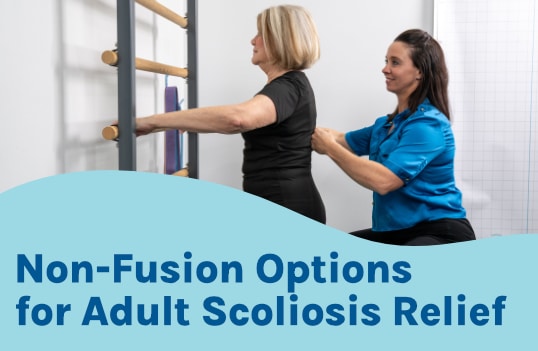
Not all cases of adult scoliosis develop in adulthood. The main type to affect adults is pre-existing, likely from adolescence, but doesn’t get diagnosed until after skeletal maturity is reached, and degenerative scoliosis affects older adults experiencing degenerative instability.
Traditional scoliosis treatment often involves spinal fusion surgery, but there are also nonsurgical treatment options for adult scoliosis, including custom bracing and scoliosis-specific exercise rehabilitation.
After skeletal maturity has been reached, the corrective potential of an adult patient’s scoliosis depends largely on the flexibility of the curve.
Types of Adult Scoliosis
Adult scoliosis affects a wide range of adults, and the main types to affect adults are pre-existing idiopathic scoliosis and degenerative scoliosis (1).
The prevalence of idiopathic scoliosis in adults highlights the importance of early detection and intervention.
An adult that’s diagnosed with scoliosis after reaching skeletal maturity may have developed the condition earlier; a common scenario is that adolescent idiopathic scoliosis goes unnoticed and untreated, progressing into adulthood and diagnosed as Adolescent Scoliosis in Adult (ASA) (2).
The most common type of scoliosis overall is adolescent idiopathic scoliosis, and as scoliosis can range from mild scoliosis to moderate and severe cases, not all patients experience noticeable symptoms that lead to assessment and diagnosis (2).
Scoliosis becomes compressive once growth has stopped, and compression is a main cause of scoliosis pain, so mild cases of adolescent idiopathic scoliosis that aren’t painful can go undetected for years (3).
Once growth stops, there is nowhere for the compressive force of the spine’s unnatural curve and rotation to go, causing back and nerve pain (3).
Some cases of ASA are stable, while others are progressive.
Pain in the extremities, due to nerve compression, is the main symptom of adult scoliosis that leads to assessment and diagnosis (3).
So an adult’s comprehensive assessment involves determining whether scoliosis is pre-existing, usually from adolescence, or if it has developed in adulthood with no prior history.
Degenerative Scoliosis
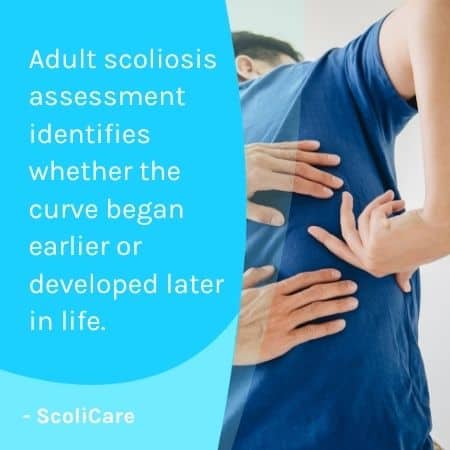
If an adult develops scoliosis fresh in adulthood with no prior history, this is known as Degenerative De-Novo Scoliosis and affects older adults, commonly over the age of 45 (4).
Degenerative scoliosis is caused by degenerative instability, so most cases are progressive and painful; lower back pain is the main complaint (4).
Degenerative instability puts older adults at risk of injury through a fall, so fall prevention is a focus of treatment.
When there is degenerative instability, there is too much movement within the spine, and most age-related spinal degeneration starts in the intervertebral discs (5).
An intervertebral disc sits between adjacent vertebrae and performs many important functions that shape overall spinal health.
The discs combine forces to facilitate the spine’s flexibility, act as the spine’s shock absorbers, provide cushioning between vertebrae to prevent friction during movement, and give the spine structural support.
If a disc starts to degenerate, it can involve desiccation and changes to the disc’s shape and position, and as adjacent vertebrae attach to the disc in between, this can also disrupt the position of nearby vertebrae, causing instability and misalignment in the area (5).
Degenerative disc disease is a contributing factor to the onset of a number of spinal conditions/issues, including degenerative scoliosis (5).
For adults recently diagnosed, treatment options can include surgical treatment or less-invasive nonsurgical options.
Nonsurgical Adult Scoliosis Treatment Options
Regardless of when a patient’s scoliosis initially developed, what’s most important is how a diagnosis is responded to with treatment.
There are different treatment approaches for patients to choose between, and while spinal fusion surgery is a traditional treatment option, additional nonsurgical options include scoliosis bracing and scoliosis-specific rehabilitative exercise programs (6, 7).
The typical path of treatment for adults with scoliosis experiencing pain is medication, back-strengthening exercise, and surgical treatment; however, these options aren’t addressing the underlying cause of pain, and are more so addressing pain as a symptom.
Individualized nonsurgical treatment plans offer long-term pain relief benefits because the goal of treatment is to improve the spine’s balance and stability: the underlying cause of back and nerve pain.
Because adults have stopped growing, there are limitations to scoliosis correction; a spine that’s no longer growing is more rigid and less responsive to treatment. While a primary goal of treating childhood scoliosis is significant curvature reductions, these are harder to achieve in adults, so treatment goals shift to improving the spine’s position, support, and stability to the point where pain is improved.
Restoring the spine’s balance means less pressure on the spine and its surrounding muscles and nerves, and it also helps with fall prevention.
ScoliBalance®
In some cases of adult scoliosis, a rehabilitative scoliosis-specific exercise program can help with pain relief and improve the spine’s balance and stability (7).
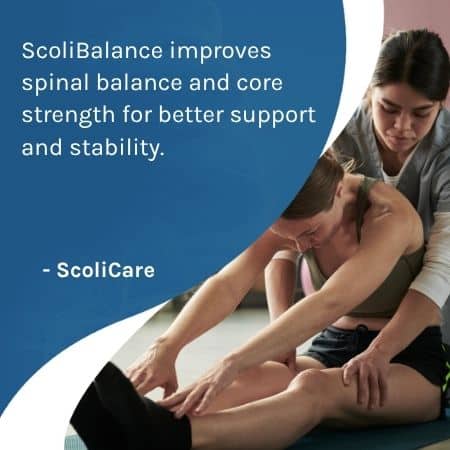
ScoliBalance® is a highly-specialized and customized scoliosis-specific rehabilitative exercise program that works towards improving the spine’s balance and core muscle strength for improved support and stability.
Individualization is at the heart of ScoliBalance® treatment plans; each plan is designed to address the specifics of a patient’s scoliosis, posture, degree of spinal flexibility, and treatment goals.
Pain management is important for quality of life, so this is a common goal of treatment for any patients experiencing pain. Scoliosis pain can involve the back muscles, spinal structures, and nerves, leading to radiating pain (3).
In cases with increasing degenerative instability, an adult scoliosis brace may be recommended.
Adult Scoliosis Bracing
A custom 3-dimensional scoliosis brace is a common nonsurgical treatment option that when designed to address adult scoliosis, may offer pain relief, increased spinal support, and postural improvement (6).
A scoliosis brace can further improve quality of life for adult patients. Wearing prescriptions are case-specific, but recommendations for part-time wear is common.
Many older adults living with degenerative scoliosis struggle with lower back and leg pain, and this can be due to too much movement within the spine (lateral listhesis) as vertebrae slip to the side and rotate (3, 4).
Wearing a scoliosis brace can provide much-needed stability by holding the spine in a straight and neutral position, which impacts pain caused by instability (6).
For younger ASA patients, cosmetic and postural improvement are common goals of adult scoliosis bracing treatment.
Scoliosis Surgery for Adults
Surgical recommendations for adults can involve cases that aren’t responsive to nonsurgical treatment options and require a more-invasive approach.
When adult scoliosis is severe, progressing quickly, and is disrupting quality of life, surgical treatment can also be recommended.
Spinal fusion is risky for all ages, but older adults experiencing spinal degeneration are prone to osteoporosis that weakens the spine’s vertebrae; attaching screws and rods to a weak spine can be complex and challenging (8).
While surgical treatment often isn’t as effective at pain relief, because it’s not actually improving the spine’s natural balance, but is instead holding it in place, in some cases where nonsurgical treatment has been unsuccessful, spinal fusion surgery is the only remaining recourse (8).
Conclusion
When it comes to treating adult scoliosis, while there are no treatment guarantees, early detection and intervention are key factors in treatment success.
In many cases of pre-existing adolescent scoliosis (ASA), the scoliosis has progressed significantly and the condition’s effects are well-established, but had the scoliosis been detected and addressed in adolescence, there is more potential for nonsurgical treatment success.
As most cases of degenerative de-novo scoliosis are progressive and painful, fall prevention and improving the spine’s balance and stability is key for long-term sustainable pain management,
While it’s ideal to diagnose and treat scoliosis while still mild, regardless of severity or patient age, the best time to start treatment is always now; even in the most severe of cases, improvements can be worked towards with potential to improve quality of life.
Find Your Nearest Clinic
ScoliCare Clinics, affiliates and product providers are in over 200 locations around the world. Find your nearest ScoliCare location here.


References:
- Aebi M. The adult scoliosis. Eur Spine J. 2005 Dec;14(10):925-48. doi: 10.1007/s00586-005-1053-9. Epub 2005 Nov 18. PMID: 16328223
- Weinstein SL. The Natural History of Adolescent Idiopathic Scoliosis. J Pediatr Orthop. 2019 Jul;39(Issue 6, Supplement 1 Suppl 1):S44-S46. doi: 10.1097/BPO.0000000000001350. PMID: 31169647
- Zaina, F., Marchese, R., Donzelli, S., Cordani, C., Pulici, C., McAviney, J., & Negrini, S. (2023). Current knowledge on the different characteristics of back pain in adults with and without scoliosis: a systematic review. Journal of Clinical Medicine, 12(16), 5182
- York PJ, Kim HJ. Degenerative Scoliosis. Curr Rev Musculoskelet Med. 2017 Dec;10(4):547-558. doi: 10.1007/s12178-017-9445-0. PMID: 28980155; PMCID: PMC5685967
- Scarcia L, Pileggi M, Camilli A, Romi A, Bartolo A, Giubbolini F, Valente I, Garignano G, D’Argento F, Pedicelli A, Alexandre AM. Degenerative Disc Disease of the Spine: From Anatomy to Pathophysiology and Radiological Appearance, with Morphological and Functional Considerations. J Pers Med. 2022 Nov 1;12(11):1810. doi: 10.3390/jpm12111810. PMID: 36579533; PMCID: PMC9698646
- Weiss HR, Moramarco K, Moramarco M. Scoliosis bracing and exercise for pain management in adults-a case report. J Phys Ther Sci. 2016 Aug;28(8):2404-7. doi: 10.1589/jpts.28.2404. Epub 2016 Aug 31. PMID: 27630444; PMCID: PMC5011608
- Negrini A, Negrini MG, Donzelli S, Romano M, Zaina F, Negrini S. Scoliosis-Specific exercises can reduce the progression of severe curves in adult idiopathic scoliosis: a long-term cohort study. Scoliosis. 2015 Jul 11;10:20. doi: 10.1186/s13013-015-0044-9. PMID: 26279670; PMCID: PMC4537533
- Weiss HR, Goodall D. Rate of complications in scoliosis surgery – a systematic review of the Pub Med literature. Scoliosis. 2008 Aug 5;3:9. doi: 10.1186/1748-7161-3-9. PMID: 18681956; PMCID: PMC2525632
More news
-
 17 October 2025
Scoliosis can affect adults too—whether ongoing or new, it’s often painful. Treatment focuses on fall prevention and restoring spinal balance.
-
 10 March 2026
Scoliosis severity is measured by Cobb angle on X-ray—early, accurate assessment is key, as untreated curves can worsen and cause body-wide effects.
-
 25 July 2025
Scoliosis can be highly responsive to treatment, particularly when conditions are diagnosed and treated early. The different types of scoliosis can have distinct treatment needs, and patients need to decide…