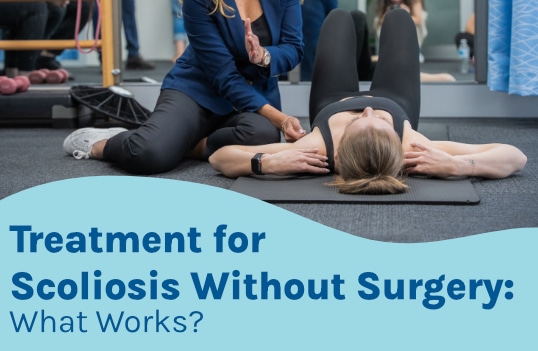
Evidence-based nonsurgical scoliosis treatment includes scoliosis-specific rehabilitative exercise, corrective bracing, and the potential of Chiropractic BioPhysics® as an adjunctive treatment. Particularly with early diagnosis and intervention, there are fewer limitations to nonsurgical scoliosis treatment.
Nonsurgical treatment for scoliosis that works is proactive, innovative, and integrative.
Scoliosis
Most cases of scoliosis are idiopathic, with no known cause, and while fully understanding the etiology of scoliosis would be beneficial, what’s more important is knowing how to treat scoliosis effectively once it’s developed (1).
Scoliosis largely affects the spine and its immediate surroundings, but particularly if scoliosis becomes severe, its effects can be widespread.
Although scoliosis is progressive, it can be highly responsive to treatment, and while there are never treatment guarantees, because progression makes scoliosis more complex to treat, the sooner treatment is started, the better.
Childhood scoliosis, in particular, needs to be managed proactively during periods of rapid growth to prevent complications in adulthood and positively impact quality of life (1).
There are two main approaches to treating scoliosis: surgical and nonsurgical.
Scoliosis Surgery
Surgical scoliosis treatment involves a type of spinal fusion, and like all surgical procedures, there are risks involved.
Spinal fusion has the goal of preventing scoliosis from progressing and does so by fusing the vertebrae at the apex of the unnatural spinal curve into one solid bone, and metal rods are attached to the spine with pedicle screws to maintain its straight alignment.
While successful spinal fusion surgery can straighten a scoliotic spine, there are no guarantees progression will stop, and there are a number of potential effects and complications to consider: a noticeable loss of spinal flexibility and range of motion, spinal rigidity causing more back pain, a fused spine is weaker and more vulnerable to injury, hardware malfunction, and disappointing cosmetic results (2).
Considering the many important roles of the spine in maintaining healthy posture, movement patterns, and central nervous system health, spinal surgery is invasive and can affect the spine’s long-term health.
Surgical intervention may be necessary in severe and/or atypical cases, or in cases that are progressing rapidly and haven’t responded to less-invasive nonsurgical treatment options, but particularly with early diagnosis and intervention, nonsurgical treatment can be highly effective (3).
Nonsurgical Scoliosis Treatment
A characteristic of nonsurgical scoliosis treatment is its proactive approach. Scoliosis is progressive, so most cases are going to become more severe over time, and growth is the main trigger for progression (4).
So even cases initially diagnosed as mild can become moderate, severe, or very severe, and if rapid growth spurts are occurring, curve progression can happen quickly (4).
A traditional surgical approach to scoliosis treatment will often recommend observation for mild cases, but observing scoliosis, particularly childhood cases involving growth, can be risky as a growth spurt can trigger rapid progression (4).
A primary goal of nonsurgical scoliosis treatment is to proactively work towards preventing progression. As progression occurs, spinal rigidity increases, along with the potential effects of scoliosis, making it more complex to treat (4).
Nonsurgical treatment is proactive and is started immediately following a diagnosis because curves are at their mildest and spines are going to be more flexible and responsive to treatment (4).
A diagnosis of mild scoliosis doesn’t indicate a lack of urgency, nor does it indicate that’s where the scoliosis will stay; as the vast majority of scoliosis cases are progressive, observing for progression, rather than immediately working towards preventing it, can waste valuable treatment time.
In fact, the best time to start treating scoliosis is while mild, but the benefits of early detection are only available to those whose treatment response values the potential of proactive nonsurgical treatment options (4, 5).
Nonsurgical Treatment Options
Scoliosis is a complex condition that requires a customized approach. No two cases are the same; cases of scoliosis differ in terms of severity, type, location, and rates of progression.
Nonsurgical treatment starts with a comprehensive initial assessment that determines a patient’s treatment needs and informs the complete customization of treatment plans.
Although scoliosis surgery was the dominant treatment choice for a number of years, nonsurgical treatment is a less-invasive treatment approach that combines the potential of multiple treatment modalities (6).
ScoliCare are world leaders in scoliosis care and can offer patients advanced and evidence-based nonsurgical treatment options including scoliosis-specific rehabilitative exercise plans, 3-dimensional corrective bracing, and Chiropractic BioPhysics® as an adjunctive treatment (6, 7).
ScoliBalance®
ScoliBalance® is an individualized scoliosis-specific rehabilitative exercise program that’s designed around a patient’s specific curve type, posture, symptoms, and treatment goals (6).
ScoliBalance® is delivered in accordance with the principles of SEAS (Scientific Exercise Approach to Scoliosis) and the Schroth method (6).
For long-term sustainable treatment results, patients need to be educated on the importance of postural and spinal alignment.
Largely through the use of Mirror Image® exercise, patients are taught postural awareness and how to hold their body and spine during movement (6). Postural awareness is needed to maintain treatment results and hold the spine in the straightest alignment possible (6).
Scoliosis-specific rehabilitative exercise also targets the spine’s surrounding muscle strength and balance for more support/stability for the spine (6).
Specific rehabilitative exercises are taught in-clinic to hold corrections, and when patients are confident and capable, they can continue these exercises at home to sustain treatment results over the long term (6).
As patients integrate corrections into their daily lives and activities, the body is being subconsciously retrained to hold the corrections through healthier body positioning, posture, and movement patterns (6).
The power of scoliosis-specific rehabilitative exercise to reduce and/or stabilize the curve is further supported by implementing Chiropractic BioPhysics® as an adjunctive treatment; CBP works towards improving the spine’s position through precise manual adjustments and a variety of evidence-based chiropractic techniques (6, 7).
To be clear, general chiropactic or physical therapy can’t replace industry-accepted and evidence-based methods such as scoliosis-specific rehabilitative exercise and corrective bracing. The focus of nonsurgical scoliosis management is the potential of ScoliBalance® and ScoliBrace®, while CBP supplements these approaches (7).
Because the principles of ScoliBalance® complement the approach of 3-dimensional corrective bracing, when combined, nonsurgical treatment has more corrective potential (6).
ScoliBrace®
ScoliBrace® is a modern and advanced scoliosis brace that’s customized and evidence-based; it addresses a patient’s specific scoliosis type, severity, and posture (6).
Through the use of an overcorrective approach to improving the spine’s alignment and balance, it uses spinal coupling to hold the spine in a straight and neutral alignment, and as the spine’s position is improved while wearing the brace, the brain and body are being retrained to maintain the spine’s position when not wearing the brace (6).
Through principles of spinal coupling, overcorrection, and Mirror Image®, particularly for adolescent idiopathic scoliosis patients, the fundamentals of ScoliBrace®, ScoliBalance®, and CBP are working towards the same goal of improving the spine’s position and 3-dimensional postural alignment (6, 7).
While more-traditional scoliosis braces immobilize the spine, ScoliBrace® was designed to work with movement, which is why it complements the principles of ScoliBalance®, offers better functional results, and can be integrated into a multifaceted treatment plan (6).
ScoliCare Clinicians are trained and certified in ScoliBalance®, CBP, and ScoliBrace® so a comprehensive treatment plan can be designed and implemented.
Through the different treatment modalities working together, there is more potential to improve the spine’s strength, flexibility, and function, and this helps many patients avoid the invasiveness of surgical treatments.
Conclusion
While scoliosis surgery maintains its prevalence as a scoliosis treatment option, it can disrupt the spine’s natural movement and function, and while not all patients will develop complications, the risk is there so should be weighed carefully against the potential risks of a less-invasive nonsurgical treatment approach.
Nonsurgical scoliosis treatment is proactive, so a goal is to diagnose and treat scoliosis early in the best interest of the patient: preventing progression means also preventing increasing symptoms and the need for invasive surgical treatment.
When it comes to preserving spinal health and function, nonsurgical treatments complement the spine’s natural movement-based design, while spinal fusion immobilizes the fused portion.
A common effect of spinal fusion surgery is less flexibility and a reduced range of motion in the spine, and this can further disrupt quality of life by causing increased pain. If spinal fusion is unsuccessful, the only recourse is revision surgery, and the risk of complications increases with each surgical procedure.
A fused spine is also weaker and more vulnerable to injury.
Nonsurgical scoliosis treatment isn’t associated with disruptions to spinal flexibility or strength, and has the potential to preserve the spine’s natural range of motion, alignment, function, and strength.
Find Your Nearest Clinic
ScoliCare Clinics, affiliates and product providers are in over 200 locations around the world. Find your nearest ScoliCare location here.

References:
- Negrini S, Grivas TB, Kotwicki T, Maruyama T, Rigo M, Weiss HR; Members of the Scientific society On Scoliosis Orthopaedic and Rehabilitation Treatment (SOSORT). Why do we treat adolescent idiopathic scoliosis? What we want to obtain and to avoid for our patients. SOSORT 2005 Consensus paper. Scoliosis. 2006 Apr 10;1:4. doi: 10.1186/1748-7161-1-4. PMID: 16759352; PMCID: PMC1475888
- Fan H, Wang Q, Huang Z, Sui W, Yang J, Deng Y, Yang J. Comparison of Functional Outcome and Quality of Life in Patients With Idiopathic Scoliosis Treated by Spinal Fusion. Medicine (Baltimore). 2016 May;95(19):e3289. doi: 10.1097/MD.0000000000003289. PMID: 27175629; PMCID: PMC4902471
- Cuschieri S, Grech S. Public Health Awareness & Early Detection of Adolescent Idiopathic Scoliosis in Med Students. Eur J Public Health. 2025 Oct 27;35(Suppl 4):ckaf161.1172. doi: 10.1093/eurpub/ckaf161.1172. PMCID: PMC12555581
- Negrini, S., Donzelli, S., Aulisa, A. G., Czaprowski, D., Schreiber, S., de Mauroy, J. C., … & Zaina, F. (2018). 2016 SOSORT guidelines: orthopaedic and rehabilitation treatment of idiopathic scoliosis during growth. Scoliosis and spinal disorders, 13(1), 3
- Wong HK, Tan KJ. The natural history of adolescent idiopathic scoliosis. Indian J Orthop. 2010 Jan;44(1):9-13. doi: 10.4103/0019-5413.58601. PMID: 20165671; PMCID: PMC2822427
- Marchese R, Du Plessis J, Pooke T, McAviney J. The Improvement of Trunk Muscle Endurance in Adolescents with Idiopathic Scoliosis Treated with ScoliBrace® and the ScoliBalance® Exercise Approach. J Clin Med. 2024 Jan 23;13(3):653. doi: 10.3390/jcm13030653. PMID: 38337346; PMCID: PMC10856658
- Haggard, J. S., Haggard, J. B., Oakley, P. A., & Harrison, D. E. (2017). Reduction of progressive thoracolumbar adolescent idiopathic scoliosis by Chiropractic BioPhysics®(CBP) Mirror Image® methods following failed traditional chiropractic treatment: a case report. Journal of Physical Therapy Science
More news
-
 15 July 2024
In recent years, patient-centred care has revolutionised the approach to scoliosis treatment by focusing on the unique needs, preferences and values of each patient. This approach places patients at the…
-
 8 August 2024
Receiving a scoliosis diagnosis often brings a flood of questions and concerns about the future. How did this happen? What are the scoliosis treatment options? Is scoliosis surgery necessary? Navigating…
-
 22 July 2026
Teen scoliosis responds best to early, proactive care. Modern nonsurgical treatment offers a personalized alternative to spinal fusion for many patients.