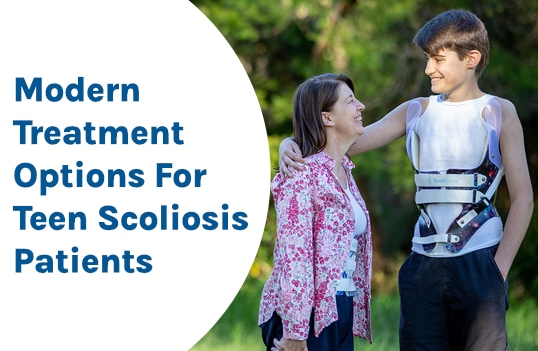
Modern treatment options for teen scoliosis patients include traditional spinal fusion surgery or conservative nonsurgical treatment. Here at ScoliCare, patients benefit from a proactive and modern nonsurgical approach that offers a less-invasive alternative to spinal surgery.
Scoliosis affects all ages, but the most-common type is adolescent idiopathic scoliosis. Modern nonsurgical treatment options are integrative, proactive, and customized. As a progressive condition triggered by growth, how teen scoliosis is managed during periods of rapid growth is key.
There are never treatment guarantees, but if a diagnosis of mild scoliosis is met with a proactive treatment response, there is more potential for treatment success.
Adolescent Idiopathic Scoliosis
Scoliosis affects all ages, but is most commonly diagnosed as adolescent idiopathic scoliosis between the age of 10 and reaching young adulthood (1).
Scoliosis causes the spine to curve unnaturally to the side and rotate, making it a complex 3-dimensional spinal condition.
Because scoliosis is progressive, its nature is to increase in severity over time, and while we don’t know what triggers the initial onset of adolescent idiopathic scoliosis, we know growth triggers progression, which is why early detection of childhood scoliosis, in particular, is so beneficial (1, 2).
The more growth potential a patient has, the more potential progression there is, and progression makes scoliosis more severe and complex to treat (2).
Adolescents are the most at risk for rapid progression due to the stage of growth they are in, characterized by rapid and unpredictable growth spurts (1, 2).
Adolescent scoliosis is more common in females and is typically detected at the onset of puberty, around 11 or 12 years of age, and it develops slightly later in males (1).
What’s most important for parents to understand is that early detection and managing scoliosis proactively during growth is key, but early detection isn’t always easy to achieve; this is where awareness and regular screening comes in (2).
So let’s talk about scoliosis risk factors and the importance of regular screening.
Scoliosis Screening and Early Detection
Not only do parents need to know what early indicators of scoliosis look like, it’s also important to understand the importance of regular scoliosis screening, particularly when there are risk factors in place (3).
Risk factors are variables that increase the likelihood of a diagnosis, and when it comes to scoliosis, these are age, gender, and family history (4, 5).
Additional risk factors in adolescents include the size and type of curve; the larger curves and single thoracic curves are at higher risk of progression, and larger curves (beyond 50 degrees) may require a more aggressive approach and sometimes need surgery (6).
Having one or more risk factors in place doesn’t guarantee a scoliosis diagnosis, but it does increase the likelihood, and considering the potential benefits of early detection, it does warrant regular screening.
Forward Bend Test
Scoliosis screening examinations are sometimes conducted in schools, but this isn’t always the case; the most common type of scoliosis screening examination is known as the Adam’s forward bend test (7).
Having a patient bend forward exposes the spine and trunk, and any related asymmetries are most visible in this position (7).
A screening examination also involves taking the patient’s medical history, family history, and a comprehensive posture, strength, and mobility assessment; we can tell a lot about a patient’s spinal health by their posture and gait.
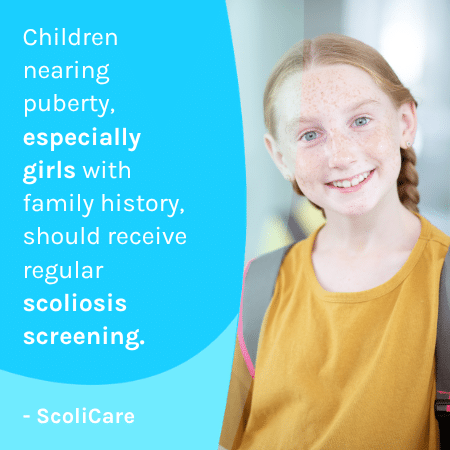
Children approaching puberty are the most likely to show signs of scoliosis, and as it’s more common in females, females approaching adolescence with a family history should be recommended for regular screening.
Having another family member diagnosed is considered a risk factor, not because a specific scoliosis gene, or genetic mutation, has been identified, but because families share more than just genes (5).
Families share socioeconomic factors, geography, body type, diet, lifestyle, posture, and more; idiopathic scoliosis isn’t associated with a single-known cause, but it is considered to be multifactorial.
There are never treatment guarantees, but there is more potential for correction when scoliosis is diagnosed and addressed prior to the first significant pubescent growth spurt triggering rapid progression (1, 2).
Early Signs of Adolescent Idiopathic Scoliosis
So what is a forward bend test looking for exactly? Parents and/or caregivers should be aware of the earliest signs of scoliosis in children because their subtlety can be a barrier to early detection.
The main symptoms of childhood scoliosis involve postural changes, and the earliest signs are often uneven shoulders and hips (1).
Scoliosis introduces uneven forces that can disrupt the body’s overall symmetry and balance.
In addition to uneven shoulders and hips, uneven shoulder blades, an arch in the rib cage, and arms and legs hanging at different lengths can develop.
Clothing suddenly seeming ill-fitting can also be an indicator of asymmetrical postural changes; watch for necklines favoring one side and arms and legs hanging unevenly.
The more posture is affected, the more unhealthy movement patterns tend to develop. Changes to gait, balance, coordination, and proprioception are also common (1).
Although we don’t know what triggers adolescent idiopathic scoliosis to develop initially, we know how to respond with treatment and understand the potential of early diagnosis and intervention (1, 2).
Diagnosing scoliosis while mild means the curve is small, flexible, and may be highly responsive, so now that we’ve covered the basics of adolescent idiopathic scoliosis and the importance of early detection and intervention, let’s explore the different facets of a modern nonsurgical treatment approach.
Adolescent Idiopathic Scoliosis Treatment
So for adolescents recently diagnosed with scoliosis, what should the next step be?
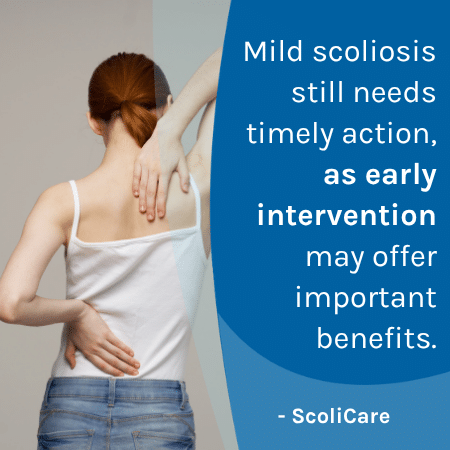
Remember, even a diagnosis of mild scoliosis doesn’t mean there is more time to decide on a course of treatment, or that it’s less likely to progress; what it does mean is that early intervention, and its related benefits, may be within reach (2).
When a diagnosis of mild scoliosis is followed with a proactive treatment plan, the goal is working towards preventing progression, increasing effects, and the need for invasive surgical intervention.
The goal of a proactive and customized nonsurgical treatment plan is to improve the spine’s position to restore alignment, balance, and stability to the spine and body.
When effective treatment options are combined and apportioned accordingly, the scope of nonsurgical treatment widens, and this may involve scoliosis-specific chiropractic care, as an adjunctive treatment, integrated into a comprehensive scoliosis-specific rehabilitation program (8).
Designed by chiropractor, Dr. Jeb McAviney, and physical therapist, Rose Mirenzi, ScoliBalance® combines the best of what scoliosis-specific chiropractic care and established scoliosis-specific exercise-based treatment programs like the Schroth Method and the Scientific Exercise Approach to Scoliosis (SEAS) has to offer (9).
While scoliosis-specific rehabilitation programs have a lot of corrective potential, most adolescent idiopathic scoliosis patients can benefit from the addition of corrective bracing to further improve the spine’s position (9).
The ScoliBrace® is a custom 3-dimensional scoliosis brace that’s evidence-based and customized to address the specifics of a patient’s posture, scoliosis type, and severity (9).
The ScoliBrace® individualizes potential corrective results through the use of an overcorrective approach to improve spinal alignment and balance through spinal coupling, and as the spine is held in an overcorrective position in the brace, the brain and body are being retrained together to maintain this position out of the brace (9).
With these different facets of treatment working together, the spine’s flexibility and strength can be preserved, scoliosis can be impacted on multiple levels, and surgical intervention may be avoided.
Conclusion
The most important thing for parents of teenagers to understand is the necessity of regular scoliosis screening, particularly when risk factors are present, and the potential benefits of early detection and intervention.
While there are no treatment guarantees, many cases of adolescent idiopathic scoliosis can be highly treatable, and the sooner scoliosis is diagnosed and addressed, the more potential there is for a successful nonsurgical treatment outcome.
A key factor, when customizing adolescent idiopathic scoliosis treatment plans, is the skeletal maturity of the patient; adolescents grow at different rates, and the more growth potential remaining indicates the amount of progression a patient may face.
Scoliosis progressing means the size of the spine’s unnatural curve and rotation is increasing, making the spine more rigid, less responsive to treatment, and the condition’s effects more established and difficult to improve and/or reverse.
Curve progression may be preventable, particularly when diagnosed and treated early in its progressive line, and knowing the early signs of scoliosis to watch for can put teenagers on the path of early detection, intervention, and treatment success.
Find Your Nearest Clinic
ScoliCare Clinics, affiliates and product providers are in over 200 locations around the world. Find your nearest ScoliCare location here.

References:
- Weinstein SL. The Natural History of Adolescent Idiopathic Scoliosis. J Pediatr Orthop. 2019 Jul;39(Issue 6, Supplement 1 Suppl 1):S44-S46. doi: 10.1097/BPO.0000000000001350. PMID: 31169647
- Negrini, S., Donzelli, S., Aulisa, A. G., Czaprowski, D., Schreiber, S., de Mauroy, J. C., … & Zaina, F. (2018). 2016 SOSORT guidelines: orthopaedic and rehabilitation treatment of idiopathic scoliosis during growth. Scoliosis and spinal disorders, 13(1), 3
- Cuschieri S, Grech S. Public Health Awareness & Early Detection of Adolescent Idiopathic Scoliosis in Med Students. Eur J Public Health. 2025 Oct 27;35(Suppl 4):ckaf161.1172. doi: 10.1093/eurpub/ckaf161.1172. PMCID: PMC12555581
- Ansari K, Singh M, McDermott JR, Gregorczyk JA, Balmaceno-Criss M, Daher M, McDonald CL, Diebo BG, Daniels AH. Adolescent idiopathic scoliosis in adulthood. EFORT Open Rev. 2024 Jul 1;9(7):676-684. doi: 10.1530/EOR-23-0162. PMID: 38949156; PMCID: PMC11297403
- Konieczny MR, Senyurt H, Krauspe R. Epidemiology of adolescent idiopathic scoliosis. Journal of Children’s Orthopaedics. 2013;7(1):3-9
- Lenz M, Oikonomidis S, Harland A, Fürnstahl P, Farshad M, Bredow J, Eysel P, Scheyerer MJ. Scoliosis and Prognosis-a systematic review regarding patient-specific and radiological predictive factors for curve progression. Eur Spine J. 2021 Jul;30(7):1813-1822. doi: 10.1007/s00586-021-06817-0. Epub 2021 Mar 26. PMID: 33772381
- Senkoylu A, Ilhan MN, Altun N, Samartzis D, Luk KDK. A simple method for assessing rotational flexibility in adolescent idiopathic scoliosis: modified Adam’s forward bending test. Spine Deform. 2021 Mar;9(2):333-339. doi: 10.1007/s43390-020-00221-2. Epub 2020 Oct 8. PMID: 33030701
- Haggard, J. S., Haggard, J. B., Oakley, P. A., & Harrison, D. E. (2017). Reduction of progressive thoracolumbar adolescent idiopathic scoliosis by chiropractic biophysics®(CBP®) mirror image® methods following failed traditional chiropractic treatment: a case report. Journal of Physical Therapy Science, 29(11), 2062-2067
- Marchese R, Du Plessis J, Pooke T, McAviney J. The Improvement of Trunk Muscle Endurance in Adolescents with Idiopathic Scoliosis Treated with ScoliBrace® and the ScoliBalance® Exercise Approach. J Clin Med. 2024 Jan 23;13(3):653. doi: 10.3390/jcm13030653. PMID: 38337346; PMCID: PMC10856658
More news
-
 15 July 2024
In recent years, patient-centred care has revolutionised the approach to scoliosis treatment by focusing on the unique needs, preferences and values of each patient. This approach places patients at the…
-
 8 August 2025
What patients need to understand about severe scoliosis is that it doesn't start that way; as a progressive condition, scoliosis severity can increase over time, and while young patients can…
-
 25 July 2025
Scoliosis can be highly responsive to treatment, particularly when conditions are diagnosed and treated early. The different types of scoliosis can have distinct treatment needs, and patients need to decide…