
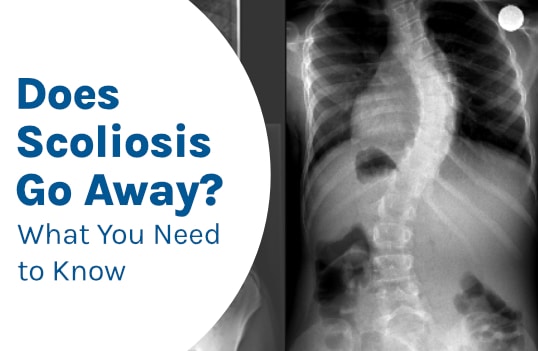
The majority of scoliosis cases are progressive, and the main trigger for progression is growth, so most cases of childhood scoliosis are progressive. How scoliosis is managed during periods of rapid growth is crucial as progression increases effects and makes treatment more complex.
Scoliosis is progressive, so most cases will increase in severity over time. There are cases that are stable and don’t progress, but scoliosis has an underlying structural nature that can’t correct on its own. In most cases, proactive treatment is needed to counteract its progressive nature.
Because most cases of scoliosis progress, let’s explore the progressive line of scoliosis from mild to severe.
Early Detection is Key
Because scoliosis is progressive, it doesn’t just go away; treatment needs are ongoing, but many cases of scoliosis are highly treatable (1).
No scoliosis treatment outcome can be guaranteed, but there are a number of factors that are associated with successful treatment outcomes, including early detection and intervention (1, 2).
Scoliosis is progressive; it ranges widely in severity from mild to moderate, severe and very severe, and the main trigger for progression is growth (2, 3).
A goal of proactive scoliosis treatment is to prevent as much progression as possible, and the earlier scoliosis is diagnosed, the sooner treatment can start, and it’s easier to correct a mild curve than a severe curve (2, 3).
As scoliosis progresses, the spine’s unnatural curve and rotation is increasing, and the effects are going to increase as well, becoming more noticeable and potentially disruptive to quality of life (2).
Early detection means diagnosing scoliosis while still mild, before significant progression has occurred (2).
Progression makes the spine increasingly rigid and less responsive to treatment. The degree of flexibility in the spine is an important factor when it comes to improving the spine’s position and alignment; this is why adult scoliosis correction is typically more limited than cases of childhood scoliosis (2, 3).
In some cases of adult scoliosis that are diagnosed later in life, preparatory work has to be done to restore a baseline level of spinal flexibility so patients can perform rehabilitative exercises that are important in nonsurgical treatment.
With early detection, treatment can be started while still mild, before significant progression has occurred, prior to the spine becoming rigid, and before scoliosis effects have become well-established and more difficult to reverse (2, 3).
Scoliosis Severity
While treatment can’t make scoliosis go away in the traditional sense of a cure, the goal of early detection is to start treatment early and prevent mild cases from becoming severe (1, 2, 3).
In most cases of scoliosis, the progressive line is mild to moderate and severe, and disrupting the line with a proactive treatment plan can shape the spine’s long-term health and function.
What you need to know about scoliosis severity is that many cases are highly treatable, but a diagnosis of mild scoliosis doesn’t mean there is more time to act, or that it won’t get worse over time (3).
The nature of scoliosis is to become more severe, so most cases, particularly those involving rapid periods of growth, or cases left untreated, will progress at some point (1, 2, 3).
The most prevalent type of scoliosis overall is adolescent idiopathic scoliosis, and this age group is closely associated with rapid progression because of puberty’s unpredictable and rapid growth spurts (4).
Adolescent idiopathic scoliosis rarely goes away on its own; in fact, adolescent scoliosis in adults (ASA) is the most common type of adult scoliosis and involves cases of pre-existing adolescent scoliosis that were undiagnosed and untreated during adolescence (4, 5).
Some cases of adolescent scoliosis go undetected until growth stops and scoliosis symptoms become more noticeable (5).
The more growth a patient has remaining prior to reaching skeletal maturity, the more potential progression there is (3).
Mild Scoliosis
A diagnosis of mild scoliosis means the spine has a small unnatural lateral curve that may be simple to correct, if treatment is applied early (2).
Mild scoliosis can be difficult to diagnose, however, because its symptoms can be subtle, and it’s important for patients to understand that where a scoliosis is at the time of diagnosis doesn’t indicate that’s where it will stay; proactive treatment is needed to work towards counteracting progression, particularly while growth is occurring (2, 3).
Mild doesn’t mean treatment is less urgent; in fact, the best time to start treating scoliosis is while mild and there is more potential for correction (2).
It’s rare for childhood scoliosis to be stable and not progress because the constant trigger of growth is occurring, but progression can also occur slowly over time (4).

The symptoms of mild scoliosis can be subtle and difficult to detect, so awareness of the early signs of childhood scoliosis to watch for is key; in most cases, the earliest sign is asymmetrical posture including uneven shoulders and hips (4).
If mild scoliosis isn’t detected early, or is left untreated, it’s likely to become moderate and/or severe (1, 2).
Moderate Scoliosis
Many patients are diagnosed with moderate scoliosis because progression from mild to moderate causes more-noticeable condition effects that lead to assessment and diagnosis (4).
Moderate scoliosis means the size and rotation of the spine’s unnatural curve has increased, and in children, the main effect is asymmetrical posture that becomes more noticeable over time (4).
At the moderate level, postural changes are more overt, and if a curve has progressed from mild to moderate, it’s likely to continue on the progressive line to become severe and/or very severe (4).
In adults, progression tends to slow because skeletal maturity has been reached, but for older adults experiencing spinal degeneration, progression can increase due to the spine’s increasing instability (5, 6).
The more severe scoliosis is, the more necessary surgical treatment may become (7), but in cases diagnosed and treated early, the scope of nonsurgical treatment is wider and there is more potential to correct the scoliosis without invasive surgical treatment (2).
Although we don’t know why most cases of scoliosis develop initially, knowing how to respond with treatment becomes more important because once scoliosis develops, it’s unlikely to resolve on its own.
Once moderate, scoliosis is on the path to becoming severe, and severe scoliosis patients may be funneled in the direction of spinal fusion surgery (7).
Severe Scoliosis
Severe scoliosis means the size and rotation of the unnatural curve has increased significantly, and the effects are going to be overt and disruptive.
The larger a curve becomes, the more likely it is to continue progressing: hence the benefit of diagnosing and starting treatment early (2).
When it comes to scoliosis pain, there are a number of factors that shape a patient’s level of pain, including patient age, the type of scoliosis, and curvature location/pattern (8).
Adults are likely to experience severe pain with severe scoliosis (5, 6, 9); milder cases of childhood scoliosis aren’t commonly associated with pain due to the lengthening motion of growth counteracting compression, although children can still experience varying degrees of back and muscle pain (4, 8).
While pain is the main symptom of adult scoliosis that leads to assessment and diagnosis; in children, postural changes are the earliest signs that lead to assessment (5, 6).
Once severe, surgical intervention is more likely, and spinal fusion surgery is associated with negative long-term effects to spinal health, many of which can be avoided through a proactive nonsurgical treatment approach (7, 10).
At the severe level, particularly in adults, scoliosis pain can be chronic and disruptions to mobility can be overt (9).
Conclusion
What you need to know about scoliosis is that it rarely goes away on its own; in fact, its nature is to increase in severity over time, making treatment a necessity.
The most important thing to understand about scoliosis is that the sooner treatment is started, the more successful it’s likely to be, so the best time to start treatment is always the present.
Treatment plans for small curves are less complex and have more corrective potential, so the goal is diagnosing cases while mild so they can be more easily corrected.
A scoliotic spine that’s corrected through nonsurgical treatment options is one more capable of maintaining a natural range of flexibility and strength; whereas spinal fusion is associated with a loss of strength and a reduced range of motion.
As a progressive spinal condition, scoliosis treatment is ongoing and shapes the spine’s long-term health and function.
Although there are stable cases of scoliosis that don’t progress, the spine’s unnaturally-tilted and rotating vertebrae can’t realign and derotate themselves, so scoliosis can’t go away on its own, but with a proactive treatment plan, symptoms may be minimized and progression prevented.
Find Your Nearest Clinic
ScoliCare Clinics, affiliates and product providers are in over 200 locations around the world. Find your nearest ScoliCare location here.


References:
- Janicki JA, Alman B. Scoliosis: Review of diagnosis and treatment. Paediatr Child Health. 2007 Nov;12(9):771-6. doi: 10.1093/pch/12.9.771. PMID: 19030463; PMCID: PMC2532872
- McCarthy RE. Prevention of the complications of scoliosis by early detection. Clin Orthop Relat Res. 1987 Sep;(222):73-8. PMID: 2957138
- Negrini, S., Donzelli, S., Aulisa, A. G., Czaprowski, D., Schreiber, S., de Mauroy, J. C., … & Zaina, F. (2018). 2016 SOSORT guidelines: orthopaedic and rehabilitation treatment of idiopathic scoliosis during growth. Scoliosis and spinal disorders, 13(1), 3
- Wong HK, Tan KJ. The natural history of adolescent idiopathic scoliosis. Indian J Orthop. 2010 Jan;44(1):9-13. doi: 10.4103/0019-5413.58601. PMID: 20165671; PMCID: PMC2822427
- Ansari K, Singh M, McDermott JR, Gregorczyk JA, Balmaceno-Criss M, Daher M, McDonald CL, Diebo BG, Daniels AH. Adolescent idiopathic scoliosis in adulthood. EFORT Open Rev. 2024 Jul 1;9(7):676-684. doi: 10.1530/EOR-23-0162. PMID: 38949156; PMCID: PMC11297403
- Kotwal S, Pumberger M, Hughes A, Girardi F. Degenerative scoliosis: a review. HSS J. 2011 Oct;7(3):257-64. doi: 10.1007/s11420-011-9204-5. Epub 2011 Jun 11. PMID: 23024623; PMCID: PMC3192887
- Weiss HR, Goodall D. Rate of complications in scoliosis surgery – a systematic review of the Pub Med literature. Scoliosis. 2008 Aug 5;3:9. doi: 10.1186/1748-7161-3-9. PMID: 18681956; PMCID: PMC2525632
- Ilharreborde B, Simon AL, Shadi M, Kotwicki T. Is scoliosis a source of pain? J Child Orthop. 2023 Nov 28;17(6):527-534. doi: 10.1177/18632521231215861. PMID: 38050593; PMCID: PMC10693849
- Zaina, F., Marchese, R., Donzelli, S., Cordani, C., Pulici, C., McAviney, J., & Negrini, S. (2023). Current knowledge on the different characteristics of back pain in adults with and without scoliosis: a systematic review. Journal of Clinical Medicine, 12(16), 5182
- Fan H, Wang Q, Huang Z, Sui W, Yang J, Deng Y, Yang J. Comparison of Functional Outcome and Quality of Life in Patients With Idiopathic Scoliosis Treated by Spinal Fusion. Medicine (Baltimore). 2016 May;95(19):e3289. doi: 10.1097/MD.0000000000003289. PMID: 27175629; PMCID: PMC4902471
More news
-
 15 July 2024
In recent years, patient-centred care has revolutionised the approach to scoliosis treatment by focusing on the unique needs, preferences and values of each patient. This approach places patients at the…
-
 14 March 2021
Kurt Cobain and his Scoliosis Part of our series of famous people who have/had a Scoliosis. Next up is Kurt Cobain! Kurt Cobain is best known as the lead…
-
 1 November 2022
It is hard to believe that the fastest man on earth has scoliosis! Olympian Usain Bolt was born with scoliosis. His right leg is half an inch shorter than his…