
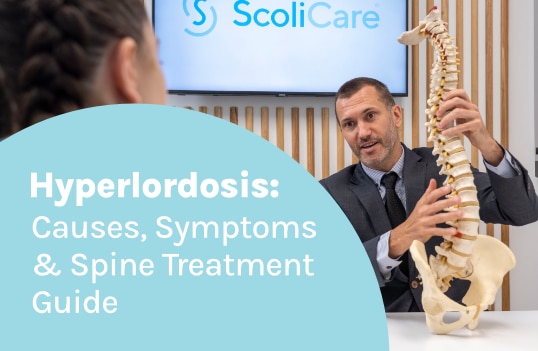
Lordosis refers to an inward spinal curve, and while there is a healthy range of lordosis, if a person’s lordosis is excessive, it can disrupt the spine’s overall health and biomechanics. Common causes for hyperlordosis include weak and/or unbalanced core muscles, chronic poor posture, and obesity.
Hyperlordosis is an excessive inward spinal curvature that commonly develops in the lumbar spine. Also known as swayback, lumbar hyperlordosis causes the buttocks and abdomen to protrude excessively.
The spine’s healthy curves make it stronger, more flexible, more balanced, and aid with shock absorption.
What is Lordosis?
A healthy spine is aligned with its natural curves in place.
The spine can be divided into three main sections including the cervical spine, the thoracic spine, and the lumbar spine, and each spinal section has a characteristic healthy curve type, known as lordosis and kyphosis.
Lordosis refers to a spinal curve that bends inward, and kyphosis is the opposite curve type that bends outward (1).
While the spinal sections are distinct with their own curve type and roles to play in the spine’s overall function, they are all interconnected; the health of one section shapes the health of the others.
The spine’s natural lordosis is found in the cervical and lumbar spinal sections, and if a spinal section loses its healthy curve, its ability to perform optimally may be disrupted, with potential to further disrupt overall spinal health and function; it can also make the spine more vulnerable to degenerative changes due to increased spinal loading (1).
While the cervical spine can develop hyperlordosis, it’s significantly more common in the lumbar spine, so for our current purposes, we’ll focus on lumbar hyperlordosis.
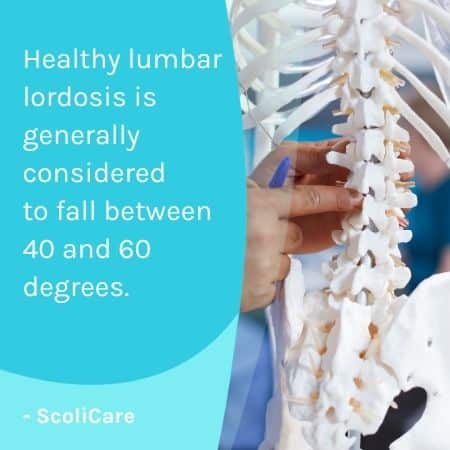
While the optimal lordotic range remains unclear (2), a healthy range of lumbar lordosis is generally considered to fall between 40 and 60 degrees (3).
If a person’s degree of lordosis becomes excessive, the spine curves too far inward and is diagnosed as hyperlordosis.
Hyperlordosis Causes
So what causes the spine to curve too far inward?
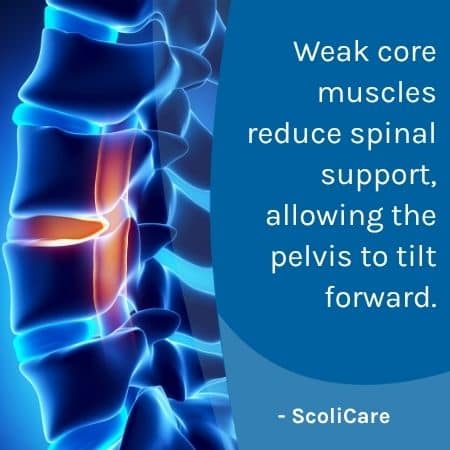
Weak core muscles and/or unbalanced muscles can cause hyperlordosis through a lack of spinal support and stability (4).
It’s not just the spine that has to maintain its natural curves and alignment; it’s also the role of the spine’s surrounding muscles to properly support and stabilize the spine, taking pressure off its individual structures and surroundings (4).
Weak and Unbalanced Core and Lower Back/Body Muscles
If the core and back muscles are weak, they aren’t giving the spine as much support, and if they are unbalanced, muscles on one side of the spine are stronger and more strained than muscles on the opposite side that can become weak from lack of use (4).
Weak abdominal muscles, gluteal muscles, and hamstrings, and tight hip flexors and lower back extensors can contribute to an anterior pelvic tilt (4, 5).
An anterior pelvic tilt occurs when postural changes cause the pelvis to tilt forward excessively and the lower back to arch forward excessively (5) in response.
When the core muscles are weak, they’re not supporting the spine effectively and can’t counterbalance the pull of the lower back’s muscle groups to maintain the upright position of the pelvis, causing it to tilt forward (4, 5).
When the gluteal and hamstring muscles are weak, they can’t pull the pelvis into a neutral/posterior tilt and the tight hip flexors take over, causing the pelvis to tilt forward excessively (4, 5).
Hip flexors are located at the front of the hip, and if they are tight and short (a common effect of sitting for extended periods of time), they pull the pelvis forward, and if the muscles of the lower back become short and tight, they attempt to counteract the forward pull on the pelvis by pulling the lumbar spine into hyperextension (over-arched position) (4, 5).
So essentially, a muscle imbalance/weak muscles can cause the pelvis to tilt forward excessively, which then causes the lumbar spine to arch excessively in an effort to counteract the unnatural forward pull of the pelvis (4, 5).
Chronic Poor Posture
Misaligned posture, over time, introduces chronic strain and pressure to the vertebrae of the lumbar spine; these vertebrae are often referred to as the stress vertebrae because they have to support the weight of the spinal sections above, the torso, and feel the effects of repeated strenuous motion (6).
Chronic pressure and strain doesn’t just affect the vertebrae of the lumbar spine, but also its intervertebral discs and nerves, so can disrupt spinal health and function in a number of ways (6).
There are a number of body compensations in place for maintaining balance and stability, and when unhealthy body posture is introducing uneven forces to the spine and its surroundings, the spine can attempt to counteract with changes to its position (6).
If a person is always slouching forward, for example, the lumbar spine can develop an excessive curvature in an attempt to pull the pelvis back and maintain the body and spine’s central upright position and balance.
Postural health and spinal health are closely linked; here at ScoliCare, a patient’s comprehensive initial assessment includes a postural assessment. How a patient holds and moves their body indicates a lot about spinal health (6).
If healthy posture is disrupted, the effects can include movement patterns that become unhealthy and uneconomical (6).
Unhealthy posture often means the upper body’s weight isn’t evenly distributed over the lower body, and this can disrupt balance, coordination, and gait, introducing further uneven wear and tear on the spine and its surroundings (6).
Chronic poor posture contributes to a cycle of weak and/or unbalanced muscles and over-arching of the spine as a response.
Obesity
In addition to muscle issues and chronic poor posture, there are certain lifestyle choices that are associated with hyperlordosis including obesity and low activity levels.
Carrying excess weight in the abdominal region can contribute to hyperlordosis by the body’s center of gravity being pushed forward because of the excess weight, and the spine’s compensatory response of arching excessively in an attempt to pull the pelvis back and maintain the spine and body’s healthy position (7).
The disruption to the lumbar spine’s alignment, and more weight on the lumbar spine, means compressive stress and strain introduced to the spine, its discs, nerves, and supportive muscles and ligaments, and all these structures work together to maintain spinal health and function (7).
As the spine’s natural design is based on movement, a sedentary lifestyle, which also contributes to obesity, can mean weak core muscles and lack of spinal support and strength, further contributing to hyperlordosis and poor posture (7).
Hyperlordosis Symptoms
The most common symptom of lumbar hyperlordosis is a swayback posture that involves the buttocks and abdomen protruding excessively.
Lower back pain, stiffness in the lower back and body, muscle pain and spasms, and the inability to lay flat without a gap between the lower back and floor are additional common symptoms of excessive lordosis in the lumbar spine.
Hyperlordosis Treatment
The first line of hyperlordosis treatment often involves condition-specific rehabilitative physical therapy that works towards strengthening and balancing the core muscles, glutes, and hips, and stretching tight hip flexors and hamstrings: all capable of improving the spine’s alignment and body posture (8).
Postural awareness and correction are focuses of hyperlordosis treatment as improvements to body posture will improve spinal health and vice versa (6, 8).
Chiropractic BioPhysics®, including manual adjustments, can also be applied to work towards improving the spine’s alignment, balance, and stability, and as the approach involves combining the potential of condition-specific chiropractic care and specialized rehabilitative exercise to improve spinal and postural health, it can be an effective treatment option (9, 8).
Lifestyle guidance in the form of weight loss and activity recommendations are important for relieving pressure on the spine and its surroundings, improving posture, the position of the pelvis, muscle strength and balance, and restoring the body’s natural center of gravity for optimal spinal alignment and balance (7).
In severe cases, a back brace and/or surgical intervention may be recommended.
Conclusion
An unhealthy spinal curve can disrupt spinal health and function, as well as body posture and healthy movement patterns.
Lordosis refers to an inward curve of the spine, and while there is a healthy range of lordosis, if a person’s lordosis becomes excessive, it can become problematic.
Too much lordosis is diagnosed as hyperlordosis and mainly affects the lumbar spine by causing an excessive forward arching of the lower back and the buttocks and abdomen to protrude excessively.
Common causes of lumbar hyperlordosis include weak and/or unbalanced muscles, chronic poor posture, and obesity, and common symptoms of lumbar hyperlordosis include the development of swayback posture, anterior pelvic tilt, lower back pain and stiffness, and disruptions to healthy movement patterns.
Treatment plans need to be customized around a number of specific patient/condition variables but generally include condition-specific physical therapy, lifestyle guidance, and chiropractic care.
Find Your Nearest Clinic
ScoliCare Clinics, affiliates and product providers are in over 200 locations around the world. Find your nearest ScoliCare location here.


References:
- Beckers L, Bekaert J. The role of lordosis. Acta Orthop Belg. 1991;57 Suppl 1:198-202. PMID: 1833945
- Been E, Kalichman L. Lumbar lordosis. Spine J. 2014 Jan;14(1):87-97. doi: 10.1016/j.spinee.2013.07.464. Epub 2013 Oct 2. PMID: 24095099
- Murray KJ, Le Grande MR, Ortega de Mues A, Azari MF. Characterisation of the correlation between standing lordosis and degenerative joint disease in the lower lumbar spine in women and men: a radiographic study. BMC Musculoskelet Disord. 2017 Aug 1;18(1):330. doi: 10.1186/s12891-017-1696-9. PMID: 28764702; PMCID: PMC5539892
- Shalamzari MH, Henteh MA, Shamsoddini A, Ghanjal A. Comparison of the effects of core stability and whole-body electromyostimulation exercises on lumbar lordosis angle and dynamic balance of sedentary people with hyperlordosis: a randomized controlled trial. BMC Sports Sci Med Rehabil. 2024 Apr 23;16(1):91. doi: 10.1186/s13102-024-00879-5. PMID: 38654368; PMCID: PMC11036689
- Suits WH. Clinical Measures of Pelvic Tilt in Physical Therapy. Int J Sports Phys Ther. 2021 Oct 1;16(5):1366-1375. doi: 10.26603/001c.27978. PMID: 34631258; PMCID: PMC8486407
- Carini F, Mazzola M, Fici C, Palmeri S, Messina M, Damiani P, Tomasello G. Posture and posturology, anatomical and physiological profiles: overview and current state of art. Acta Biomed. 2017 Apr 28;88(1):11-16. doi: 10.23750/abm.v88i1.5309. PMID: 28467328; PMCID: PMC6166197
- Vismara L, Menegoni F, Zaina F, Galli M, Negrini S, Capodaglio P. Effect of obesity and low back pain on spinal mobility: a cross sectional study in women. J Neuroeng Rehabil. 2010 Jan 18;7:3. doi: 10.1186/1743-0003-7-3. PMID: 20082692; PMCID: PMC2821381
- Dimitrijević V, Šćepanović T, Milankov V, Milankov M, Drid P. Effects of Corrective Exercises on Lumbar Lordotic Angle Correction: A Systematic Review and Meta-Analysis. Int J Environ Res Public Health. 2022 Apr 18;19(8):4906. doi: 10.3390/ijerph19084906. PMID: 35457772; PMCID: PMC9025799
- Kallan SZ, Oakley PA, Harrison DE. Reduction of lumbar hyperlordosis in a pediatric: a Chiropractic BioPhysics® case report. J Phys Ther Sci. 2022 Sep;34(9):646-650. doi: 10.1589/jpts.34.646. Epub 2022 Sep 1. PMID: 36118660; PMCID: PMC9444519
More news
-
 10 August 2026
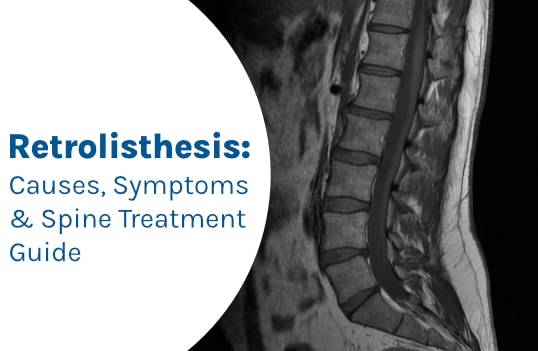
Retrolisthesis is a backward vertebral slip that can affect posture, stability, and nerves. Early diagnosis helps guide effective treatment and symptom relief.
-
 12 September 2025
The spine’s natural curves enhance strength and flexibility—but when curves become excessive, like in hyperkyphosis, problems can arise. Early detection is key.
-
 3 July 2026
Healthy lordosis and kyphosis keep the spine strong and balanced. Too much or too little of either curve can affect posture, movement, and function.