
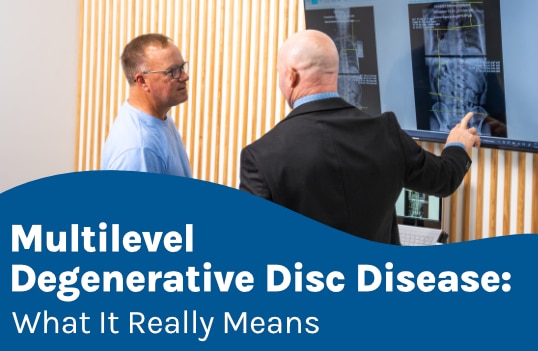
The spine’s intervertebral discs shape overall spinal health in a number of ways. Most degenerative changes in the spine start with the discs; they perform a number of key functions to facilitate the spine’s flexibility, structure, and ability to handle stress.
Multilevel degenerative disc disease involves the spine’s intervertebral discs degenerating in more than one spinal section simultaneously, impacting spinal health and function. Degenerative disc disease can develop anywhere in the spine but is most common in the cervical and lumbar spinal sections.
When one or more spinal discs are degenerating, the spine can be affected in multiple ways.
Spinal Disc Structure and Function
The spine’s healthy alignment and balance is the result of a number of structures working together, including the intervertebral discs.
The spine’s vertebrae are separated by an intervertebral disc, and the discs have two main components: a soft interior (nucleus) and a durable outer layer (annulus) (1).
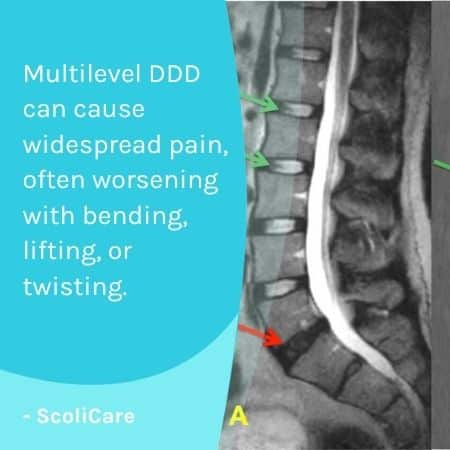
A spinal disc sits between adjacent vertebrae and is essential for providing cushioning during activity so friction is prevented (a cause of uneven wear and tear and degeneration) and vertebral health is preserved (1).
The soft gel-like nucleus helps to absorb shock from impact and stress and evenly distribute it throughout the spine to prevent degenerative changes. The discs also combine forces to support the spine’s flexibility (1).
Discs give the spine structure as the vertebral body above and below attaches to the disc in between and protects the nucleus within (1).
Disc health isn’t easily maintained because they are largely avascular (no direct blood supply). The discs receive oxygen and nutrients through diffusion, so when the goal is improving disc health, increasing circulation and blood flow in the area around an affected disc is a common approach (1, 2).
Discs rely heavily on changes in pressure through healthy movement to facilitate diffusion and remove waste (1, 2).
Degenerative Disc Disease
Degenerative disc disease (DDD) can develop anywhere in the spine but most commonly affects the neck and lower back (2, 3, 4).
The cervical spine refers to the neck and is vulnerable because it has to support the weight of the head, and the lumbar spine refers to the lower back and has to support the weight of the thoracic and cervical spinal sections above and the trunk (3, 4).
The majority of degenerative disc disease develops in the lower half of the lumbar spine where the vertebrae are under the most strain from weight and the effects of strenuous movement (bends, twists, and lifts) (2, 4).
After the lumbar spine, the cervical spine is most commonly affected, and this is due to the neck supporting the weight of the head, and poor posture can increase the weight of the head on the cervical spine (forward head posture) (3).
Despite the name, degenerative disc disease is more of an age-related degenerative process that’s natural and takes place slowly over time. The discs lose fluid as we age, and when they experience excessive fluid loss, this is called desiccation (2)|.
When a disc becomes desiccated, it tends to lose height, and this change in its shape also affects adjacent vertebrae attached and the disc’s immediate surroundings (1, 2).
A disc can degenerate in any spinal section, and when discs are degenerating in more than one section simultaneously, this is known as multilevel degenerative disc disease, and what it means is that multiple areas of the spine are experiencing degenerative changes capable of causing instability and pain (2).
Symptoms of Degenerative Disc Disease
The most common symptoms of degenerative disc disease include pain, sensory changes, muscle weakness, and spinal rigidity (2, 3, 4).

Chronic pain is a common effect and can involve localized back pain (around the affected disc) in the neck or lower back, or pain can radiate into the lower body and extremities due to compressed nerves (2, 3, 4).
Effects are also shaped by the location of the disc within the spine. If DDD has developed in the cervical spine alone, neck pain is common, and disc degeneration in the lower back is going to cause the majority of its effects in the lower back and body (3, 4).
Pain Patterns
If DDD is occurring in multiple levels of the spine, its effects can be widespread, and pain caused by degenerative disc disease tends to increase with strenuous movement such as lifts, bends, and twists (2).
Pain often improves when lying down as it even;y distributes the body’s weight and reduces pressure on the spine and discs, and changes to position also can help reduce pain by shifting pressure off an affected disc (2).
Pain can flare up with intensity, but can also disappear for long periods of time (2).
Sensory Changes
Sensory issues can also develop due to a degenerating disc changing shape and putting pressure on a spinal nerve and can include sensations of tingling and/or numbness in the arms, hands, legs, and feet (3, 4).
A common complication of DDD in the lumbar spine, for example, is sciatic nerve pain. The sciatic nerve is the largest in the body and starts in the lower back and extends down the back of the lower body (4, 5).
If a degenerating disc compresses the sciatic nerve, it can cause sciatic nerve pain felt anywhere along the nerve’s extensive pathway: lower back, hip, buttock, leg, foot (5).
Muscle Weakness and Spinal Rigidity
Muscle weakness and loss of strength is common in the legs or arms, and stiffness in the back can be painful and cause a loss of mobility (2, 3, 4).
The spine’s design is movement-based, and increasing spinal rigidity can cause limited mobility and flexibility in the spine, and remember, the best way to preserve disc health is through regular healthy movement and pressure changes (2).
Conclusion
Multilevel degenerative disc disease means more than one section of the spine contains degenerating discs that are impacting spinal health.
Degenerative changes in the spine generally start with the spinal discs as they lose fluid over time, and because they are avascular, they are slow to repair, and it can be difficult to reverse disc degeneration.
The first line of treatment involves nonsurgical conservative options such as physical therapy, lifestyle changes, weight loss, and pain medications. Surgical recommendations can be given in cases involving severe nerve compression and/or bowel/bladder issues.
Physical therapy focuses on core strengthening and postural improvement to take pressure off the spine and its discs. Stretching exercises can help with pain management and increasing spinal flexibility for improved mobility. Targeted low-impact exercise also helps improve disc health through improving circulation and blood flow around an affected disc.
When it comes to spinal health, the cumulative effect of certain lifestyle factors can impact disc health, so lifestyle guidance can include weight loss, cultivating a healthy activity level, improving posture, and education on the ergonomics of proper lifting.
Common symptoms of multilevel degenerative disc disease include localized back pain, radiating pain felt in the extremities, sensory changes, muscle weakness, and spinal rigidity that impacts mobility.
If disc health isn’t preserved, and/or if natural degenerative changes are occurring, a disc can become desiccated and start the degenerative cycle.
If a disc’s inner nucleus is pushing outwards against its outer annulus, this is known as a bulging disc, and if the inner nucleus pushes through a tear in the outer annulus, the disc has herniated; cultivating a spine-friendly lifestyle is important for disc health and quality of life.
References:
- Waxenbaum JA, Reddy V, Futterman B. Anatomy, Back, Intervertebral Discs. [Updated 2023 Dec 9]. In: StatPearls [Internet]. Treasure Island (FL): StatPearls Publishing; 2025 Jan-. Available from: https://www.ncbi.nlm.nih.gov/books/NBK470583/
- Scarcia L, Pileggi M, Camilli A, Romi A, Bartolo A, Giubbolini F, Valente I, Garignano G, D’Argento F, Pedicelli A, Alexandre AM. Degenerative Disc Disease of the Spine: From Anatomy to Pathophysiology and Radiological Appearance, with Morphological and Functional Considerations. J Pers Med. 2022 Nov 1;12(11):1810. doi: 10.3390/jpm12111810. PMID: 36579533; PMCID: PMC9698646
- Margetis K, Dowling TJ. Cervical Degenerative Disc Disease. [Updated 2025 Aug 2]. In: StatPearls [Internet]. Treasure Island (FL): StatPearls Publishing; 2025 Jan-. Available from: https://www.ncbi.nlm.nih.gov/books/NBK560772/
- Donnally III CJ, Hanna A, Varacallo MA. Lumbar Degenerative Disk Disease. [Updated 2023 Aug 4]. In: StatPearls [Internet]. Treasure Island (FL): StatPearls Publishing; 2025 Jan-. Available from: https://www.ncbi.nlm.nih.gov/books/NBK448134/
- Saleem S, Aslam HM, Rehmani MA, Raees A, Alvi AA, Ashraf J. Lumbar disc degenerative disease: disc degeneration symptoms and magnetic resonance image findings. Asian Spine J. 2013 Dec;7(4):322-34. doi: 10.4184/asj.2013.7.4.322. Epub 2013 Nov 28. PMID: 24353850; PMCID: PMC3863659
More news
-
 21 October 2025
Degenerative scoliosis in older adults is painful and progressive—caused by spinal wear, it affects balance, posture, and needs proactive treatment.
-
 9 February 2022
Scoliosis can start in later life too Adult degenerative scoliosis, or denovo scoliosis, is a structural change of the spine with a higher incidence than adolescent idiopathic scoliosis. The aging…
-
 3 February 2026
Early detection and customized nonsurgical care—like 3D bracing and scoliosis-specific rehab—can help stop progression and improve spinal health.