
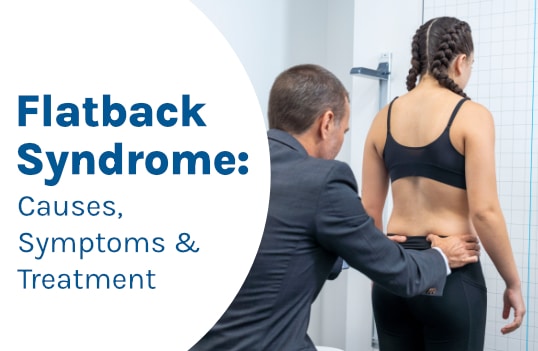
When the lower back loses some of its natural inward curve, it can affect posture, comfort, walking, and the ability to stand upright for long periods. The spine acts as the central structural anchor for the body, supporting healthy posture and movement, so changes to spinal health can have a number of effects.
Flatback syndrome involves the lower spine’s natural lordosis (inward curve) straightening out, and common causes include degenerative disc disease, spinal surgery, and vertebral compression fractures. Symptoms can include leg and back pain, fatigue, and a forward-leaning posture. Treatment options may include physical therapy, targeted exercise, and/or chiropractic care.
Flatback syndrome is a postural condition where the lower spine becomes too straight, often causing a forward-leaning posture, back or leg pain, fatigue, and difficulty standing upright. Treatment depends on the cause and severity.
Healthy Spinal Curves
The spine is curved at each of its main sections, and the spinal curves work together to keep the spine balanced and stable. If a section loses its healthy curve, the spine becomes less stable (1).
Spinal health is key to overall health. The spine anchors the body, helps us stay upright and practice healthy posture, supports healthy movement patterns, protects the spinal cord and important organs (1).
Each spinal section has a characteristic healthy curve type: the cervical spine (neck), thoracic spine (middle/upper back), and the lumbar spine (lower back).
The lumbar and cervical spinal sections should have a soft inward spinal curve, and the largest spinal section, the thoracic spine, should curve outward; these curves give the spine a soft ‘S’ shape when viewed from either side, and make it appear straight when viewed from the front/or back (1).
Inward spinal curves are known as lordosis, and the thoracic spine has a natural kyphosis. Awareness of the difference between healthy and unhealthy spinal curves is important so changes to spinal health are noticed, assessed by a medical professional, and treated.
Flatback Syndrome
There is a healthy spinal curve size range, but if a spinal curve doesn’t fall within a healthy range, it can become problematic by disrupting the spine’s alignment. If the spine’s bones (vertebrae) are aligned, they are stacked evenly on top of one another so the spine is balanced, stable, and wearing evenly.
A spinal curve can become too large and excessive, or too small and excessively straight. Flatback syndrome is present if the lumbar spine’s healthy inward curve straightens out (2).
The lower back’s natural inward curve is important. Each spinal section has its role to play in how the spine functions. Each section of the spine helps balance the others, so a change in the lower back can affect posture and movement throughout the body.
The lumbar spine has to support the weight of the spinal sections above and the upper body, so its vertebrae are the largest; they are designed to support weight, provide stability for the entire spine, and allow for bending and twisting motion (3).
Common causes of a loss of lumbar lordosis include degenerative changes to spinal health, vertebral compression fractures, and spinal surgery.
Flatback Syndrome Causes
The spine’s healthy curves can be lost for a number of reasons, the most common is age-related spinal degeneration.
The spine is vulnerable to a number of degenerative changes, and adults become vulnerable with increasing age, and women after menopause, when changes in bone density can increase the risk of spinal changes and compression fractures (5).
Degenerative disc changes are one common contributor to changes in spinal alignment, including loss of lumbar lordosis.
Disc Degeneration
The vertebrae are separated by an intervertebral disc, and these discs act as attachment points for adjacent vertebrae, giving the spine structure, and provide cushioning so vertebrae don’t rub against one another during movement. The discs also work together to increase the spine’s flexibility and act as shock absorbers (5).
Degenerative disc disease can start with fluid loss. As we age, the discs can lose fluid, and disc health is also shaped by a number of lifestyle factors such as weight and exercise.
As disc height reduces, the spacing and alignment between nearby vertebrae can change.
The discs don’t have their own vascular supply, meaning there is no direct pathway that blood and nutrients can enter the discs and waste material can exit, so they can be slow to heal, and once the degenerative cycle is started, it can be difficult to stop. Early detection can help.
If one or more discs lose a significant amount of height in the lumbar spine, it can contribute to a loss of lordosis through a loss of cushioning between the vertebrae This can contribute to a flatter lower-back curve and a forward shift in posture.
Vertebral Compression Fracture
Vertebral compression fractures can also cause flatback syndrome if a vertebra in the lumbar spine has broken and collapsed the front portion of the bone, causing a loss of spinal height and the lower back’s natural lordotic curve (6).
Spinal Surgery
A loss of lumbar lordosis can also develop as a complication of spinal surgery. For example, spinal fusion surgery using distraction instrumentation can cause flatback syndrome by failing to restore the lumbar spine’s healthy lordosis (7).
When the lower back loses its natural lordosis and shifts forward, the body tries to compensate to maintain stability, causing an excessively-straight spine and related symptoms.
Flatback Syndrome Symptoms
The main symptoms of flatback syndrome include postural changes, lower back pain, lower body pain, changes to gait, difficulty standing upright, and fatigue (2).
Flatback syndrome causes changes to posture: a noticeably straight spine and a stooped-forward posture as the upper body tries to compensate for the lower back’s excessive straightening.
Spinal health shapes postural health and vice versa, so poor posture is a common effect of changes to spinal health and alignment, and postural changes can be a warning sign of changes to spinal health.
Flatback syndrome can cause lower back pain by disrupting the spine’s balance and causing the body to lean forward excessively; the imbalance strains the spine, its discs, surrounding muscles, and supportive structures as they try to counteract the loss of lordosis (2).
Due to the postural changes and strain, healthy movement patterns can also be disrupted, and the development of an abnormal gait is common; a walk that’s unbalanced can cause mechanical problems that further strain the lower back and body, causing sore hips and legs (2).
With the forward shift in posture, upper body weight isn’t evenly distributed over the lower body, causing uneven wear and tear on the spine and its surroundings.
Forward head posture can also develop as the change in posture causes the head to shift forward, increasing weight and strain on the cervical spine, causing neck pain and radiating pain in the upper body (8).
Fatigue is also common. It takes extra energy as the body attempts to restore balance and counteract the effects of unhealthy movement patterns. Difficulty standing upright for long periods of time is also common as symptoms of a loss of lumbar curve can get worse throughout the day (2).
Flatback Syndrome Treatment Options
Treatment options for flatback syndrome are shaped by its severity, symptoms, and underlying cause.
Common treatment options include physical therapy that aims to restore the spine’s balance and increase core strength for more spinal support and better posture (2, 9).
A strong core supports the spine and healthy posture, and targeted exercise that improves the lumbar spine’s surrounding muscle strength takes pressure off the spine and its individual structures (9).
Personalized physical therapy and specific targeted exercise can also improve disc health by increasing circulation and blood flow around an affected disc, and discs maintain their hydration through changes to pressure that happen with movement (5, 9). Staying active is important for disc health.
Targeted stretching can also help loosen tight hamstrings for pain relief, and some patients may use manual therapy or chiropractic care as part of a broader conservative plan to help with mobility, comfort, and function, depending on the underlying cause.
In severe cases, surgical intervention may be recommended and commonly involves an osteotomy to restore the lower back’s healthy inward curve (2).
Conclusion
Flatback syndrome is a loss of the lumbar spine’s natural inward curve. The spine’s lordosis and kyphosis balance the spine for stability and function, so if a healthy lordotic or kyphotic curve is lost, overall spinal health can be affected.
Common causes of flatback syndrome include disc degeneration, vertebral compression fractures, and spinal surgery.
Common symptoms of a loss of lumbar lordosis include postural changes (prominent forward-lean), chronic pain in the lower back and body, changes to gait and balance, difficulty standing upright, and fatigue.
If you are noticing a forward-leaning posture, increasing difficulty standing upright, or ongoing back or leg pain, a spine-focused assessment can help identify the cause and guide appropriate treatment options.
Find Your Nearest Clinic
ScoliCare Clinics, affiliates and product providers are in over 200 locations around the world. Find your nearest ScoliCare location here.

References:
- InformedHealth.org [Internet]. Cologne, Germany: Institute for Quality and Efficiency in Health Care (IQWiG); 2006-. In brief: How does the spine work? [Updated 2025 Aug 28]. Available from: https://www.ncbi.nlm.nih.gov/books/NBK279468/
- Lu DC, Chou D. Flatback syndrome. Neurosurg Clin N Am. 2007 Apr;18(2):289-94. doi: 10.1016/j.nec.2007.01.007. PMID: 17556130
- Sassack B, Carrier JD. Anatomy, Back, Lumbar Spine. [Updated 2023 Aug 14]. In: StatPearls [Internet]. Treasure Island (FL): StatPearls Publishing; 2026 Jan-. Available from: https://www.ncbi.nlm.nih.gov/books/NBK557616
- Boody BS, Rosenthal BD, Jenkins TJ, Patel AA, Savage JW, Hsu WK. Iatrogenic Flatback and Flatback Syndrome: Evaluation, Management, and Prevention. Clin Spine Surg. 2017 May;30(4):142-149. doi: 10.1097/BSD.0000000000000522. PMID: 28266956
- Scarcia L, Pileggi M, Camilli A, Romi A, Bartolo A, Giubbolini F, Valente I, Garignano G, D’Argento F, Pedicelli A, Alexandre AM. Degenerative Disc Disease of the Spine: From Anatomy to Pathophysiology and Radiological Appearance, with Morphological and Functional Considerations. J Pers Med. 2022 Nov 1;12(11):1810. doi: 10.3390/jpm12111810. PMID: 36579533; PMCID: PMC9698646
- Donnally III CJ, Margetis K, Varacallo MA. Vertebral Compression Fractures. [Updated 2025 May 4]. In: StatPearls [Internet]. Treasure Island (FL): StatPearls Publishing; 2026 Jan-. Available from: https://www.ncbi.nlm.nih.gov/books/NBK448171/
- Lagrone MO, Bradford DS, Moe JH, Lonstein JE, Winter RB, Ogilvie JW. Treatment of symptomatic flatback after spinal fusion. J Bone Joint Surg Am. 1988 Apr;70(4):569-80. PMID: 3356724
- Lin G, Zhao X, Tao Z, Wang W. Gait biomechanics and postural adaptations in forward head posture: a comparative cross-sectional study. BMC Musculoskelet Disord. 2025 Aug 7;26(1):754. doi: 10.1186/s12891-025-08882-8. PMID: 40775337; PMCID: PMC12329986
- Kim WM, Seo YG, Park YJ, Cho HS, Lee CH. Effect of Different Exercise Types on the Cross-Sectional Area and Lumbar Lordosis Angle in Patients with Flat Back Syndrome. Int J Environ Res Public Health. 2021 Oct 17;18(20):10923. doi: 10.3390/ijerph182010923. PMID: 34682669; PMCID: PMC8535726
- Harrison DE, Oakley PA. Non-operative correction of flat back syndrome using lumbar extension traction: a CBP® case series of two. J Phys Ther Sci. 2018 Aug;30(8):1131-1137. doi: 10.1589/jpts.30.1131. Epub 2018 Aug 7. PMID: 30154615; PMCID: P
More news
-
 12 September 2025
The spine’s natural curves enhance strength and flexibility—but when curves become excessive, like in hyperkyphosis, problems can arise. Early detection is key.
-
 10 August 2026
Retrolisthesis is a backward vertebral slip that can affect posture, stability, and nerves. Early diagnosis helps guide effective treatment and symptom relief.
-
 12 August 2026
Hyperlordosis, or swayback, is an excessive inward spinal curve that can affect posture, balance, and movement. Early treatment can help restore spinal health.