
Scoliosis symptoms can vary widely and are shaped by a number of factors. While cardiac issues aren’t considered a primary effect of scoliosis, they can develop in severe and/or untreated cases. Scoliosis effects increase alongside progression, so the goal is early detection and intervention.
The heart is most likely to be affected in severe cases of thoracic scoliosis in adults. The thoracic spine and rib cage form the thoracic cage that protects important organs, including the lungs and heart. If the thoracic spine’s unnatural curve compresses the lungs and heart within, cardiac issues may develop.
The best way to avoid potential scoliosis complications is a proactive and customized treatment plan.
Scoliosis Symptoms
No two cases of scoliosis are the same, which is why customizing treatment plans is so important.
Not only are there different types of scoliosis with unique causes and characteristics, scoliosis also ranges widely in severity from mild to very severe, and as a progressive spinal condition, most cases of scoliosis will get worse over time.
The main trigger for progression in childhood scoliosis is growth, and in adults, age-related spinal degeneration and degenerative instability can trigger the onset/progression of scoliosis (1, 2).
As an asymmetrical condition, the main symptom of childhood scoliosis is postural deviation; in many cases, the earliest signs of scoliosis are uneven shoulders and hips.
If a growth spurt triggers progression, the spine’s unnatural lateral curve and rotation can increase, and this makes the scoliosis more complex to treat, and symptoms become more overt and disruptive (1).
In adults, progression can also increase postural changes, but pain is the main symptom of adult scoliosis, and scoliosis related pain can involve the back, radiating pain into the extremities, the spine’s surrounding muscles and supportive structures (2, 3).
The most important scoliosis-factor for patients to be aware of is its progressive nature. Scoliosis patients initially diagnosed with mild or moderate scoliosis aren’t guaranteed to stay at that severity level; it’s far more likely that, if left untreated, the scoliosis will become more severe over time (1).
There are never treatment guarantees, but with early diagnosis and a proactive treatment plan, there are fewer limits to what nonsurgical treatment can achieve, and many cases of scoliosis are highly treatable when caught early.
Cardiac abnormalities and issues aren’t considered typical symptoms of mild and moderate scoliosis, but when severe, atypical, or left untreated, they can develop, hence the benefit of starting treatment early to prevent increasing symptoms (4).
Severe Scoliosis and Organ Involvement
While heart problems aren’t considered a primary symptom of scoliosis, particularly when mild or in cases being treated proactively, they can develop alongside disruptions to lung function in severe cases (4, 5).
Adults are the most likely to experience compression-related issues because scoliosis becomes compressive once growth has stopped.
Severe cases of thoracic scoliosis in adult patients are the most likely to involve compression of vital organs such as the lungs and heart.
Disruptions to lung function are also not a primary effect of scoliosis and are more so an indication of increasing severity and the need for effective treatment (5).
The thoracic spine is the largest spinal section and the only section of the spine that attaches to the rib cage; together, the thoracic spine and rib cage protect important organs by forming the thoracic cage.
If the thoracic spine has an unnatural lateral spinal curvature with rotation, it can disrupt the healthy position of the rib cage and cause rib cage compression; related chest pain and issues with lung expansion can develop (5).
When lung function is affected, because of the lungs’ close proximity to the heart, heart health can also be affected and lead to pulmonary hypertension (4, 5).
The cardiac notch is a structural indentation on the edge of the left lung that accommodates the left side of the heart and pericardium, so if the lungs are compressed and pushed into the heart, a number of issues can develop (4, 5).
Severe Scoliosis and Cardiac Function
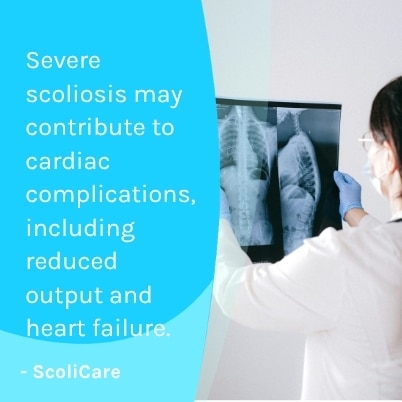
Scoliosis-related cardiac complications can impact cardiac structure, causing reduced cardiac output, atrial fibrillation, pulmonary hypertension, mitral valve prolapse, cardiovascular disease, and in severe cases, heart failure (4).
Due to compression, the heart’s ability to pump blood efficiently can be disrupted, leading to fatigue and potential heart failure when severe (4).
But while scoliosis can affect heart health and function, in many cases, these types of complications may be avoidable with a proactive treatment plan that impacts the underlying structural nature of scoliosis by restoring spinal alignment and function.
Making significant improvements to the spine’s position, alignment, balance, and stability restores symmetry and balance to the entire body, including the rib cage.
As the position of the spine and rib cage are improved, pressure is taken off the lungs and heart, allowing more space for the lungs to fully expand and the heart to efficiently pump blood throughout the body (4).
Adult patients with severe thoracic scoliosis should be aware of symptoms of heart strain to look for.
Symptoms of Scoliosis-Related Cardiac Issues
Scoliosis patients who are vulnerable to cardiac issues are likely experiencing a number of additional symptoms and potential complications related to increasing severity and the need for treatment.
Symptoms to be aware of include chronic tiredness, shortness of breath, and chest pain (4).
Fluid build up in the lungs can develop when the heart’s left side isn’t efficiently pumping blood that backs up into the pulmonary veins and causes fluid to leak into the air sacs of the lungs; this decreases the amount of oxygen in the bloodstream and can cause chronic shortness of breath (4, 5).
Simple low-impact exercise can become too taxing. As oxygen is needed to maintain muscle and ligament health, the body attempts to compensate for the lower-oxygen levels by increasing breathing rate, leading to breathlessness, particularly during physical activity (4).
Heart failure can occur if the heart’s decreased pumping ability causes blood to accumulate in the body’s vessels, leading to lung congestion (4).
If the heart valves are compressed, heart rate increases to compensate and increase blood flow, contributing to tiredness, blood back up, and more lung congestion (4).
Tachycardia involves a fast heart rate that makes it too difficult for the heart to fully fill, reducing cardiac output, and also contributing to breathlessness (4).
Conclusion
If scoliosis patients are experiencing increasing symptoms and related complications, it’s important to seek treatment that proactively works towards improving the effects and preventing the development of additional complications.
Severe curves are more likely to continue progressing, so the goal is to manage progression to prevent increasing symptoms, potential complications such as lung and cardiac issues, and the need for invasive surgical intervention.
Mild scoliosis symptoms can be subtle, so it’s not always easy to achieve early detection; awareness of the early signs of scoliosis in children and adults is important so an early and accurate diagnosis can be reached and treatment can be started.
Research findings support the benefit of early detection and proactive management, particularly in cases of childhood scoliosis with rapid growth periods.
ScoliCare are leaders in global scoliosis education and nonsurgical scoliosis treatment options that are current, integrative, and proven; treatment plans are integrative and combine the potential benefits of scoliosis-specific rehabilitative exercise, corrective 3-dimensional bracing, and Chiropractic BioPhysics® as an adjunctive treatment.
Find Your Nearest Clinic
ScoliCare Clinics, affiliates and product providers are in over 200 locations around the world. Find your nearest ScoliCare location here.


References:
- Negrini, S., Donzelli, S., Aulisa, A. G., Czaprowski, D., Schreiber, S., de Mauroy, J. C., … & Zaina, F. (2018). 2016 SOSORT guidelines: orthopaedic and rehabilitation treatment of idiopathic scoliosis during growth. Scoliosis and spinal disorders, 13(1), 3
- York PJ, Kim HJ. Degenerative Scoliosis. Curr Rev Musculoskelet Med. 2017 Dec;10(4):547-558. doi: 10.1007/s12178-017-9445-0. PMID: 28980155; PMCID: PMC5685967
- Zaina, F., Marchese, R., Donzelli, S., Cordani, C., Pulici, C., McAviney, J., & Negrini, S. (2023). Current knowledge on the different characteristics of back pain in adults with and without scoliosis: a systematic review. Journal of Clinical Medicine, 12(16), 5182
- Xiao J, Li T, Wang Y, Zhao Z, Xie J, Zhou J. Effects of severe scoliosis on cardiac structure and function in resting patients: a retrospective study. J Orthop Surg Res. 2025 Jul 19;20(1):681. doi: 10.1186/s13018-025-06113-3. PMID: 40684229; PMCID: PMC12276671
- Qiabi M, Chagnon K, Beaupré A, Hercun J, Rakovich G. Scoliosis and bronchial obstruction. Can Respir J. 2015 Jul-Aug;22(4):206-8. doi: 10.1155/2015/640573. Epub 2015 Jun 17. PMID: 26083538; PMCID: PMC4530852
More news
-
 5 May 2026
Scoliosis often causes posture changes and pain—severe or atypical cases can affect heart function, making early detection and treatment important.
-
 14 March 2021
Kurt Cobain and his Scoliosis Part of our series of famous people who have/had a Scoliosis. Next up is Kurt Cobain! Kurt Cobain is best known as the lead…
-
 1 November 2022
It is hard to believe that the fastest man on earth has scoliosis! Olympian Usain Bolt was born with scoliosis. His right leg is half an inch shorter than his…