
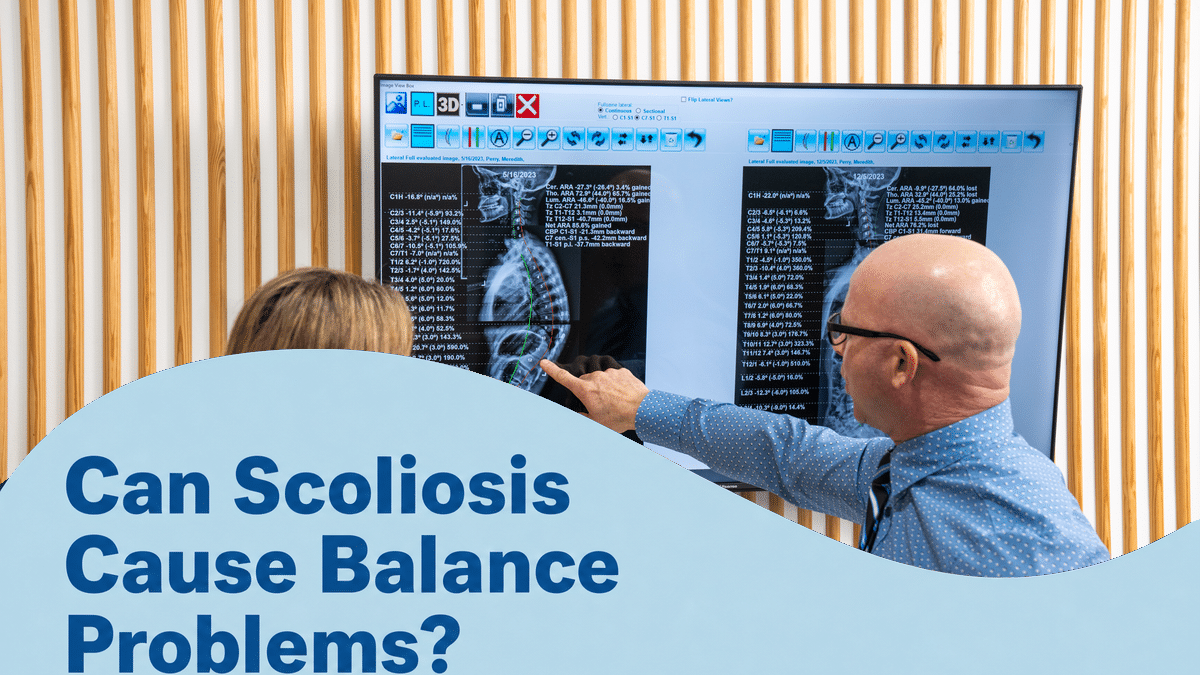
What you need to know about scoliosis is that while treatment results can never be guaranteed, many potential effects can be avoided through a proactive and customized treatment plan capable of improving the spine and body’s overall balance and stability.
One of the spine’s roles is to facilitate a straight and upright posture. As scoliosis causes the spine to curve unnaturally to the side and rotate, it can shift the body’s center of gravity, and because it’s progressive, uneven forces of scoliosis can increase over time, disrupting posture, coordination, gait, and balance.
The effects of scoliosis can be widespread, and when the spine’s balance is disrupted, it can become increasingly unstable.
Scoliosis and Center of Gravity
Think of your center of gravity as the point where the body’s weight is concentrated and the body parts are balanced around it (1).
A primary role of the spine is to facilitate a straight and upright posture, and in adults with a straight healthy posture, the center of gravity is typically in front of the sacrum (triangular-shaped bone connecting the spine to the pelvis), but the body’s center of gravity isn’t a fixed point; it can shift with movement and is shaped by a person’s posture and limb-position (1).
The lower a person’s center of gravity and the wider the base of support, the more stability there is, but what happens if the spine develops an unnatural sideways curve and rotates?
Scoliosis can affect a person’s center of gravity by introducing uneven forces to the spine, its surroundings, and the entire body, and the type of disruptions that occur due to the spine’s unhealthy curve/rotation are shaped by a number of factors, including severity (2).
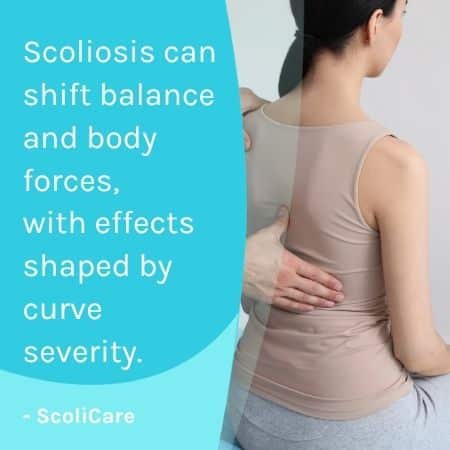
Scoliosis severity is determined by the size of the scoliosis, the angle of trunk rotation, rate of progression, and curvature location.
In a healthy spine, its vertebrae are aligned and stacked on top of one another in a straight and neutral alignment, but when an unhealthy curve and rotation develops, some of those vertebrae are unnaturally tilting out of the spine’s alignment, and the more misaligned the spine becomes, the more off-balance and unstable it can be.
If the body’s center of gravity has shifted due to the scoliosis, this can also get worse over time because scoliosis is progressive, and unless counteracted by a proactive treatment plan, the nature of scoliosis and its effects are to increase over time, including disruptions to balance (1, 2).
So if the spine is off-balance, so is the body, and this can be noticeable in a patient’s proprioception.
Scoliosis and Proprioception
As the spine is one long structure, the health of each section is shaped by the health of the other sections, so even if one section is misaligned, it can disrupt the biomechanics of the entire spine.
Proprioception refers to the body’s ability to orient itself in space without visual cues, so in darkness, many scoliosis patients experience sensations of dizziness and/or have difficulty maintaining balance (3).
Proprioception depends on input sent from sensory receptors (proprioceptors) in the muscles, tendons, and joints to the brain to coordinate movement, posture, and balance; this is an unconscious process (3).
The process of proprioception depends on sensory receptors sending information to the brain and central nervous system, and this integration facilitates an unconscious awareness of body position and movement (3).
As it’s the brain and spinal cord that form the central nervous system (the body’s vast communication network coordinating conscious and unconscious processes), if the spine has developed an unnatural curve and twist, it can affect the function of the spinal nerves, potentially disrupting communication between the spinal nerves and the brain (4).
Muscular Imbalance
Scoliosis can also interfere with a person’s proprioception by causing a muscular imbalance; as the muscles surrounding the spine are pulled in different directions, muscles on one side of the curve’s concave side can become tight and strained from overuse, while muscles on the convex side of the curve can become weak from lack of use (5, 6).
A muscle imbalance doesn’t just mean less support and stability for the spine, it can also interfere with muscle spindle and mechanoreceptors providing proprioceptive accurate feedback; when this occurs, information about movement, muscle health, length, and tension isn’t properly represented in the brain (6).
Scoliosis and Postural Changes
Scoliosis affects all ages and ranges widely in severity, but in most cases of childhood scoliosis, the earliest signs involve the development of asymmetrical posture; as the spine becomes misaligned, body posture is also affected (7).
For parents and/or caregivers, awareness of the early signs of scoliosis can lead to early detection, and while treatment results can’t be guaranteed, there are direct links between early intervention and treatment success (7).
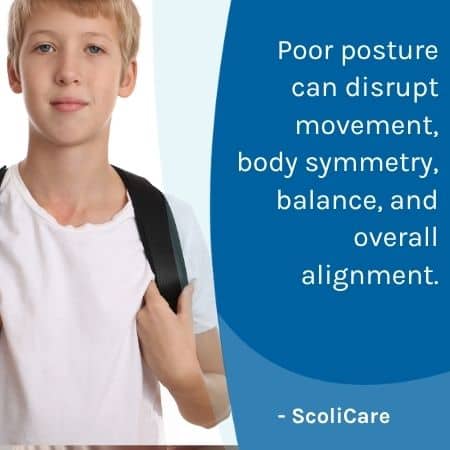
Uneven shoulders and hips are common, as is the development of a rib cage arch and asymmetrical arm and leg length.
The more posture is disrupted, the more movement can be affected, and as unhealthy movement patterns develop, it’s not just the spine that’s misaligned, but also the body’s overall symmetry and balance that’s disrupted (8).
Changes to balance are common even in some cases of mild scoliosis, and if left untreated, or not treated proactively, balance-issues caused by scoliosis may get worse over time as progression occurs, and the more posture is affected, the more potential there is for an uneconomical gait to develop (8).
Unhealthy posture and movement patterns can cause uneven wear and tear on the spine, leading to more degenerative changes within the spine.
When balance is disrupted, patients are more at risk of injury through a fall, and in cases of degenerative scoliosis that affect older patients and are caused by degenerative instability, restoring the spine’s balance and stability is a focus of fall prevention (9).
Conclusion
Can scoliosis cause balance problems? As an asymmetrical spinal condition, scoliosis has the potential to disrupt a patient’s proprioception, muscle symmetry, posture, gait, and overall balance.
Scoliosis can disrupt balance through changes to proprioception and muscle balance, posture and movement patterns.
If an abnormal curvature of the spine is left untreated, it’s likely to get worse over time, and as progression is triggered by growth, cases of adolescent idiopathic scoliosis are the most at risk for rapid advancement due to the unpredictable growth spurts of puberty.
If the spine is misaligned, it needs to be addressed; spinal health shapes our ability to remain upright and maintain healthy posture and movement patterns, and it also works with the brain to form the central nervous system, so disruptions to spinal health and balance can cause widespread effects.
When scoliosis is treated proactively with early diagnosis and intervention, many related effects may be preventable.
Find Your Nearest Clinic
ScoliCare Clinics, affiliates and product providers are in over 200 locations around the world. Find your nearest ScoliCare location here.


References:
- Le Huec JC, Saddiki R, Franke J, Rigal J, Aunoble S. Equilibrium of the human body and the gravity line: the basics. Eur Spine J. 2011 Sep;20 Suppl 5(Suppl 5):558-63. doi: 10.1007/s00586-011-1939-7. Epub 2011 Aug 2. PMID: 21809013; PMCID: PMC3175916
- Zabjek KF, Coillard C, Rivard CH, Prince F. Estimation of the centre of mass for the study of postural control in Idiopathic Scoliosis patients: a comparison of two techniques. Eur Spine J. 2008 Mar;17(3):355-360. doi: 10.1007/s00586-007-0568-7. Epub 2008 Jan 8. PMID: 18183428; PMCID: PMC2270390
- Johnson EO, Babis GC, Soultanis KC, Soucacos PN. Functional neuroanatomy of proprioception. J Surg Orthop Adv. 2008 Fall;17(3):159-64. PMID: 18851800.
- Le Berre M, Guyot MA, Agnani O, Bourdeauducq I, Versyp MC, Donze C, Thévenon A, Catanzariti JF. Clinical balance tests, proprioceptive system and adolescent idiopathic scoliosis. Eur Spine J. 2017 Jun;26(6):1638-1644. doi: 10.1007/s00586-016-4802-z. Epub 2016 Nov 14. PMID: 27844226
- Fidler MW, Jowett RL. Muscle imbalance in the aetiology of scoliosis. J Bone Joint Surg Br. 1976 May;58(2):200-1. doi: 10.1302/0301-620X.58B2.932082. PMID: 932082
- Research on the Correlation between Balance Function and Core Muscles in Patients With Adolescent Idiopathic Scoliosis Neurospine. 2025;22(1):264-275. Published online March 31, 202
DOI: https://doi.org/10.14245/ns.2448938.469Xu - de Groot C, Heemskerk JL, Willigenburg NW, Altena MC, Kempen DHR. Educating Parents Improves Their Ability to Recognize Adolescent Idiopathic Scoliosis: A Diagnostic Accuracy Study. Children (Basel). 2022 Apr 15;9(4):563. doi: 10.3390/children9040563. PMID: 35455607; PMCID: PMC9025014
- J, Chen M, Wang X, Luo X. Biomechanical changes in adolescent idiopathic scoliosis during walking: A protocol for systematic review and meta-analysis. Medicine (Baltimore). 2023 Dec 8;102(49):e36528. doi: 10.1097/MD.0000000000036528. PMID: 38065886; PMCID: PMC10713143
- Marty-Poumarat, Catherine MD*; Scattin, Luciana MD†; Marpeau, Michèle MD*; Garreau de Loubresse, Christian MD‡; Aegerter, Philippe MD, PhD§. Natural History of Progressive Adult Scoliosis. Spine 32(11):p 1227-1234, May 15, 2007. | DOI: 10.1097/01.brs.0000263328.89135.a6
More news
-
 14 March 2021
Kurt Cobain and his Scoliosis Part of our series of famous people who have/had a Scoliosis. Next up is Kurt Cobain! Kurt Cobain is best known as the lead…
-
 24 April 2023
Scoliosis and hyperkyphosis are complex conditions that can present significant challenges for healthcare providers. With progressive and degenerative cases, it's essential that patients have access to the right treatment options…
-
 1 November 2022
It is hard to believe that the fastest man on earth has scoliosis! Olympian Usain Bolt was born with scoliosis. His right leg is half an inch shorter than his…