
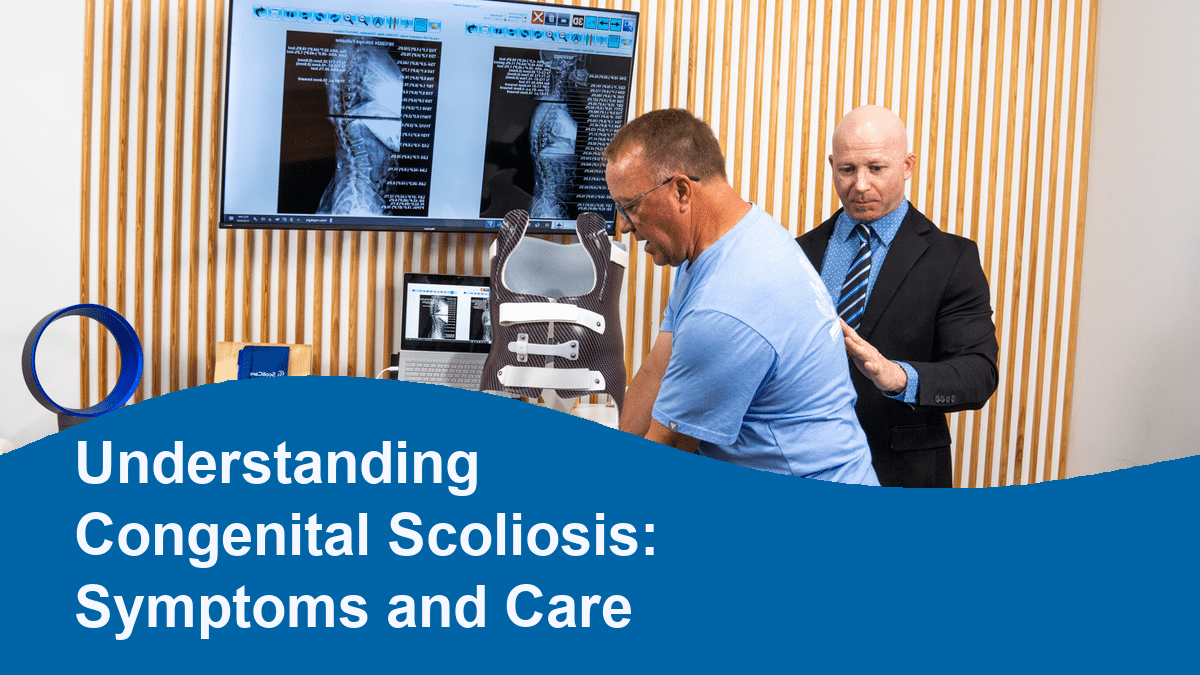
Part of diagnosing scoliosis involves further classifying cases based on key variables, and the more thorough and accurate a patient’s initial assessment, the more customized a treatment plan can be. When it comes to congenital scoliosis patients, these cases can present with additional congenital abnormalities so require thorough assessment.
Congenital scoliosis is a rare type that babies are born with; it’s caused by a malformed spine that develops in utero. While there are different types of malformations, the structural abnormality within the spine causes an unnatural curve with rotation to form.
Scoliosis affects all ages, from babies to the elderly. There are two types of scoliosis to affect babies, and those born with it are diagnosed with congenital scoliosis.
What is Congenital Scoliosis
Babies are born with congenital scoliosis, and scoliosis causes the spine to curve unnaturally to the side and rotate.
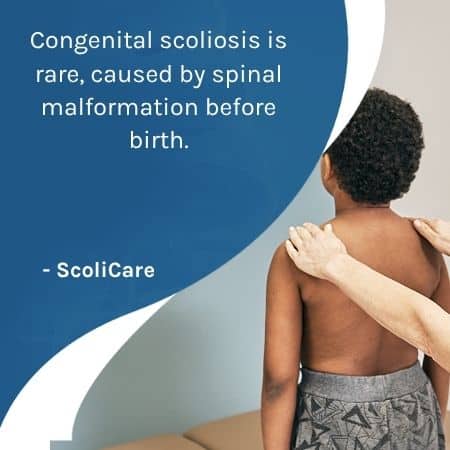
Congenital scoliosis is a rare form affecting approximately 1 in 10,000, and it’s caused by a malformed spine that develops in utero (1).
A healthy spine is formed through multiple stages and starts in early pregnancy with the formation of the neural tube, around 2 to 3 weeks after conception (2).
The neural tube consists of the brain and spinal cord, which work in tandem to form the body’s central nervous system (CNS) (2); the central nervous system is the body’s vast communication network.
After the neural tube is formed, cells (somites) separate and form into vertebrae (bones of the spine). Next, cartilage is formed (flexible connective tissue), and as ossification occurs, bones become fully formed (2).
As the baby grows throughout the stages of pregnancy, so does the spine, and the spine’s curves and alignment are formed throughout the process.
If a baby’s spine forms a scoliosis, it has an unnatural lateral curvature that also twists, and when there is this type of abnormal development in the spline, additional congenital abnormalities are more likely to be present at birth (1).
Congenital Spinal Malformations
A healthy spine will form in a straight and neutral alignment; it will have its natural curves in place and have no rotation.
In a healthy spine, its vertebrae are rectangular-shaped and stack on top of each other evenly, separated by an intervertebral disc (3).
A spine that’s aligned is one that has its natural and healthy curves in place at each of the spine’s main sections: the cervical spine (neck), thoracic spine (middle/upper back), and the lumbar spine (lower back).
Congenital spinal malformations can occur in formation (how a vertebra forms in terms of shape) and/or segmentation (how a vertebral body forms as a distinct and separate bone (3).
Formation Abnormalities
If there is a failure of formation, this may involve vertebrae missing or only partially forming (hemivertebra) (3).
When a vertebral body isn’t completely formed, it can be more triangular in shape and cause a sharp angle within the spine, and when there is an entire vertebra missing, this can also disrupt the spine’s structure (3).
Segmentation Abnormalities
While the spine is one long structure with each section affecting the health of the other sections, its individual bones (24 vertebrae) in the three main spinal sections should be separate and distinct.
When a fusion occurs, one or more vertebrae form together, failing to separate into distinct individual bones. Multiple vertebrae fused together is known as a bony bar and restricts healthy development and growth.(3).
A formation or segmentation defect can occur individually, but it’s also common for formation and segmentation abnormalities to occur together, and these cases are more severe (3).
Symptoms of Congenital Scoliosis
Symptoms of congenital scoliosis can include an asymmetrical posture that includes uneven shoulders, hips, the head not aligned over the torso, and an arch in the rib cage. A hairy patch, discolored portion, and/or dimples on the back are also common, as is a prominent lean to one side (4).
Severe cases can involve muscle weakness, numbness, and poor coordination, due to nervous system irregularities, and many infants diagnosed with congenital scoliosis present with additional congenital abnormalities, often involving kidney problems and a tethered spinal cord (4).
Many patients are diagnosed with congenital scoliosis due to indicators of spinal irregularities detected during an initial pediatric examination, but mild cases can go undetected.
As most cases of scoliosis are progressive, and progression is triggered by growth, signs of congenital scoliosis can become more overt as growth is occurring.
Congenital Scoliosis Care Options
Following a diagnosis of congenital scoliosis, there are a number of treatment options, but plans need to be customized and shaped around the specifics of a patient’s scoliosis.
The type, location, and number of abnormal vertebrae, the curve and rotation’s severity, and/or additional abnormalities will be key factors to consider in care (4, 5).
A comprehensive assessment will focus on how likely continued progression is, and this can include recommendations to observe and monitor how a patient’s spine is responding to growth.
Not all cases of congenital scoliosis are progressive, but due to the nature of progression and the amount of growth an infant has to go through prior to reaching skeletal maturity, progression is likely.
Congenital scoliosis features curves caused by structural abnormalities, but in some cases, compensatory curves can also develop as the spine attempts to counteract the uneven forces of the scoliosis.
When it comes to structural abnormalities, bracing and casting is more effective on compensatory curves, but when congenital scoliosis is progressing with growth and/or in severe cases, surgical recommendations are common (4, 5).
Spinal fusion is a common surgical response, and in cases of a single hemivertebra, surgical treatment can involve the abnormal vertebra’s removal (4, 5).
The more vertebrae that are malformed, the more severe the scoliosis, the more potential there is for continued progression, and the more likely surgical recommendations are (4, 5).
Conclusion
While congenital scoliosis is a rare type, it needs to be taken seriously and treated proactively. In mild cases, observation may be recommended with periodic physical examinations and X-rays to monitor how the spine is responding to growth.
In mild cases that don’t progress, these can be deemed stable and may be recommended for continued observation without surgical treatment, but in cases of severe curves and continued progression during growth, surgical treatment may be necessary to address the structural abnormalities within the spine’s vertebrae, and to work towards counteracting the progressive nature of scoliosis.
Here at ScoliCare, cases of congenital scoliosis are comprehensively assessed and monitored, and treatment plans are fully customized to address the specifics of an individual’s scoliosis.
Find Your Nearest Clinic
ScoliCare Clinics, affiliates and product providers are in over 200 locations around the world. Find your nearest ScoliCare location here.


References:
- Sebaaly A, Daher M, Salameh B, Ghoul A, George S, Roukoz S. Congenital scoliosis: a narrative review and proposal of a treatment algorithm. EFORT Open Rev. 2022 May 5;7(5):318-327. doi: 10.1530/EOR-21-0121. PMID: 35510738; PMCID: PMC9142820
- Kuwar Chhetri P, Das JM. Neuroanatomy, Neural Tube Development and Stages. [Updated 2023 Jul 24]. In: StatPearls [Internet]. Treasure Island (FL): StatPearls Publishing; 2025 Jan-. Available from: https://www.ncbi.nlm.nih.gov/books/NBK557414/
- Burnei G, Gavriliu S, Vlad C, Georgescu I, Ghita RA, Dughilă C, Japie EM, Onilă A. Congenital scoliosis: an up-to-date. J Med Life. 2015 Jul-Sep;8(3):388-97. PMID: 26351546; PMCID: PMC4556925
- Grabala P. Congenital Scoliosis: A Comprehensive Review of Diagnosis, Management, and Surgical Decision-Making in Pediatric Spinal Deformity-An Expanded Narrative Review. J Clin Med. 2025 Nov 14;14(22):8085. doi: 10.3390/jcm14228085. PMID: 41303121; PMCID: PMC12653983
- Peng Z, Zhang H, Wang S, Zhang J. Advances in the diagnosis and treatment of congenital scoliosis. Eur J Med Res. 2025 Jul 29;30(1):683. doi: 10.1186/s40001-025-02943-3. PMID: 40731016; PMCID: PMC12306066
More news
-
 3 March 2026
Early signs of scoliosis—like uneven shoulders or hips—can be subtle. Spotting them early boosts the chances of successful, proactive treatment.
-
 25 July 2025
Scoliosis can be highly responsive to treatment, particularly when conditions are diagnosed and treated early. The different types of scoliosis can have distinct treatment needs, and patients need to decide…
-
 8 August 2025
What patients need to understand about severe scoliosis is that it doesn't start that way; as a progressive condition, scoliosis severity can increase over time, and while young patients can…