
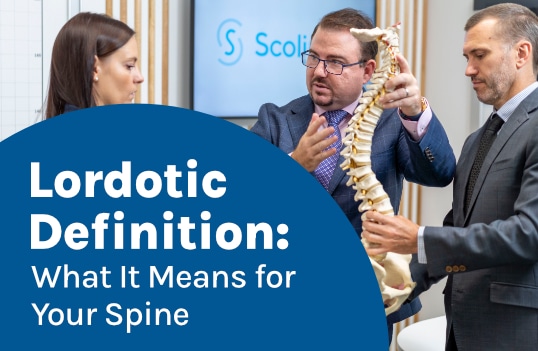
In order for the spine to function optimally, it needs to maintain its healthy curves for balance and stability. Spinal-curve size is measured in degrees, and while there is a natural variance in curve size from person to person, curves that are over-pronounced can disrupt the spine’s biomechanics.
Lordosis refers to the spine’s natural and healthy inward curve found in the cervical and lumbar spinal sections. The spine’s healthy curves facilitate strength, flexibility, shock absorption, balance, and stability. If a person’s lordosis becomes excessive and symptomatic, this is known as hyperlordosis.
The two main spinal-curve types include lordosis and kyphosis, and while they are opposite curve types, they work together to maintain the spine’s balance, strength, and stability.
Lordosis
Lordosis causes the spine to curve inward, towards the center of the body, and lordotic curves are found in the neck (cervical spine) and the lower back (lumbar spine). Kyphosis is the opposite curve type that curves outwards.
Together, the curves maintain the spine’s balance and alignment. If a spinal curve becomes over-pronounced, however, it can disrupt the health of the entire spine; the spinal sections are connected and shape each other’s health.
Hyperlordosis is diagnosed if a person’s lordosis becomes excessive, and hypolordosis is diagnosed if there is an excessive loss of lordosis, but hyperlordosis is far more common (1).
A diagnosis of cervical lordosis, aka, cervical hyperlordosis, means the neck curves too far inward, and lumbar hyperlordosis means the lower back has developed an excessive lordotic curve.
Cervical Hyperlordosis
There are a number of spinal conditions that cause a loss of its healthy curves, and when it comes to hyperlordosis, the main effects will be felt in the affected spinal section and its immediate surroundings.
Symptoms of hyperlordosis are shaped by the size of the curve, its underlying cause, and the lordotic curve’s location.
While the spinal sections work together, they also have distinct roles to play in the spine’s biomechanics.
The cervical spine, for example, has to support the weight of the head, connects the brain to the spine and the rest of the body, protects the spinal cord and vertebral arteries, and facilitates the neck’s range of motion.
If the cervical spine curves too far forward, the head can shift forward in an attempt to counteract what’s happening below, significantly increasing the weight of the head on the cervical spine (2).
Cervical hyperlordosis and forward head posture disrupt the straight and neutral alignment of the cervical spine, and this strains the muscles of the upper neck and can compress the cervical vertebrae (2).


Common symptoms of cervical hyperlordosis include neck pain, shoulder pain, headaches, muscle pain and imbalance, and a reduced range of motion (2).
While hyperlordosis can develop in the cervical spine, it most commonly affects the lumbar spine.
Lumbar Hyperlordosis
Lumbar hyperlordosis affects the lower back; the lower back is vulnerable to a number of spinal conditions/issues, and lower back pain is a leading cause of disability globally (3).
The lumbar spine has to support the weight of the thoracic and cervical spinal sections, the torso, so its vertebrae are the largest and strongest, and they also feel the effects of strenuous movement such as heavy lift, deep bends, and twists (3).
The lumbar spine shapes lower body health and movement; if the lower back is not aligned, it can affect body posture, the distribution of body weight over the pelvis, the transfer of energy down the legs, and movement patterns (3).
The unnatural lower-back curve can cause the pelvis to tilt (pelvic obliquity), exposing the lower body to uneven forces and disrupting its ability to stabilize the hips and attached muscles, and transfer and support upper body weight (3).
Lumbar hyperlordosis is commonly referred to as swayback, due to the condition’s main visual effect: the exercise forward spinal curve causes the abdomen and buttocks to protrude excessively (3).
Back pain and numbness are common symptoms, along with the inability to lay flat with the lower spine in contact with the surface below; instead, there is a noticeable gap (3).
Postural health and spinal health shape each other, so disruptions to one will always affect the other, and the main symptom of lumbar hyperlordosis is the postural shift that occurs as the lower back curves too far forward (3).
What too much lordosis means for the spine is that it can’t function optimally.
The spine’s main roles are to act as a central structural anchor for the body, provide attachment points for muscles and supportive structures, protect the spinal cord for central nervous system health, important organs, maintain a straight and upright posture, and healthy movement patterns.
Back pain, particularly lower back pain, is a leading cause of disability in older adults, and this is often related to unhealthy posture: the body leaning too far forward or excessively backward (3).
Poor posture causes uneven wear on the spine and body, and can initiate the onset of spinal disc and joint degeneration (3).
Conclusion
The definition of lordosis is the spine’s natural inward curve at the cervical and lumbar spinal sections.
The term lordosis can refer both to healthy and unhealthy levels, while hyperlordosis specifies the lordosis is excessive and problematic.
If the neck loses its healthy degree of lordosis, its ability to support the weight of the head is affected as the head shifts forward to maintain its straight upright position, increasing weight and strain on the cervical vertebrae. As stiffness develops in the cervical spine, pain in the neck and shoulders are common, along with tension headaches.
Because the cervical spine acts as the bridge between the brain, spine, and body, nerve communication and health can also be disrupted due to compression.
If the lower back loses its healthy degree of lordosis, becoming excessive, the lumbar spine’s weight-bearing ability can be disrupted, along with the transfer for mechanical stress evenly throughout the lower body.
An unhealthy lumbar spine can disrupt the position of the pelvis which shapes lower body movement and weight distribution.
Lumbar hyperlordosis also causes postural changes in the form of a swayback appearance involving the buttocks and abdomen protruding excessively.
Posture shapes movement patterns and the type of forces exerted on the discs and joints of the spine, along with the spine’s surrounding muscles and supportive structures.
The way we hold our bodies during rest and movement shapes the type of forces experienced by the spine and body, and if unhealthy spinal curves are present, uneven pressure is occurring, the spine won’t wear evenly, potentially contributing to the early onset of disc and joint degeneration.
When treating a number of spinal conditions including hyperlordosis, hyperkyphosis, and scoliosis, a focus is on restoring as much of the spine’s healthy curves, balance, alignment, and stability as possible; and this involves a focus on postural restoration for long-term improvements to spinal health.
What any unnatural spinal curve means for the spine is assessment and treatment is needed to prevent increasing effects and degenerative changes.
Find Your Nearest Clinic
ScoliCare Clinics, affiliates and product providers are in over 200 locations around the world. Find your nearest ScoliCare location here.


References:
- Beckers L, Bekaert J. The role of lordosis. Acta Orthop Belg. 1991;57 Suppl 1:198-202. PMID: 1833945
- Morningstar MW. Cervical hyperlordosis, forward head posture, and lumbar kyphosis correction: A novel treatment for mid-thoracic pain. J Chiropr Med. 2003 Summer;2(3):111-5. doi: 10.1016/S0899-3467(07)60055-X. PMID: 19674605; PMCID: PMC2646952
- Du SH, Zhang YH, Yang QH, Wang YC, Fang Y, Wang XQ. Spinal posture assessment and low back pain. EFORT Open Rev. 2023 Sep 1;8(9):708-718. doi: 10.1530/EOR-23-0025. PMID: 37655847; PMCID: PMC10548303
More news
-
 2 September 2026
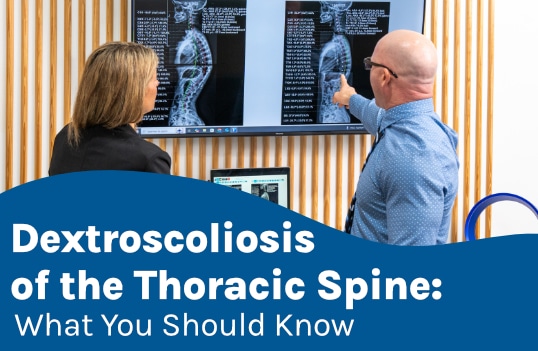
Thoracic dextroscoliosis is a right-curving spinal condition affecting the upper back. Early diagnosis helps guide personalized treatment and manage progression.
-
 12 June 2026
Scoliosis is a condition that affects the spine: an unnatural sideways-bending spinal curvature that rotates develops. As a progressive lateral curvature of the spine, the nature of scoliosis is to…
-
 6 February 2024
As students head back to school, a trusty backpack becomes an essential companion. However, the convenience of carrying books, laptops, and supplies on your back comes with a responsibility to…