
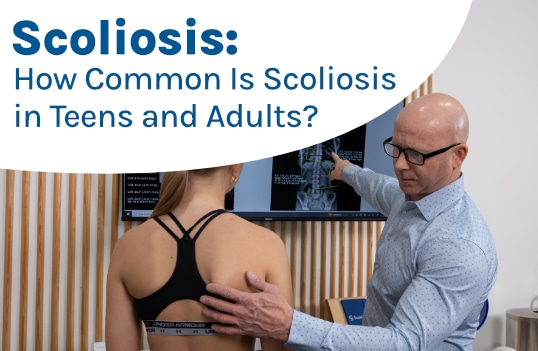
With current estimates at close to seven million people currently living with scoliosis in the United States alone, spreading awareness is important. Understanding who scoliosis affects, and just how common it is, can lead to recognizing the condition’s early signs for early intervention.
Scoliosis causes the spine to curve unnaturally to the side and rotate, and it affects all ages from babies to infants, juveniles to adolescents, adults and the elderly. Scoliosis is the most prevalent spinal condition affecting school-aged children, and while scoliosis is more frequently diagnosed during childhood, the actual rate of scoliosis increases among the aging population.
Scoliosis treatment plans need to be fully customized to address a number of key variables, one of which is patient age.
Scoliosis in Teens
Scoliosis affects all ages, but is most prevalent among adolescents; adolescent idiopathic scoliosis is the most common type of scoliosis with some studies showing 5 percent of adolescents between the ages of 10 and 18 living with scoliosis (1).
Adolescent idiopathic scoliosis affects children from 10 years of age into young adulthood. In females, it appears around the onset of puberty, and a little later in males; it’s more commonly seen in females and is also more likely to progress in females (1).
Teens with scoliosis don’t typically present with other health issues, but because scoliosis is progressive, and progression is triggered by growth, it can become severe quickly (2, 3).
Scoliosis ranges from mild scoliosis to moderate, severe and very severe scoliosis, and the goal of treating teens with scoliosis is to counteract progression during growth, and as corrections are made, to maintain those corrections, despite the intense and unpredictable nature of pubescent growth spurts (2, 3).

Given how prevalent scoliosis is in teenagers, it’s important for parents and caregivers to be aware of the early signs of scoliosis to watch for, particularly if there are risk factors in place.
Early Signs of Scoliosis in Teens
No treatment outcome can ever be guaranteed, but an early diagnosis means the potential benefits of early intervention are within reach, but only if a proactive treatment approach is applied (2).
The earliest signs of scoliosis in adolescents are postural changes. As scoliosis develops and progresses, it exposes the spine, its surroundings, and the entire body to uneven forces, and its main effect in children is the development of asymmetrical posture (3).
In many cases, the earliest scoliosis symptoms are uneven shoulders and uneven hips. As growth occurs triggering progression, symptoms can increase and become more noticeable and disruptive (3).
In mild cases, postureal changes can be subtle and difficult to notice, which is why awareness becomes important.
If a teenager suddenly seems to be showing signs of asymmetrical posture, clothing seems ill-fitting, not hanging evenly, this warrants the need for assessment.


Changes to balance, coordination, and gait are additional signs of scoliosis progression to watch for (2), but the goal is to recognize the earliest signs of scoliosis so progression can be prevented, and patients can be spared the challenges associated with increasing scoliosis severity and more-complex treatment needs (3).
Adolescent Idiopathic Scoliosis Risk Factors
In addition to being aware of the early indicators of scoliosis in children, understanding scoliosis risk factors is key.
If a child has certain risk factors in place, they should be undergoing regular scoliosis screening examinations with the goal of early detection and intervention, and parents should be regularly checking for postural changes as well.
While medical studies and research aren’t without limitations, one of the largest studies exploring the association between family history of scoliosis and curve size found that in 1,463 patients with idiopathic scoliosis, those with another family member diagnosed had larger curve sizes than those without a family history (4).
Because a single gene has yet to be identified that accounts for the development of scoliosis, yet family history is a significant predictor of more family members being diagnosed, scoliosis is considered more familial than genetic; remember, families share more than just genes (5, 6).
As females are more often affected and are more likely to face severe curve progression, females approaching adolescence with a family history of scoliosis should be regularly screened (5, 6).
Some studies on scoliosis prevalence among family members found 26 percent of scoliosis patients had a family member with scoliosis and a sibling recurrence risk of scoliosis of 18 percent (6).
So while we don’t fully understand the etiology of idiopathic scoliosis, we know it’s most often diagnosed during adolescence, and we know it’s most common in females with a family history (3, 5).
Scoliosis in Adults
As mentioned, scoliosis is most often diagnosed during childhood, but it also affects adults. Adult scoliosis is diagnosed once skeletal growth has stopped.
It’s estimated that the rate of adult scoliosis is 8 percent in adults over the age of 25, and rates increase to as high as 68 percent in adults between the ages of 60 and 90 (7).
The increasing scoliosis rate in older adults is due to degenerative instability (7).
Although growth is the main trigger for curve progression, adults still face progression, and even incremental increases in curve size can seem minor, but over time, add up to significant progression capable of disrupting the spine’s stability (7).
Idiopathic Scoliosis in Adulthood
The most common type of adult scoliosis is idiopathic scoliosis in adulthood; these cases typically involve pre-existing adolescent scoliosis that was neither diagnosed nor treated during adolescence (8).

Mild adolescent idiopathic scoliosis can be difficult to recognize, which is why most patients are diagnosed when they have progressed into the moderate stage and symptoms become more noticeable; some cases can remain unnoticed until after growth has stopped and scoliosis effects intensify (3).
The main symptom of adult scoliosis that leads to assessment and diagnosis is pain. Scoliosis pain can include the back, its surrounding muscles and supportive structures, and radiating pain in the extremities caused by nerve compression (9).
Degenerative De Novo Scoliosis
While most cases of idiopathic scoliosis in adulthood are pre-existing from adolescence, degenerative de novo scoliosis develops later in life with no prior history.
Degenerative scoliosis affects older adults over the age of 45, and with rates as high as 68 percent in adults over the age of 60, it’s a significant cause of disability in seniors (7).
Most degenerative changes in the spine start with the intervertebral discs; as the uneven forces of scoliosis cause uneven pressure and weight distribution, the discs and joints of the spine are wearing unevenly during movement, and because the spinal discs don’t have their own vascular supply, it can be difficult to reverse degenerative changes that have occurred slowly over the years (10).
And remember, it’s not just disc degeneration caused by scoliosis that contributes, but also the cumulative effect of daily stressors and certain lifestyle choices; carrying excess weight, low activity levels, and chronic poor posture can makes discs and joints more vulnerable to the onset of degenerative changes (10).
Degenerative scoliosis is caused by degenerative instability, so most cases are painful (lower back pain) and progressive, and this makes older adults increasingly vulnerable to injury from a fall (10).
Conclusion
When an unnatural spinal curve of more than 10 degrees with rotation develops, scoliosis is diagnosed, and patient age can shape scoliosis symptoms, progressive rates, and treatment needs.
There are approximately 7 million people living with scoliosis in the United States alone, representing 2 to 3 percent of the general population.
An approximate 5 percent of adolescents are affected by scoliosis, and while adolescents are more frequently diagnosed, due to spinal degeneration in older adults, scoliosis becomes more common amongst the aging population with rates as high as 60-68 percent.
As such a highly-prevalent progressive spinal condition that benefits from early diagnosis and proactive treatment, spreading awareness to support early detection and intervention shapes the ScoliCare approach.
Find Your Nearest Clinic
ScoliCare Clinics, affiliates and product providers are in over 200 locations around the world. Find your nearest ScoliCare location here.


References:
- Konieczny MR, Senyurt H, Krauspe R. Epidemiology of adolescent idiopathic scoliosis. Journal of Children’s Orthopaedics. 2013;7(1):3-9
- Negrini, S., Donzelli, S., Aulisa, A. G., Czaprowski, D., Schreiber, S., de Mauroy, J. C., … & Zaina, F. (2018). 2016 SOSORT guidelines: orthopaedic and rehabilitation treatment of idiopathic scoliosis during growth. Scoliosis and spinal disorders, 13(1), 3
- Weinstein SL. The Natural History of Adolescent Idiopathic Scoliosis. J Pediatr Orthop. 2019 Jul;39(Issue 6, Supplement 1 Suppl 1):S44-S46. doi: 10.1097/BPO.0000000000001350. PMID: 31169647
- Grauers A, Danielsson A, Karlsson M, Ohlin A, Gerdhem P. Family history and its association to curve size and treatment in 1,463 patients with idiopathic scoliosis. Eur Spine J. 2013 Nov;22(11):2421-6. doi: 10.1007/s00586-013-2860-z. Epub 2013 Jun 26. PMID: 23801015; PMCID: PMC3886503
- Understanding Genetic Factors in Idiopathic Scoliosis, a Complex Disease of Childhood – Curr Genomics. 2008 Mar; 9(1): 51–59 Source
- Grauers A, Einarsdottir E, Gerdhem P. Genetics and pathogenesis of idiopathic scoliosis. Scoliosis Spinal Disord. 2016 Nov 28;11:45. doi: 10.1186/s13013-016-0105-8. PMID: 27933320; PMCID: PMC5125035
- Trobisch P, Suess O, Schwab F. Idiopathic scoliosis. Dtsch Arztebl Int. 2010 Dec;107(49):875-83; quiz 884. doi: 10.3238/arztebl.2010.0875. Epub 2010 Dec 10. PMID: 21191550; PMCID: PMC3011182
- Ansari K, Singh M, McDermott JR, Gregorczyk JA, Balmaceno-Criss M, Daher M, McDonald CL, Diebo BG, Daniels AH. Adolescent idiopathic scoliosis in adulthood. EFORT Open Rev. 2024 Jul 1;9(7):676-684. doi: 10.1530/EOR-23-0162. PMID: 38949156; PMCID: PMC11297403
- Zaina, F., Marchese, R., Donzelli, S., Cordani, C., Pulici, C., McAviney, J., & Negrini, S. (2023). Current knowledge on the different characteristics of back pain in adults with and without scoliosis: a systematic review. Journal of Clinical Medicine, 12(16), 5182
- Kotwal S, Pumberger M, Hughes A, Girardi F. Degenerative scoliosis: a review. HSS J. 2011 Oct;7(3):257-64. doi: 10.1007/s11420-011-9204-5. Epub 2011 Jun 11. PMID: 23024623; PMCID: PMC3192887
More news
-
 25 October 2023
Back pain in patients with scoliosis is quite prevalent. It is also possible that patients with scoliosis present with specific features of low back or leg pain. ScoliCare Head of…
-
 17 July 2024
Receiving a scoliosis diagnosis as an adult can be daunting. Many people wonder how it happened, what the future holds, and whether it can be treated. Understanding scoliosis in adults…
-
 14 March 2021
Kurt Cobain and his Scoliosis Part of our series of famous people who have/had a Scoliosis. Next up is Kurt Cobain! Kurt Cobain is best known as the lead…