
Spinal fusion surgery has the goal of stopping progression. Harrington rods revolutionized spinal fusion surgery in the mid-20th century, but have since been replaced by alternative spinal instrumentation and modern nonsurgical treatment options.
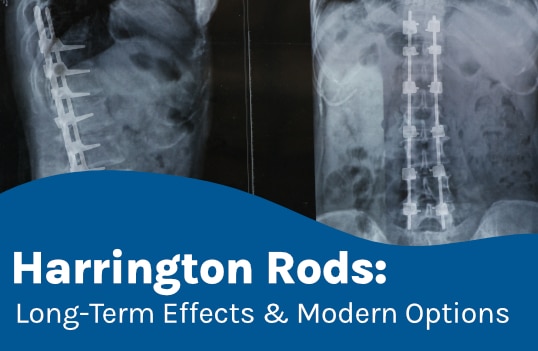
Harrington rods are stainless steel implants used in spinal fusion surgery. Invented in the 1950s as revolutionary surgical instrumentation of the time, Harrington rods were attached to the spine with hooks to maintain the spine’s position after two or more vertebrae were fused together into one solid bone.
Let’s take a look at the history of spinal fusion surgery, before exploring modern nonsurgical scoliosis treatment options.
Spinal Fusion Surgery
Scoliosis involves the development of an unnatural lateral spinal curvature with rotation; it’s 3-dimensional and progressive, meaning its nature is to increase in severity over time (1).
Scoliosis treatment can work towards preventing progression through a curvature reduction or stopping progression through surgical intervention (1).
Traditional scoliosis treatment can include surgical treatment, while nonsurgical scoliosis treatment involves the integration of a multiple scoliosis-specific treatment disciplines such as the practice of ScoliBalance®, and the ScoliBrace®, with adjunctive support through Chiropractic BioPhysics® (1, 2, 3).
Spinal fusion surgery is a scoliosis treatment option that started in the late 1800s, early 1900s. Early efforts to straighten the spine through spinal fusion involved the use of wires to stabilize the spine, and the first spinal fusions using bone grafts were performed on tuberculosis patients (2).
These early spinal fusion surgeries set the surgical stage for spinal fusion as a scoliosis treatment option.
Spinal fusion surgery has the goal of stopping curve progression and does so by fusing the curve’s most-tilted vertebrae into one solid bone, sometimes with a bone graft, so they can’t tilt further out of alignment with the rest of the spine (2).
The main trigger for progression is growth, so how scoliosis is managed during periods of rapid growth is important (4).
Harrington Rods: Early Spinal Fusion Instrumentation
The early 1900s saw early spinal fusions using bone chips to stabilize spines, followed by celluloid bars, steel and silk wiring, and Paul Harrington’s use of distraction rods with hooks in 1955 (2).
The Harrington procedure formed the cornerstone of surgical scoliosis treatment into the late 1980s (2).
The Harrington procedure involved the use of a single metal rod attached to the spine with hooks, and through a ratcheting system, pressure could be applied to the spine’s unnatural curve to realign the spine and hold it in place while the fusion healed (2).
The progression of spinal fusion surgery continued after Harrington rods to include Cotrel-Dubousset instrumentation to pedicle screw systems, and vertebral body tethering (2).
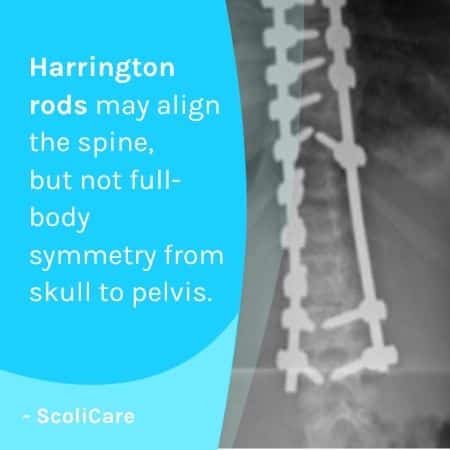
A shortcoming of spinal fusion with Harrington rods is its inability to align the skull and pelvis, focusing only on the spine, when the effects of scoliosis extend beyond the spine; a misaligned spine can disrupt the symmetry of the entire body from the head to the feet (2).
Another limitation of the Harrington rod is its inability to address the rotational component of the spine’s unnatural curve, prompting the emergence of pedicle screws attaching bilateral rods to the spine for improved 3-dimensional correction (2).
Long-Term Effects of Spinal Fusion
Spinal surgery always comes with risks, and when it comes to spinal fusion surgery for scoliosis, it’s important to understand that surgery isn’t the only treatment option available, and because scoliosis is progressive, treatment choices can shape the spine’s long-term health.
Spinal fusion surgery doesn’t aim to correct scoliosis, but rather to stop it from progressing, and the procedure works through immobilization: limiting the spine’s movement so the scoliosis can’t increase.
Because Harrington rods are straight, rigid, and inflexible, they could cause the spine to become too straight, an over-correction of sorts, causing a loss of the lumbar spine’s lordosis (natural inward spinal curve), and leading to flatback syndrome (2, 5).
Flatback syndrome causes people to lean too far forward, chronic poor posture, pain, and unhealthy movement patterns (5).
A spine that’s rigid and immoveable can be painful, and a decreased range of motion can impact quality of life in a number of ways.
Additional potential long-term effects include hardware malfunction; Harrington rods implanted are permanent, and while breakage and/or hooks coming loose isn’t considered a common effect, it is a risk that warrants awareness (6).
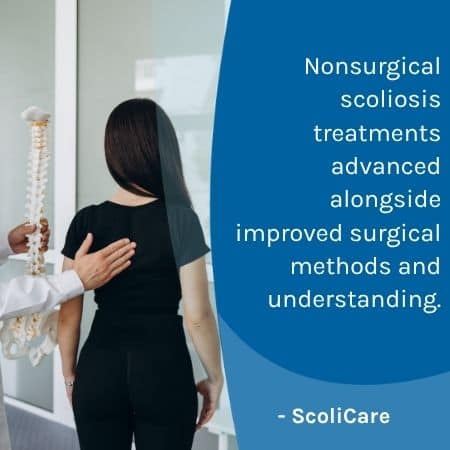
As spinal fusion instrumentation was improving, nonsurgical scoliosis treatment options were developing alongside our growing understanding of scoliosis and potential treatment efficacy.
While treatment results can never be guaranteed, the earlier scoliosis is diagnosed and treated, the more potential there is for nonsurgical scoliosis correction, and avoiding the potential complications of spinal fusion surgery (3).
Nonsurgical Scoliosis Treatment
Modern nonsurgical scoliosis treatment options are innovative, integrative, and evidence-based.
Because scoliosis ranges so widely in severity and there are so many factors that vary from one patient to the next, treatment plans are customized to address the specifics of each patient’s scoliosis.
Modern scoliosis treatment offers a less-invasive treatment alternative, and involves the combination of Chiropractic BioPhysics® (CBP), scoliosis-specific rehabilitative exercise programs, and corrective bracing, which may be also supported by Chiropractic BioPhysics® (CBP) (3, 7).
At ScoliCare Clinics around the world, patients benefit from an entire holistic scoliosis-specific rehabilitation program and a highly specialized approach to scoliosis treatment.
ScoliBalance®
Designed by chiropractor, Dr. Jeb McAviney, and physical therapist Rose Mirenzi, ScoliBalance® combines the best of what scoliosis-specific chiropractic care and established scoliosis-specific exercise-based treatment programs like the Schroth Method and the Scientific Exercise Approach to Scoliosis (SEAS) has to offer (3, 7).
This approach Combining the CBP method with ScolBalance® and ScoliBrace® has potential to impact scoliosis on different levels, including the spine, its surrounding musculature, and the entire body’s 3-dimensional posture (3, 7).
Multiple facets of nonsurgical scoliosis treatment work together to increase the spine’s flexibility and strength, while improving the spine’s alignment and balance.
Being proactive with a customized nonsurgical scoliosis treatment plan can mean avoiding the need for invasive surgical treatment in the future.
Non-surgical scoliosis management should be prioritized in the form of 3D corrective bracing and scoliosis-specific exercise programs: supporting international guidelines and research (3, 4). Other treatments, such as CBP, are considered adjunctive (7).
ScoliBrace®
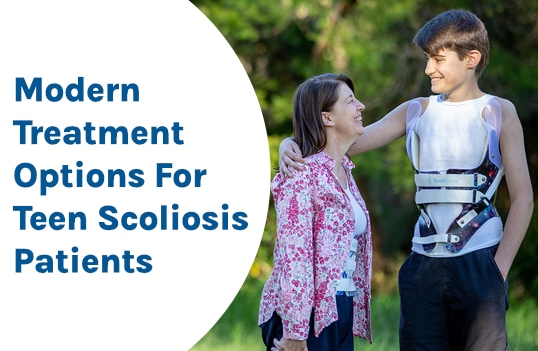
The ScoliBrace® is a custom 3-dimensional scoliosis brace that’s evidence-based and customized to address the specifics of a patient’s posture, scoliosis type, and severity (3).
The ScoliBrace® individualizes potential corrective results through the use of an overcorrective approach to improving spinal alignment and balance through spinal coupling (3).
The brain and body are being retrained, while wearing the brace, to maintain the overcorrective position when not wearing the brace (3).
The ScoliBrace® applies principles of spinal coupling, overcorrection and Mirror Image®, particularly for adolescents with idiopathic scoliosis (4). These are principles that are fundamental components of CBP methods and teachings (3).
The various nonsurgical treatment options work towards the same goal: improving the spine’s position and body posture.
Conclusion
Scoliosis was first documented in ancient times by who was to become known as the Father of Medicine: Hippocrates.
Early forms of scoliosis treatment included tying patients to sticks in an attempt to straighten the unnaturally-curved spine, and these efforts contained the germ of the idea of scoliosis bracing and spinal fusion surgery.
Harrington rods were invented in the 1950s as a means of stabilizing the scoliotic spine through limiting its movement and potential curve progression, but the rod-and-hook system was limited to impacting a 3-dimensional condition in only 2 dimensions, leaving the rotational component unaddressed.
Spinal fusion surgery involves fusing the spine’s most unnaturally-tilted vertebrae into one solid bone and attaching hardware to the spine to maintain its position, but a common long-term effect is a noticeable loss of spinal flexibility and increasing back pain as a result.
Spinal fusion with Harrington rods also offered poor cosmetic results as it failed to realign the head with the pelvis, failing to improve and/or reverse postural changes caused by scoliosis.
Flatback syndrome caused additional issues to arise; the Harrington rod was known to cause an excessive straightening of the lumbar spine due to the straight and rigid nature of the rod.
While there are never treatment guarantees, particularly with early detection and intervention, nonsurgical scoliosis treatment has reshaped scoliosis treatment and potential outcomes available to patients.
Nonsurgical scoliosis treatment is proactive and integrative, combining the power of scoliosis-specific chiropractic principles, customized rehabilitative exercise plans, and corrective bracing.
Find Your Nearest Clinic
ScoliCare Clinics, affiliates and product providers are in over 200 locations around the world. Find your nearest ScoliCare location here.


References:
- Janicki JA, Alman B. Scoliosis: Review of diagnosis and treatment. Paediatr Child Health. 2007 Nov;12(9):771-6. doi: 10.1093/pch/12.9.771. PMID: 19030463; PMCID: PMC2532872
- Tarpada SP, Morris MT, Burton DA. Spinal fusion surgery: A historical perspective. J Orthop. 2016 Nov 9;14(1):134-136. doi: 10.1016/j.jor.2016.10.029. PMID: 27872518; PMCID: PMC5107724
- Marchese, R., Du Plessis, J., Pooke, T., & McAviney, J. (2024). The Improvement of Trunk Muscle Endurance in Adolescents with Idiopathic Scoliosis Treated with ScoliBrace® and the ScoliBalance® Exercise Approach. Journal of Clinical Medicine, 13(3), 653. https://doi.org/10.3390/jcm13030653
- Negrini, S., Donzelli, S., Aulisa, A. G., Czaprowski, D., Schreiber, S., de Mauroy, J. C., … & Zaina, F. (2018). 2016 SOSORT guidelines: orthopaedic and rehabilitation treatment of idiopathic scoliosis during growth. Scoliosis and spinal disorders, 13(1), 3
- Lu DC, Chou D. Flatback syndrome. Neurosurg Clin N Am. 2007 Apr;18(2):289-94. doi: 10.1016/j.nec.2007.01.007. PMID: 17556130
- Erwin WD, Dickson JH, Harrington PR. Clinical review of patients with broken Harrington rods. J Bone Joint Surg Am. 1980 Dec;62(8):1302-7. PMID: 7440608
- Haggard JS, Haggard JB, Oakley PA, Harrison DE. Reduction of progressive thoracolumbar adolescent idiopathic scoliosis by Chiropractic BioPhysics® (CBP®) mirror image® methods following failed traditional chiropractic treatment: a case report. J Phys Ther Sci. 2017 Nov;29(11):2062-2067. doi: 10.1589/jpts.29.2062. Epub 2017 Nov 24. PMID: 29200657; PMCID: PMC5702847
More news
-
 10 March 2026
Scoliosis severity is measured by Cobb angle on X-ray—early, accurate assessment is key, as untreated curves can worsen and cause body-wide effects.
-
 22 July 2026
Teen scoliosis responds best to early, proactive care. Modern nonsurgical treatment offers a personalized alternative to spinal fusion for many patients.
-
 28 August 2024
While scoliosis is quite widely known, the term hyperkyphosis is less familiar. If you're just starting to learn about hyperkyphosis and how it relates to adolescents, you may have questions…