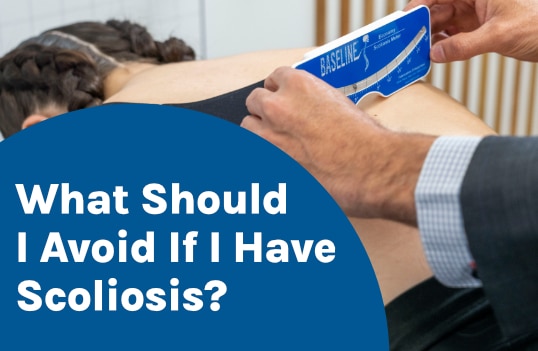
While no two cases of scoliosis are the same, there are certain activities and lifestyle factors that may need to be modified or avoided completely. People with scoliosis need to lead a spine- and scoliosis-friendly lifestyle to preserve spinal health and increase potential treatment efficacy.
Scoliosis patients should avoid exercise that strains the spine, exposes the spine to excessive compressive force, or overuses one side of the body. Poor posture, low-activity levels, and carrying excess weight should also be avoided.
People with scoliosis can lead fulfilling lives in every regard, but in some cases, there are certain activities and exercises to avoid, and leading a spine-friendly lifestyle is important.
Understanding a Scoliosis Diagnosis
It’s important for people recently diagnosed with scoliosis to fully understand what it means in terms of scoliosis symptoms, daily life, and treatment needs.
Being diagnosed with scoliosis means the presence of an unnatural sideways spinal curve with rotation has been confirmed, and because scoliosis is progressive, patients and their families need to understand that scoliosis isn’t a static condition.
The nature of scoliosis is to become more severe over time, and as growth is the main trigger for progression, childhood scoliosis, in particular, can progress quickly (1, 2).
Scoliosis can range from mild to very severe, and although a patient’s treatment-outcome can never be guaranteed, early detection and intervention are crucial (1, 2).
So a diagnosis of mild scoliosis means early detection has been achieved, but patients need to understand that it’s unlikely to stay mild without the help of a proactive treatment plan, and the sooner treatment is started, the more likely it is to stay mild.
Classification Factors
A scoliosis diagnosis will also involve further classification of a condition based on a number of important variables: patient age, scoliosis type, severity, and curve location.
Patient age is important because it indicates a patient’s potential rate of progression, based on whether growth or age-related degenerative changes in the spine are occurring (1, 3).
There are also different types of scoliosis determined by causation, and the most common type is idiopathic scoliosis, with no known cause, but it’s important to understand that not knowing the cause doesn’t mean we don’t know how to treat it, nor does it affect potential treatment efficacy (4).
Scoliosis severity is based largely on curve size, and the more severe, the more likely continued progression is, and curve location is also important because it helps predict the type of symptoms a patient may experience, along with progressive rates; thoracic curves are the most prone to rapid advancement (2).
A diagnosis of scoliosis needs to be fully understood because these important factors shape the customization of treatment plans and daily life, and part of professional assessment and treatment includes guidance of what scoliosis patients should avoid to protect their spines.
Exercises to Avoid With Scoliosis
While scoliosis patients may receive activity restrictions, staying active is important.
Just as treatment plans need to be customized, activity restrictions/recommendations will also be case-specific, which is why it’s essential for patients to consult with treatment providers before participating in sports or adopting a new exercise regimen.
In general, because a scoliotic spine is misaligned, it’s weaker, off-balance, and more vulnerable to injury, and scoliosis doesn’t just affect the spine but also its immediate surroundings; a misaligned spine can disrupt the body’s overall symmetry from the head to the feet (5).
Compressive Force
Scoliosis becomes compressive once growth stops, and compression is uneven and/or excessive pressure, so exercises and activities to avoid include those that expose the spine to increased compressive force.
Sports that involve repeated shock from impact increase compression and strain on the spine so are generally not recommended for people with scoliosis, including high-impact sports like football, soccer, and horseback riding.
While lifting weights can benefit scoliosis patients when it comes to increasing spinal support through improving core strength, lifting heavy weights straight overhead also increases weight and pressure on the spine and should be avoided.
Asymmetrical Exercise
Scoliosis is an asymmetrical condition that disrupts the body’s overall symmetry, and a common effect is muscular imbalance as the spine’s surrounding muscles are worked unevenly; muscles on one side of the spine are working harder to counteract the spine’s unnatural curve, and muscles on the opposite side are becoming weak from lack of use.
So exercises to avoid include those that overuse one side of the body as they can exacerbate the asymmetrical effects of scoliosis and increase muscular imbalance.
Uneven spinal loading increases adverse spinal tension and makes the spine weaker and more vulnerable to injury so should be avoided.
As scoliosis also involves a rotational component, exercises to avoid include those that involve unnatural spinal rotation with twisting motion as this can increase the spine’s unnatural rotation.
Sports like tennis, bowling, golf, and certain yoga poses are generally not considered safe exercises for scoliosis patients, and severe cases are the most likely to include activity restrictions.
Posture and Scoliosis
Postural and spinal health can’t be separated. People with scoliosis need to have postural awareness, and a key component of nonsurgical scoliosis treatment involves patient education through the use of corrective Mirror Image® exercise (6).
The earliest sign of childhood scoliosis is often postural deviation in the form of uneven shoulders and hips (2).
It’s important for patients to know how to hold the spine and body during movement and to carry the corrections into daily activity to maintain the spine’s optimal straight alignment.
A benefit of corrective scoliosis bracing is that the spine’s straight and neutral alignment, and the torso’s upright position, is supported, and the connection between the brain and the spine’s improved position is strengthened and retrained for postural remodeling when out of the brace (6).
A strong core supports healthy posture and movement patterns, and a focus of nonsurgical scoliosis treatment is on improving core strength through scoliosis-specific rehabilitative exercise for more support for the spine, improved balance and stability (6).
Movement and Scoliosis
The spine’s natural design is based on movement, and spinal health depends on a healthy activity level.
As scoliosis progresses, the spine becomes increasingly rigid and less responsive to treatment; this is a key benefit to starting treatment while curves are mild and more flexible.
A focus of nonsurgical scoliosis treatment is increasing and preserving the spine’s flexibility, and flexibility of the curve is a determining factor in treatment.
Staying active can also maintain core strength and spinal support, and symmetrical activity can help counteract muscle imbalances (7).
Most cases of spinal degeneration start with disc degeneration, and staying active can help preserve disc health and function (8).
The intervertebral discs that sit between adjacent vertebral bodies facilitate the spine’s flexibility, shock absorption, and provide cushioning for the vertebrae to prevent friction during movement, but they also don’t have their own vascular supply (8).
The discs depend on changes in pressure to increase circulation and blood flow around the discs, and this means regular movement (8).
Staying active can help slow the onset of degenerative changes in the spine by keeping the spine flexible, its surrounding muscles strong, and discs hydrated and healthy (7, 8).
Unhealthy movement patterns and too little movement are both associated with poor spinal health and degenerative changes.
Weight and Scoliosis
Maintaining a healthy body weight is an important spine-friendly lifestyle factor, and for people with scoliosis, it’s important to not increase pressure on the spine, its surrounding muscles, and supportive structures.
There are a number of lifestyle factors that have a cumulative effect on spinal health over time including poor posture, a sedentary lifestyle, improper repeated heavy lifting, and carrying excess body weight (9).
Carrying excess weight increases spinal loading, particularly with extra weight in the torso area, and can increase an unnatural spinal curve, contributing to degeneration and progression.
In addition, when it comes to diagnosing scoliosis in obese patients, the process can be more difficult as obesity makes it harder to identify spine and trunk asymmetries early (9).
The best way to prevent scoliosis progression is to treat scoliosis proactively with a customized treatment plan while avoiding certain strenuous exercise and practicing a spine-friendly lifestyle.
Conclusion
While not all cases of scoliosis involve activity restrictions, all scoliosis patients can benefit from treatment, and the sooner treatment is started, the better.
There are no treatment guarantees, but with progressive conditions like scoliosis, the timing of treatment can be an important outcome-shaping factor.
Part of protecting a scoliotic spine means avoiding strenuous exercise and activity that can increase progression, exacerbate scoliosis symptoms, and interfere with treatment.
The cumulative effect of certain lifestyle factors can also shape spinal health over time, and leading a spine- and scoliosis-friendly lifestyle involves practicing good posture and cultivating a healthy activity level and body weight.
The most important factor in living with scoliosis is the type of treatment applied, and scoliosis requires an individualized treatment approach that’s proactive and integrative.
References:
- Negrini, S., Donzelli, S., Aulisa, A. G., Czaprowski, D., Schreiber, S., de Mauroy, J. C., … & Zaina, F. (2018). 2016 SOSORT guidelines: orthopaedic and rehabilitation treatment of idiopathic scoliosis during growth. Scoliosis and spinal disorders, 13(1), 3
- Weinstein SL. The Natural History of Adolescent Idiopathic Scoliosis. J Pediatr Orthop. 2019 Jul;39(Issue 6, Supplement 1 Suppl 1):S44-S46. doi: 10.1097/BPO.0000000000001350. PMID: 31169647
- Kotwal S, Pumberger M, Hughes A, Girardi F. Degenerative scoliosis: a review. HSS J. 2011 Oct;7(3):257-64. doi: 10.1007/s11420-011-9204-5. Epub 2011 Jun 11. PMID: 23024623; PMCID: PMC3192887
- Trobisch P, Suess O, Schwab F. Idiopathic scoliosis. Dtsch Arztebl Int. 2010 Dec;107(49):875-83; quiz 884. doi: 10.3238/arztebl.2010.0875. Epub 2010 Dec 10. PMID: 21191550; PMCID: PMC3011182
- Trobisch P, Suess O, Schwab F. Idiopathic scoliosis. Dtsch Arztebl Int. 2010 Dec;107(49):875-83; quiz 884. doi: 10.3238/arztebl.2010.0875. Epub 2010 Dec 10. PMID: 21191550; PMCID: PMC3011182
- Marchese R, Du Plessis J, Pooke T, McAviney J. The Improvement of Trunk Muscle Endurance in Adolescents with Idiopathic Scoliosis Treated with ScoliBrace® and the ScoliBalance® Exercise Approach. J Clin Med. 2024 Jan 23;13(3):653. doi: 10.3390/jcm13030653. PMID: 38337346; PMCID: PMC1085665
- Green BN, Johnson C, Moreau W. Is physical activity contraindicated for individuals with scoliosis? A systematic literature review. J Chiropr Med. 2009 Mar;8(1):25-37. doi: 10.1016/j.jcm.2008.11.001. PMID: 19646383; PMCID: PMC2697577
- Scarcia L, Pileggi M, Camilli A, Romi A, Bartolo A, Giubbolini F, Valente I, Garignano G, D’Argento F, Pedicelli A, Alexandre AM. Degenerative Disc Disease of the Spine: From Anatomy to Pathophysiology and Radiological Appearance, with Morphological and Functional Considerations. J Pers Med. 2022 Nov 1;12(11):1810. doi: 10.3390/jpm12111810. PMID: 36579533; PMCID: PMC9698646
- Catanzariti JF, Rimetz A, Genevieve F, Renaud G, Mounet N. Idiopathic adolescent scoliosis and obesity: prevalence study. Eur Spine J. 2023 Jun;32(6):2196-2202. doi: 10.1007/s00586-023-07709-1. Epub 2023 Apr 25. PMID: 37097342
More news
-
 14 March 2021
Kurt Cobain and his Scoliosis Part of our series of famous people who have/had a Scoliosis. Next up is Kurt Cobain! Kurt Cobain is best known as the lead…
-
 15 July 2024
In recent years, patient-centred care has revolutionised the approach to scoliosis treatment by focusing on the unique needs, preferences and values of each patient. This approach places patients at the…
-
 1 November 2022
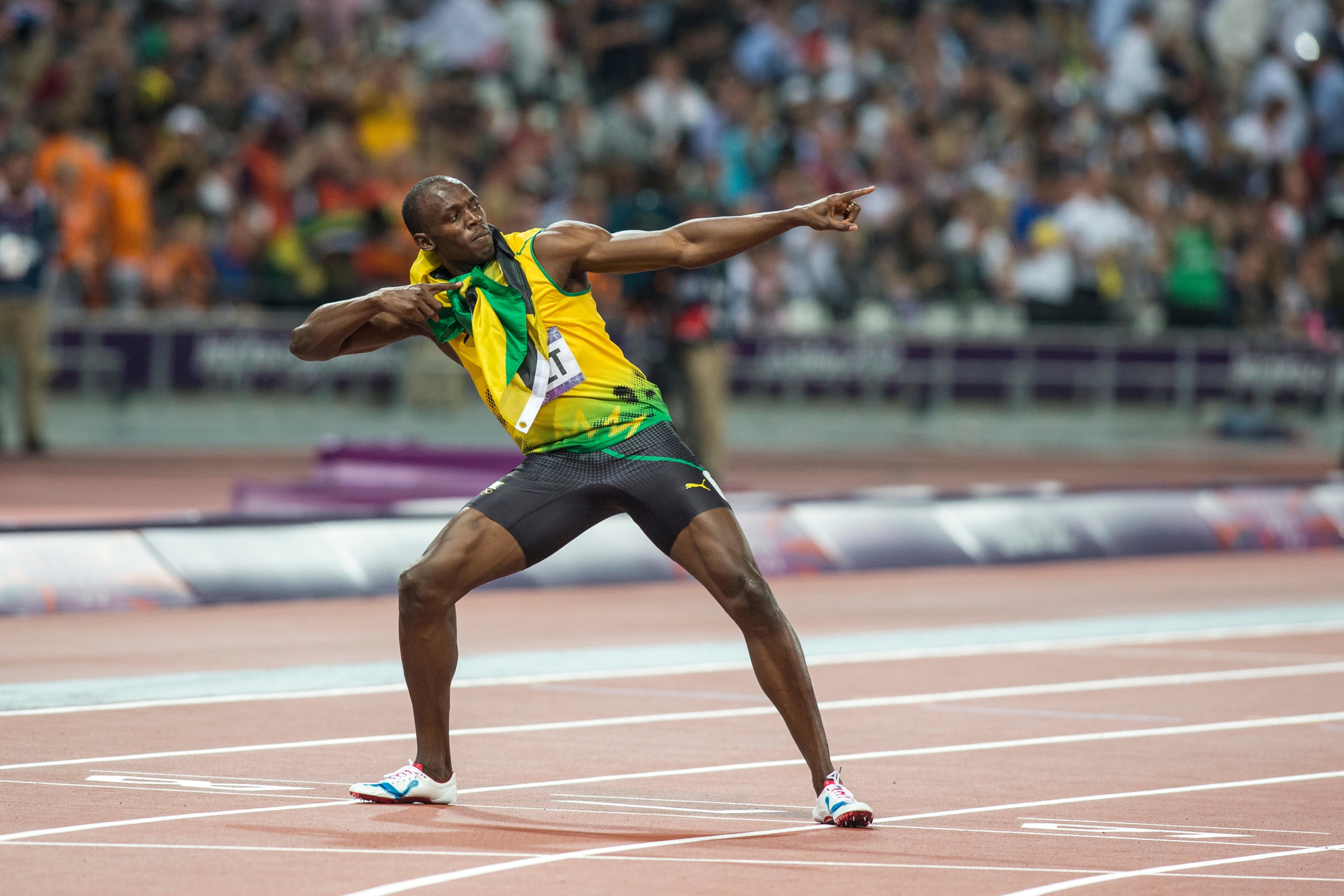
It is hard to believe that the fastest man on earth has scoliosis! Olympian Usain Bolt was born with scoliosis. His right leg is half an inch shorter than his…