
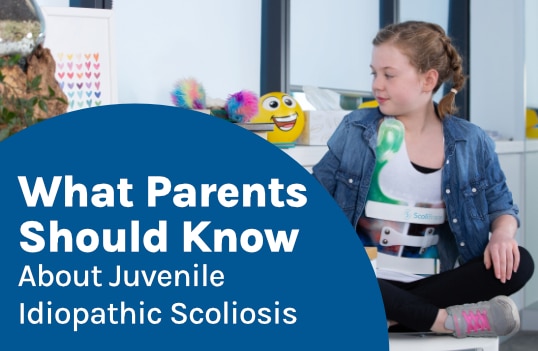
Juvenile scoliosis is idiopathic, but we know it’s growth that makes it progress, and we understand the importance of early diagnosis and a customized proactive treatment plan. Mild juvenile scoliosis doesn’t always cause pain, but a degree of back pain and discomfort isn’t uncommon.
Juvenile scoliosis affects children between the ages of 4 and 10. What parents should know is that most cases of juvenile scoliosis are progressive, and because progression is triggered by growth, how scoliosis is managed during growth is key. Early detection and intervention are important.
Knowing the early signs of scoliosis to watch for in children can lead to early detection, and while no treatment outcome can be guaranteed, early intervention increases the potential for treatment success.
Understanding Juvenile Scoliosis
Juvenile scoliosis is diagnosed in children between the ages of 4 and 10 who have developed an unnatural lateral curvature of the spine with rotation; scoliosis is 3-dimensional.
Most cases of juvenile scoliosis are progressive, and the main trigger for scoliosis progression is growth, so patients who have not yet reached skeletal maturity are at a higher risk of progression.
Juvenile scoliosis rarely resolves on its own; proactive treatment is needed.
Juvenile scoliosis isn’t the most common type of scoliosis to affect children; adolescent idiopathic scoliosis diagnosed most often at the onset of puberty is the most prevalent type of scoliosis (1, 2).
Juvenile scoliosis is more common in females and can range from mild to severe. Mild scoliosis in children isn’t closely associated with back pain, which can be a barrier to early detection (1).
The earliest sign of juvenile scoliosis for parents to watch for is the development of asymmetrical posture. Watching for uneven shoulders and hips is important, particularly if there is a family history of scoliosis (3).
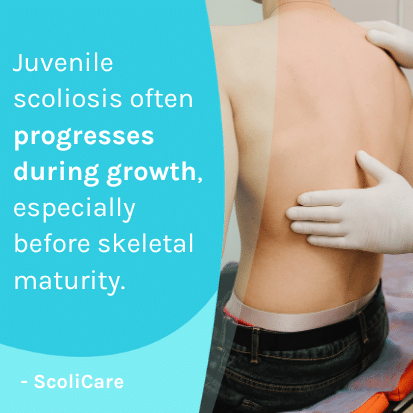
Most juvenile scoliosis cases involve dextroscoliosis (right-bending curves), and early detection and intervention are important factors for shaping a patient’s treatment outcome.
Regular screening, particularly when there are risk factors in place, is highly recommended (3, 4).
Juvenile Scoliosis Causes
Juvenile scoliosis is classified as idiopathic because the exact cause is unknown (5).
Because having a family history of scoliosis is considered a risk factor, it’s been suggested there is a genetic component to the development of juvenile scoliosis, but more research is needed to locate a specific gene that accounts for its onset, and remember, families share a lot more than genes (3, 4).
There are theories supporting the multifactorial nature of idiopathic scoliosis; family members can share body type, diet, lifestyle, stress response, mental health, posture, and a number of other factors that may contribute to the onset of juvenile scoliosis (3, 4).
Regardless of cause, regular screening is recommended for children with a family history of scoliosis, and the goal is diagnosing cases while still mild and there is more corrective potential (4).
Diagnosing Juvenile Scoliosis
Parents and caregivers of juveniles are the first line of defence when it comes to early detection.
Most cases of juvenile scoliosis are initially discovered by parents who notice postural asymmetries developing such as uneven shoulders and hips, followed by assessment from a medical professional.
The most common scoliosis screening examination is known as the Adams forward bending test and involves the child bending forward at the waist and holding the spine parallel to the floor while the spine and trunk are examined; in this position, the spine and common postural asymmetries are highly visible (6, 7).
Clinicians are looking for a visibly-crooked spine, uneven shoulders, shoulder blades, hips, and most noticeably, a rib hump (6, 7).
An arch in the rib cage most often signals a thoracic curve as the thoracic spine is the only spinal section that attaches to the rib cage. If the thoracic curve pulls on one side of the rib cage, causing it to protrude more than the other, an arch in the rib cage is more noticeable in a forward-bend position (6, 7).
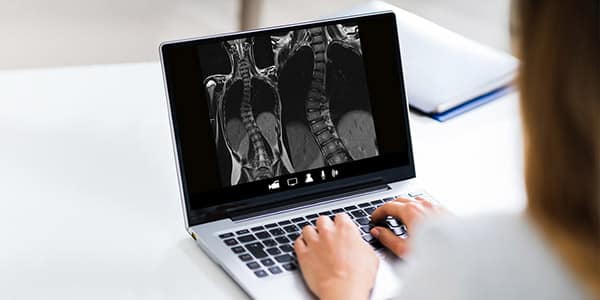
If a screening examination finds indicators of scoliosis, further evaluation is warranted, and the only way to diagnose scoliosis is through X-ray imaging to confirm the spine’s unnatural curve, rotation, and to measure curve size to determine severity (6).
Standing X-rays are important; the success of treatment plans are shaped by the accuracy of a patient’s initial assessment and X-ray measurements, and when patients are lying down, the curve isn’t subject to gravity so isn’t being represented accurately (8).
Standing X-rays offer the most precise and accurate measurements needed to fully customize treatment plans accordingly (8).
Treatment Options for Juvenile Scoliosis
Once a juvenile is diagnosed with scoliosis, it’s important that treatment is started immediately. Because progression is virtually guaranteed and increases the complexity of treatment, waiting is wasting valuable treatment time (9).
In some cases of mild scoliosis, a scoliosis-specific rehabilitative exercise plan may help (10).
ScoliBalance® is a fully customized scoliosis-specific exercise plan that addresses the specifics of a patient’s scoliosis, body type, posture, symptoms, ability, and treatment goals (11).
In mild cases with small curves, ScoliBalance® alone may have the potential to correct scoliosis and/or counteract progression during growth (10, 12), but remember, because it’s progressive, most cases diagnosed as mild won’t stay mild without treatment, particularly during growth spurts (9).
Scoliosis Bracing for Juveniles
For cases of moderate and severe juvenile scoliosis, rehabilitative scoliosis-specific exercise alone may be ineffective at managing the scoliosis and may require the help of corrective bracing (11, 12).
In some cases, mild curves in younger patients can be highly responsive to nighttime bracing such as ScoliNight that holds the spine in a hyper-corrective position during sleep (13). When diagnosed early, mild juvenile scoliosis may benefit from nighttime bracing used as early intervention (13).
For moderate and severe cases of juvenile scoliosis, full-time corrective bracing such as the ScoliBrace® is commonly recommended (11).
The more flexible a curve is, the more potential there is for correction, and as progression causes increasing spinal rigidity, the sooner treatment is started, the better (9). When the ScoliNight is successful as early intervention, it can prevent progression and the need for full-time bracing (11, 13).
The ScoliBrace® holds the spine in an over-corrective position to improve the spine’s alignment, body posture, and retrains the brain and body to adjust to the spine and torso’s healthier upright position.
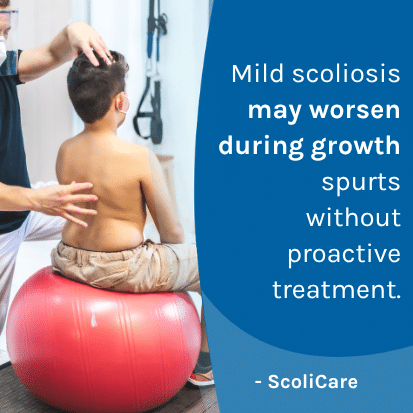
When ScoliBrace® is combined with the power of ScoliBalance®, the scope of nonsurgical treatment widens, and invasive future surgical intervention may be avoided (11).
Conclusion
So what do parents need to know about juvenile scoliosis? Juvenile scoliosis is idiopathic, but we know most cases are progressive so can benefit from early treatment options used as early intervention.
Parents need to know that regular screening is strongly recommended if there is a family history of scoliosis, and females are also more commonly affected; the earliest signs of juvenile scoliosis to look for are postural changes including uneven shoulders, shoulder blades, and hips.
If juvenile scoliosis is undiagnosed and untreated, it can progress quickly once puberty starts, triggered by rapid and unpredictable growth spurts. There are never treatment guarantees, but there are a number of benefits to diagnosing and starting treatment prior to a young patient’s first pubescent growth spurt.
When juvenile scoliosis is diagnosed while mild in younger patients, curves are small, flexible, and are more likely to respond to early intervention with a ScoliNight brace to be worn during sleep, and in other cases, a scoliosis-specific exercise plan such as ScoliBalance® can facilitate corrective treatment results.
In cases where nighttime bracing is unsuccessful and a juvenile’s curve continues to progress becoming moderate and/or severe, a combination of ScoliBalance® and a full-time corrective bracing with the ScoliBrace® may help avoid the need for surgical intervention.
Here at ScoliCare, the goal is early detection through education and awareness, followed by proactive and customized treatment plans combining the power of scoliosis-specific rehabilitative exercise and corrective bracing.
References:
- Li M, Nie Q, Liu J, Jiang Z. Prevalence of scoliosis in children and adolescents: a systematic review and meta-analysis. Front Pediatr. 2024 Jul 23;12:1399049. doi: 10.3389/fped.2024.1399049. PMID: 39108696; PMCID: PMC11300313
- Weinstein SL. The Natural History of Adolescent Idiopathic Scoliosis. J Pediatr Orthop. 2019 Jul;39(Issue 6, Supplement 1 Suppl 1):S44-S46. doi: 10.1097/BPO.0000000000001350. PMID: 31169647
- Wise CA, Gao X, Shoemaker S, Gordon D, Herring JA. Understanding genetic factors in idiopathic scoliosis, a complex disease of childhood. Curr Genomics. 2008 Mar;9(1):51-9. doi: 10.2174/138920208783884874. PMID: 19424484; PMCID: PMC2674301
- Oetgen ME, Heyer JH, Kelly SM. Scoliosis Screening. J Am Acad Orthop Surg. 2021 May 1;29(9):370-379. doi: 10.5435/JAAOS-D-20-00356. PMID: 33475302
- Trobisch P, Suess O, Schwab F. Idiopathic scoliosis. Dtsch Arztebl Int. 2010 Dec;107(49):875-83; quiz 884. doi: 10.3238/arztebl.2010.0875. Epub 2010 Dec 10. PMID: 21191550; PMCID: PMC3011182
- Dunn J, Henrikson NB, Morrison CC, et al. Screening for Adolescent Idiopathic Scoliosis: A Systematic Evidence Review for the U.S. Preventive Services Task Force [Internet]. Rockville (MD): Agency for Healthcare Research and Quality (US); 2018 Jan. (Evidence Synthesis, No. 156.) Chapter 1, Introduction. Available from: https://www.ncbi.nlm.nih.gov/books/NBK493369/
- Senkoylu A, Ilhan MN, Altun N, Samartzis D, Luk KDK. A simple method for assessing rotational flexibility in adolescent idiopathic scoliosis: modified Adam’s forward bending test. Spine Deform. 2021 Mar;9(2):333-339. doi: 10.1007/s43390-020-00221-2. Epub 2020 Oct 8. PMID: 33030701
- Vavruch L, Tropp H. A Comparison of Cobb Angle: Standing Versus Supine Images of Late-Onset Idiopathic Scoliosis. Pol J Radiol. 2016 Jun 10;81:270-6. doi: 10.12659/PJR.895949. PMID: 27354881; PMCID: PMC4912347
- Negrini, S., Donzelli, S., Aulisa, A. G., Czaprowski, D., Schreiber, S., de Mauroy, J. C., … & Zaina, F. (2018). 2016 SOSORT guidelines: orthopaedic and rehabilitation treatment of idiopathic scoliosis during growth. Scoliosis and spinal disorders, 13(1), 3
- Jiang HT, Chen JY, Wu FZ, Chen SJ, Wang WQ, Wu MJ. Preliminary study on the treatment of prepubescent adolescent idiopathic scoliosis with Schroth exercises combined with core exercises. Front Rehabil Sci. 2025 Sep 5;6:1586538. doi: 10.3389/fresc.2025.1586538. PMID: 40980155; PMCID: PMC12446239
- Marchese R, Du Plessis J, Pooke T, McAviney J. The Improvement of Trunk Muscle Endurance in Adolescents with Idiopathic Scoliosis Treated with ScoliBrace® and the ScoliBalance® Exercise Approach. J Clin Med. 2024 Jan 23;13(3):653. doi: 10.3390/jcm13030653. PMID: 38337346; PMCID: PMC10856658
- Ridderbusch K, Spiro AS, Kunkel P, Grolle B, Stücker R, Rupprecht M. Strategies for Treating Scoliosis in Early Childhood. Dtsch Arztebl Int. 2018 Jun 1;115(22):371-376. doi: 10.3238/arztebl.2018.0371. PMID: 29932047; PMCID: PMC6039715
- Charalampidis A, Diarbakerli E, Dufvenberg M, Jalalpour K, Ohlin A, Ahl AA, Möller H, Abbott A, Gerdhem P; CONTRAIS Study Group. Nighttime Bracing or Exercise in Moderate-Grade Adolescent Idiopathic Scoliosis: A Randomized Clinical Trial. JAMA Netw Open. 2024 Jan 2;7(1):e2352492. doi: 10.1001/jamanetworkopen.2023.52492. PMID: 38285447; PMCID: PMC10825714
More news
-
 12 January 2022
Juvenile idiopathic scoliosis (JIS) needs careful attention and it is so important that these children are not ‘missed’. With much of the attention in the literature often falling to the…
-
 6 September 2021
What is the progression risk for very young children with scoliosis? A child that has Juvenile idiopathic scoliosis (JIS) is characterised by a high risk of progression. The growth spurts…
-
 12 January 2022
What Happens in Clinical Practice? What are the typical postural habits of adolescents with idiopathic scoliosis (AIS)? And, are there any that are actually ‘typical’ at all? While it’s imperative…