
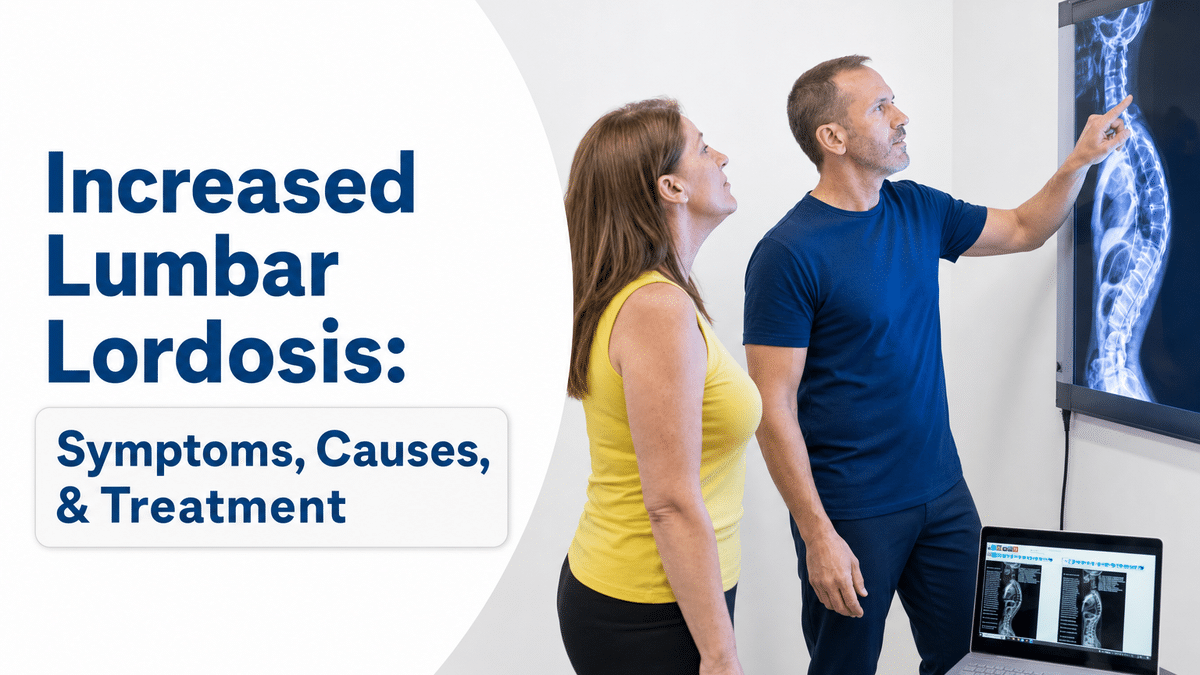
The spine’s healthy curves, when viewed from the side, increase its strength, flexibility, and ability to handle mechanical stress. The spine naturally has an inward curve in the neck (cervical spine) and lower back (lumbar spine) called a lordosis and a more-outward curve in the middle back (thoracic spine). Healthy spinal curves can vary in size from person to person, but if a curve becomes over-pronounced, the curve size is no longer typical and can affect overall spinal health and function.
Lordosis is a type of spinal curvature that’s found in the cervical and lumbar spinal sections. A diagnosis of increased lumbar lordosis, aka lumbar hyperlordosis, means the lower back arches inward excessively, and too much of an increase can be problematic.
Let’s talk briefly about the difference between healthy and unhealthy spinal curves.
Healthy and Unhealthy Spinal Curves
The spine will have an S-shape when viewed from the left or right side because the spine curves at each of the main spinal sections.
The cervical spine is the first spinal section (neck), followed by the largest spinal section and the only that attaches to the rib cage, the thoracic spine (middle/upper back), and the lumbar spine refers to the lower back (1).
A shared role of all spinal sections is to protect the spinal cord within. The spinal cord consists of 31 pairs of spinal nerves that pass through each vertebra of the spine, so the brain and spinal cord form the central nervous system (CNS), and the spine’s healthy curves and alignment are needed to facilitate optimal brain-body communication (1).
A misaligned spine can compress its nerves within, and compressed nerves can cause a number of effects felt throughout the body.
The spinal sections, and their curves, work together to facilitate the spine’s strength, flexibility, and range of motion. If a single spinal section loses its natural curve, the effects may be felt throughout the spine.
Lordosis
The spine’s lordosis is found in the cervical and lumbar spinal sections, meaning the spine curves inward, and a healthy range of cervical lordosis is considered to be within 20 – 40 degrees, while a healthy range of lumbar lordosis would fall between 20 – 60 degrees (2).
Depending on where the increased lordosis develops, symptoms will vary based on the specific roles of the affected spinal section.
It’s important to maintain a healthy curve in the cervical spine because the neck is the bridge between the brain and the spine; it also initiates the spine’s alignment, has to support the weight of the head, and facilitates the neck’s range of motion (2, 3).
It’s important for the lumbar spine to maintain a healthy degree of lordosis because the function of the lower back and body depend on it, so let’s talk about the role of the lumbar spine in overall spinal biomechanics (2).
The Lumbar Spine
In addition to protecting the spinal cord within, the lumbar spine also has to support the weight of the thoracic spine, the cervical spine, and the upper body.
The weight-bearing nature of the lumbar spine is why its vertebrae are larger than the other spinal sections. The vertebrae of the lumbar spine are also responsible for distributing the weight of the upper body evenly over the pelvis and into the legs (4).
So the health of the lumbar spine is essential for healthy movement patterns in the lower body; if the upper body’s weight isn’t evenly absorbed and distributed throughout the lower body, an uneconomical gait can develop, and this can further disrupt the spine and body’s balance and stability.
If a person’s lumbar lordosis increases and is considered excessive, lumbar hyperlordosis can cause a number of symptoms, including pain (4).
Increased Lumbar Lordosis Symptoms
If a person’s lumbar lordosis increases to a small degree, it may not be problematic and/or symptomatic, but if it increases excessively, it can have a number of effects.
As the spine facilitates a straight and upright posture, postural changes are a common effect of unhealthy spinal curves.
If the lumbar spine has excessive lordosis, the main symptom is the development of a swayback posture, characterized by the abdomen and buttocks protruding excessively, and lower back pain is common (4).
In response to the excessive inward-arching of the lumbar spine, the cervical spine can also be affected if it shifts forward in an attempt to counteract the uneven forces occurring in the lower back, known as forward head posture (3).
Forward head posture increases the weight of the head on the neck, and when it’s related to increased lumbar lordosis, this shows how interconnected the health of the spinal sections are (3).
The lumbar spine’s vertebrae facilitate a wide range of motion including bends, twists, and lifts, so they feel the effects of poor posture and/or repeatedly lifting heavy objects incorrectly, which is why it’s said that everyone will experience lower back pain at some point in their lives (4).
As the lumbar spine plays a role in lower body movement, a loss of the lower back’s healthy curve can cause unhealthy movement patterns to develop (2, 5, 6, 7).
If the lumbar spine bends too far inward, it can disrupt its ability to evenly distribute forces along the spine and throughout the lower body; it can also interfere with a patient’s ability to maintain an upright posture and economical gait (2, 5, 6, 7).
Increased Lumbar Lordosis Causes
Lordosis is a normal healthy spinal curve, but its size is specific to each individual and is shaped by a number of factors, including the health and position of the person’s pelvis (5, 6, 7).
Increased lumbar lordosis can have a number of causes from genetics to poor posture, lifestyle factors, muscle weakness and imbalance, degenerative changes, to the presence of an underlying spinal condition.
In many cases, a combination of these factors can occur and contribute to hyperlordosis in the lumbar spine.
Genetics
Genetics can be a factor in how the spine forms and is shaped, so some children are born with an increased risk of developing lumbar lordosis.
Lifestyle Factors
Chronic poor posture can also contribute to the development of lumbar lordosis as constant slouching, and other types of poor posture, can strain and weaken the lower spine and its surrounding muscles and ligaments over time (5).
If the lumbar spine’s surrounding muscles are weak and/or unbalanced, this can also contribute to a loss of the lumbar spine’s healthy degree of lordosis due to a lack of support.
A spine-friendly lifestyle includes maintaining a healthy weight and activity level so the spine’s strength and flexibility can be maintained, and knowing how to lift heavy objects without straining the lower back is also important.
Lifestyle factors can have a cumulative effect on spinal health.
Degenerative Changes in the Lumbar Spine
Older adults affected by spinal degeneration are particularly vulnerable to a number of spinal issues, injuries, and conditions as degeneration can make the spine increasingly unbalanced and unstable.
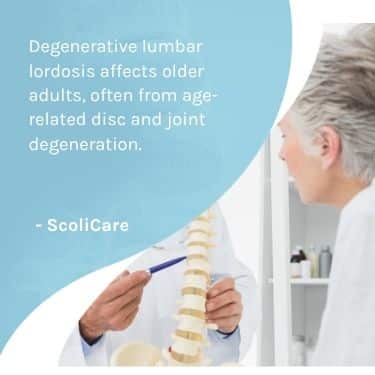
Degenerative lumbar lordosis refers to an increasing loss of the lumbar spine’s healthy lordosis, and while there can be a number of contributing factors, disc health, arthritis, asymmetrical posture and/or movement changes can affect a person’s lordosis (5).
Degenerative lumbar hyperlordosis affects older adults experiencing age-related degenerative changes, most often involving degeneration of discs and joints in the spine (5).
Conditions Capable of Increasing Lumbar Lordosis
Conditions that affect the hips such as hip dysplasia and pelvic obliquity can also contribute to the development of lumbar lordosis (6, 7).
Hip dysplasia involves the hip joint not forming properly, particularly in young children, with the potential to cause hip flexion contractures and pelvic obliquity (6, 7).
If the pelvis is tilted, one hip can sit higher than the other, and this type of asymmetry can affect the lower spine and body’s health, mobility, and can cause pain in the pelvis, hips, and lower extremities (4, 5, 6, 7).
In addition, the presence of an underlying spinal condition, like scoliosis, that causes a loss of the spine’s healthy curves can also contribute to an increase in lumbar lordosis (5).
Nature favors symmetry, and the spine and body wants to maintain its alignment, so if an unhealthy spinal curve develops, the spine may respond by adding a compensatory curve to counteract the uneven forces of the first unnatural spinal curve.
If scoliosis develops in the upper back, a body compensation can include increasing the lower back’s curve to maintain balance and stability in the spinal sections above: compensatory hyperlordosis.
Increased Lumbar Lordosis Treatment
If an increase in lumbar lordosis is considered excessive, hyperlordosis treatment may be necessary and focuses on conservative options.
Treatment plans are shaped by the cause and severity of the increase and experienced symptoms.
An initial assessment has to be comprehensive; treatment plans are customized around the information gleaned, and treatment for increased lumbar lordosis has to address its underlying cause for long-term treatment results.
Lifestyle guidance is a common facet of treatment, particularly in patients who are overweight as carrying excess weight puts more pressure on the joints of the spine, body, and doesn’t facilitate good posture.
Lordosis-specific physical therapy is the keystone of conservative treatment options; physical therapy involves exercises and stretches used to improve the lumbar spine’s surrounding muscle balance and strength (7).
Physical therapy can also target the hips and glutes for more mobility, strength, support for the pelvis and lower back, and this further supports healthy symmetrical movement patterns (7).
Chiropractic BioPhysics (CBP) involves the application of chiropractic care to improve the spine’s alignment (8).
CBP combines chiropractic care with additional treatment facets (physical therapy and bracing) to restore a patient’s healthy degree of lumbar lordosis (7, 8).
A strong core facilitates good posture and a wide range of motion, and bracing is an additional treatment option that can help stabilize the spine and is commonly used to prevent progression in children during growth.
If the presence of another spinal condition like scoliosis is the cause of the lower back’s excessive lordosis, the scoliosis is the underlying cause and has to be addressed. By working towards reducing the size of the scoliosis, the uneven forces causing the compensatory lordosis may also be improved.
Conclusion
The spine curves at each of its main sections, and these curves are essential to the spine’s overall health and function.
The spine’s healthy curves make it more flexible, resistant to injury, and better able to handle mechanical stress incurred during movement and/or rest; the curves also make it possible to stand upright and practice healthy posture.
When it comes to spinal health, a patient’s body position is important because chronic poor posture can strain the spine and its surrounding muscles, and over time, may disrupt the spine’s alignment and surrounding muscle strength/balance.
When the spine isn’t aligned, it’s off-balance, and this can impact the body’s overall balance and stability: the spine’s healthy curves need to be preserved.
If a diagnosis of increased lumbar lordosis, aka lumbar hyperlordosis, is given, this is reached through a physical examination that includes taking the patient’s family history, medical history, assessing movement, posture, strength, flexibility, and if deemed necessary, an X-ray is ordered to determine the severity of the lordosis angle.
Treatment plans for lumbar lordosis should be shaped by the condition’s underlying cause for sustainable treatment results, and nonsurgical treatment plans often combine condition-specific chiropractic care, physical therapy and corrective bracing.
Although there are no treatment guarantees, in most cases of increased lumbar lordosis, determining the underlying cause, customizing a treatment plan, and treating it proactively is associated with treatment success.
Find Your Nearest Clinic
ScoliCare Clinics, affiliates and product providers are in over 200 locations around the world. Find your nearest ScoliCare location here.


References:
- Ganapathy MK, Reddy V, Tadi P. Neuroanatomy, Spinal Cord Morphology. [Updated 2024 Sep 10]. In: StatPearls [Internet]. Treasure Island (FL): StatPearls Publishing; 2025 Jan-. Available from: https://www.ncbi.nlm.nih.gov/books/NBK545206/
- Lippa L, Cacciola F. Loss of cervical lordosis: What is the prognosis? J Craniovertebr Junction Spine. 2017 Jan-Mar;8(1):9-14. doi: 10.4103/0974-8237.199877. PMID: 28250631; PMCID: PMC5324370.Been E, Kalichman L. Lumbar lordosis. Spine J. 2014 Jan;14(1):87-97. doi: 10.1016/j.spinee.2013.07.464. Epub 2013 Oct 2. PMID: 24095099
- Oakley PA, Kallan SZ, Harrison DE. Structural rehabilitation of the cervical lordosis and forward head posture: a selective review of Chiropractic BioPhysics® case reports. J Phys Ther Sci. 2022 Nov;34(11):759-771. doi: 10.1589/jpts.34.759. Epub 2022 Nov 1. PMID: 36337218; PMCID: PMC9622351.
- Chun SW, Lim CY, Kim K, Hwang J, Chung SG. The relationships between low back pain and lumbar lordosis: a systematic review and meta-analysis. Spine J. 2017 Aug;17(8):1180-1191. doi: 10.1016/j.spinee.2017.04.034. Epub 2017 May 2. PMID: 28476690.
- Fei H, Li WS, Sun ZR, Jiang S, Chen ZQ. Effect of patient position on the lordosis and scoliosis of patients with degenerative lumbar scoliosis. Medicine (Baltimore). 2017 Aug;96(32):e7648. doi: 10.1097/MD.0000000000007648. PMID: 28796046; PMCID: PMC5556212.
- Levine D, Whittle MW. The effects of pelvic movement on lumbar lordosis in the standing position. J Orthop Sports Phys Ther. 1996 Sep;24(3):130-5. doi: 10.2519/jospt.1996.24.3.130. PMID: 8866271.
- James W Youdas, Tom R Garrett, Kathleen S Egan, Terry M Therneau, Lumbar Lordosis and Pelvic Inclination in Adults With Chronic Low Back Pain, Physical Therapy, Volume 80, Issue 3, 1 March 2000, Pages 261–275, https://doi.org/10.1093/ptj/80.3.261
- Oakley PA, Ehsani NN, Harrison DE. Non-surgical reduction of lumbar hyperlordosis, forward sagittal balance and sacral tilt to relieve low back pain by Chiropractic BioPhysics® methods: a case report. J Phys Ther Sci. 2019 Oct;31(10):860-864. doi: 10.1589/jpts.31.860. Epub 2019 Oct 19. PMID: 31645820; PMCID: PMC6801353.
More news
-
 12 September 2025
The spine’s natural curves enhance strength and flexibility—but when curves become excessive, like in hyperkyphosis, problems can arise. Early detection is key.
-
 17 October 2025
Scoliosis can affect adults too—whether ongoing or new, it’s often painful. Treatment focuses on fall prevention and restoring spinal balance.
-
 28 August 2024
While scoliosis is quite widely known, the term hyperkyphosis is less familiar. If you're just starting to learn about hyperkyphosis and how it relates to adolescents, you may have questions…