
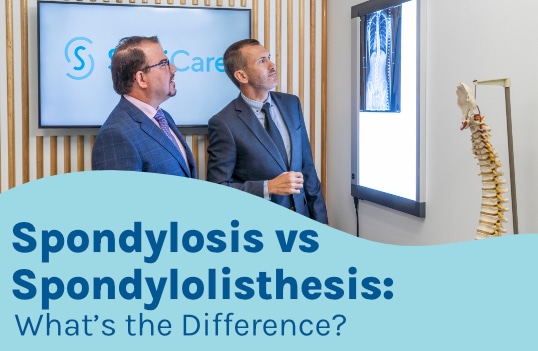
Like the rest of the body, the spine will experience degenerative changes with age and the cumulative effect of lifestyle factors. Spondylosis refers to general degenerative changes in the spine, affecting the discs and joints; spondylolisthesis, however, references the specific occurrence of a slipped vertebra.
Both spondylosis and spondylolisthesis involve changes to spinal health and function. Spondylosis refers to general degenerative changes that affect the spine, including osteoarthritis and disc degeneration; spondylolisthesis refers to the slippage of one vertebra over another, disrupting the spine’s alignment and balance.
Spinal health and function is key to quality of life, and once the degenerative process is initiated, it can be difficult to slow and/or reverse.
Spondylosis
Spondylosis is a medical term for general degenerative changes in the spine that affect the joints, bones, and discs.
Degenerative changes are a natural part of aging caused by the cumulative effect of wear and tear on the spine over time, and certain lifestyle factors, such as obesity and low activity levels, can accelerate the process.
All sections of the spine can experience degeneration, but the cervical and lumbar spinal sections are the most vulnerable due to the weight-bearing nature of the neck (supporting the weight of the head) and the lower back supporting the spinal sections above, the torso, and feeling the effects of strenuous movement (1, 2).
Most spinal degeneration starts in the intervertebral discs.
Spondylosis can involve disc desiccation, osteoarthritis, cartilage erosion, bone spur formation, and nerve compression.
Disc Desiccation
When the spine starts to degenerate, it often starts with disc issues caused by excessive fluid loss (3).
When we’re born, the discs consist largely of water, but over time, and as we age, water content decreases, and excessive fluid loss is known as disc desiccation (3).
Intervertebral discs perform many key functions in spinal biomechanics. A disc sits between each pair of adjacent vertebrae and acts as a cushion to prevent friction during movement (4).
The discs give the spine structural support as adjacent vertebrae attach to the disc in between and combine forces to facilitate the spine’s flexibility and range of motion (4).
The discs also act as the spine’s shock absorbers, and in order for the discs to function optimally, they need to maintain a certain level of hydration (3, 4).
The discs consist of two main structures: a soft gel-like inner nucleus and a tough but flexible outer layer known as the annulus (3, 4).
The disc’s inner material and outer protective layer work together to maintain the central position of the nucleus inside the disc and the disc’s central position between adjacent vertebrae, facilitating the spine’s alignment and balance (3, 4).
Degenerative Disc Disease
Most cases of degenerative disc disease are initiated by desiccation, and because the discs are largely avascular, once the degenerative process is initiated, it can be difficult to slow (3).
If a disc becomes desiccated, it thins out, and the outer layer becomes less flexible, more brittle, and less able to handle shock absorption; in addition, the disc is more vulnerable to further degeneration and can become a bulging and/or herniated disc (3).
A bulging disc occurs if its inner nucleus is pushing outwards against the outer annulus and causes the disc to bulge outwards, taking up more space within the spine. A herniated disc can follow a bulging disc if the pressure from the inner nucleus causes a tear in the outer layer through which the nucleus projects (3).
A disc changing shape can compress nearby spinal nerves and contribute to uneven wear and tear on the spine (3).
If a disc degenerates, it can also affect the position of adjacent vertebrae attached and cause the spine to become misaligned, disrupting its balance and stability (3, 4).
Osteoarthritis
Osteoarthritis is the most common type of arthritis; it’s a degenerative joint disease that involves a loss of cartilage that cushions the edges of bones, where they meet, and facilitates the smooth gliding motion of joints during movement (5).
When protective cartilage breaks down, bones rub together, particularly during movement, and this causes uneven wear and tear and can accelerate the degenerative process (5).
Bone spurs are a common effect of osteoarthritis (6).
Bone Spur Formation
Osteophytes, commonly known as bone spurs, are overgrowths of bone that typically grow on the edges of bones or in the joints where bones meet (6).
These bony overgrowths project into the surrounding area and can cause compression of nearby nerves, and damage bones, muscles, and tendons (6).
Bone spurs, and any other changes that cause spinal structures to take up more space within the spine, can lead to a narrowing of the spinal canal known as stenosis; this means a loss of space for the spinal cord and can impact its health and function (1, 2, 3, 5, 6).
Nerve compression can be painful and cause a number of symptoms felt throughout the body.
Spondylolisthesis
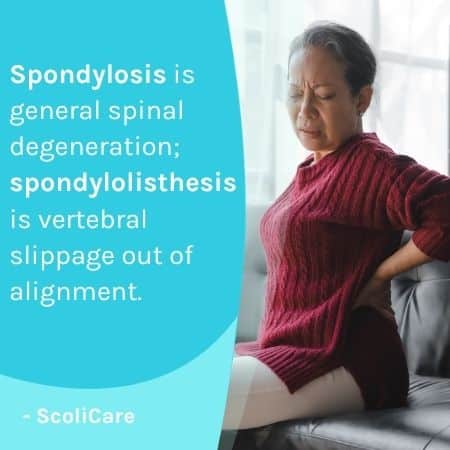
While spondylosis involves general degenerative changes in the spine, spondylolisthesis refers to the specific issue of a vertebra slipping out of alignment with the rest of the spine, either forward or backward onto the vertebral body below (7).
Spondylolisthesis occurs most often in the lumbar spine; the vertebrae of the lumbar spine have a lot of weight to support, and they feel the effects of potentially-strenuous movement such as deep bends, twists, and lifts (7).
Degenerative spondylolisthesis affects older adults, is more common in females, and involves increasing degenerative instability (7).
Any condition that weakens the bones or joints of the spine can contribute to the development of spondylolisthesis, including osteoarthritis, degenerative disc disease, and stress fractures (7).
When a vertebra slips forward or backward onto the bone below, its slipping out of alignment with the rest of the spine, and the spine’s straight and neutral alignment is key to its overall health and function, along with facilitating healthy posture and movement patterns (7).
The spine’s alignment shapes its balance and stability, so any condition that causes a shift in the healthy positioning of one or more vertebral bodies can introduce compression and uneven forces to the spine and its surroundings, and a spine that’s not aligned can disrupt the body’s alignment from the head to the feet.
Conclusion
The difference between spondylosis and spondylolisthesis is that spondylosis is a general term for age-related spinal degeneration, and spondylolisthesis occurs when one vertebral bone slips out of position, either forward or backward onto the bone below.
If a single vertebra slips out of alignment with the rest of the spine, this introduces uneven forces to the spine and can disrupt its balance and stability.
Because the spine’s alignment shapes its overall health and function, a misaligned spine is likely to degenerate faster, and once the degenerative process starts, a cycle’s initiated that can be difficult to break.
Most cases of natural age-related spondylosis involve osteoarthritis and/or degenerative disc disease, and treatment options focus on conservative methods for slowing the degenerative process, improving function, pain management, and improving the spine’s stability; this can involve physical therapy, chiropractic care, and lifestyle guidance.
Treatment for spondylolisthesis also involves physical therapy that focuses on increasing core strength for more spinal support and stability, pain medications, and activity modifications. In severe cases, surgical treatment options may be recommended (decompression or spinal fusion surgery).
When it comes to preserving the spine’s health and function over time, cultivating healthy lifestyle habits including weight management and regular exercise can help, but there is a certain amount of spinal degeneration that occurs naturally with age.
References:
- Margetis K, Tadi P. Cervical Spondylosis. [Updated 2025 Aug 2]. In: StatPearls [Internet]. Treasure Island (FL): StatPearls Publishing; 2025 Jan-. Available from: https://www.ncbi.nlm.nih.gov/books/NBK551557/
- Middleton K, Fish DE. Lumbar spondylosis: clinical presentation and treatment approaches. Curr Rev Musculoskelet Med. 2009 Jun;2(2):94-104. doi: 10.1007/s12178-009-9051-x. Epub 2009 Mar 25. PMID: 19468872; PMCID: PMC2697338
- Scarcia L, Pileggi M, Camilli A, Romi A, Bartolo A, Giubbolini F, Valente I, Garignano G, D’Argento F, Pedicelli A, Alexandre AM. Degenerative Disc Disease of the Spine: From Anatomy to Pathophysiology and Radiological Appearance, with Morphological and Functional Considerations. J Pers Med. 2022 Nov 1;12(11):1810. doi: 10.3390/jpm12111810. PMID: 36579533; PMCID: PMC9698646
- Waxenbaum JA, Reddy V, Futterman B. Anatomy, Back, Intervertebral Discs. [Updated 2023 Dec 9]. In: StatPearls [Internet]. Treasure Island (FL): StatPearls Publishing; 2025 Jan-. Available from: https://www.ncbi.nlm.nih.gov/books/NBK470583
- Sen R, Hurley JA. Osteoarthritis. [Updated 2023 Feb 20]. In: StatPearls [Internet]. Treasure Island (FL): StatPearls Publishing; 2025 Jan-. Available from: https://www.ncbi.nlm.nih.gov/books/NBK482326/
- Wong SH, Chiu KY, Yan CH. Review Article: Osteophytes. J Orthop Surg (Hong Kong). 2016 Dec;24(3):403-410. doi: 10.1177/1602400327. PMID: 28031516
- Margetis K, Gillis CC. Spondylolisthesis. [Updated 2025 Mar 28]. In: StatPearls [Internet]. Treasure Island (FL): StatPearls Publishing; 2025 Jan-. Available from: https://www.ncbi.nlm.nih.gov/books/NBK430767/
More news
-
 12 December 2022
Hyperkyphosis is going to be a buzzword in the coming years, if it isn’t already. Today’s more sedentary lifestyle has seen a massive shift towards more time spent hunched over…
-
 21 August 2026
Multilevel degenerative disc disease affects discs in multiple spinal areas, impacting flexibility, stability, and movement. Early care can help manage symptoms.
-
 24 August 2026
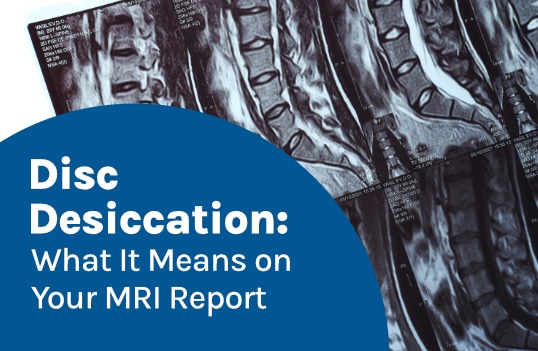
Disc desiccation is age-related disc dehydration visible on MRI. As discs lose water, spinal flexibility and function can decline, contributing to degeneration.