
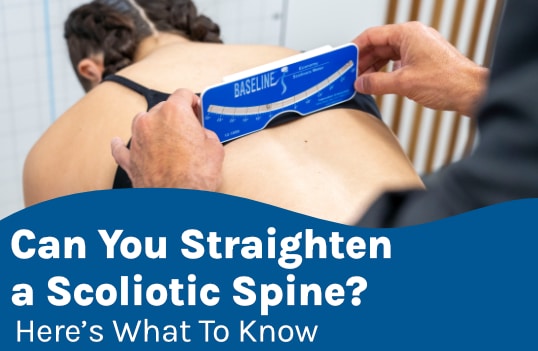
Progressive conditions can be more complex to treat because their nature is to get worse over time, so successful treatment has to work towards counteracting that tendency. What’s important to know about scoliosis treatment is the earlier scoliosis is diagnosed and addressed, the more potential there is for treatment success.
Scoliosis is often progressive, so treatment is ongoing, but many cases can be managed effectively and significantly improved. There are two main treatment options: nonsurgical treatment or traditional spinal fusion surgery.
Scoliosis patients need to be aware of all treatment options available to them; how a diagnosis is responded to with treatment can shape the spine’s long-term health.
Being Diagnosed with Scoliosis
Being diagnosed with scoliosis means an unnatural lateral spinal curve with rotation has developed, and because scoliosis is progressive, it rarely resolves on its own; most cases that are left untreated will progress at some point (1).
In children, scoliosis progression is triggered by growth, and degenerative changes can cause a scoliotic spine to become increasingly unstable in older adults (1, 2).
Being diagnosed with scoliosis means careful monitoring and treatment is needed, particularly in young patients and during periods of rapid growth (3).
Scoliosis can range from mild to moderate and severe cases, and it’s important for patients to understand that due to its progressive nature, symptoms experienced at the time of a diagnosis don’t indicate where they will stay (1).
Scoliosis progression means the spine’s unnatural curve and rotation is increasing over time, and the main factors that shape a patient’s potential rate of progression include patient age, scoliosis, type, severity, and curve location (1, 3).
Thoracic scoliosis is the most prone to rapid advancement, and because the main trigger for progression is growth, adolescents with thoracic scoliosis need to be treated proactively; the stage of puberty is lengthy and characterized by rapid and unpredictable growth spurts (3).
So being diagnosed with scoliosis means treatment is necessary, and patients need to fully understand the importance of a proactive treatment response and how it works towards straightening the spine.
Nonsurgical Scoliosis Treatment
Following a scoliosis diagnosis, patients have to decide the type of treatment approach to commit to, and this is key because scoliosis is progressive so treatment is ongoing and will shape the spine’s long-term health.
Even mild scoliosis needs treatment; in fact, the best time to start treatment is while curves are still mild because they’re smaller, more flexible, and more likely to respond to treatment (3).
Progression increases spinal rigidity, making it less responsive and more complex to treat. In addition, the many potential effects of scoliosis are more established the longer they’re left unaddressed, and this makes them more difficult to improve and/or reverse (3, 4).
Common scoliosis effects include postural changes such as the development of uneven shoulders, shoulder blades, hips, and a rib cage arch (4).
The appearance of asymmetrical posture is the earliest sign of childhood scoliosis, and pain from compressed nerves is the most common symptom of adult scoliosis, followed by back pain and poor posture (4).
Here at ScoliCare, the customization of treatment plans is informed by a comprehensive initial patient assessment, and a variety of treatment disciplines are combined including scoliosis-specific chiropractic care as an adjunctive treatment, but it needs to be a part of an entire holistic scoliosis-specific rehabilitation program (5, 6).
ScoliBalance®
Designed by chiropractor, Dr. Jeb McAviney, and physical therapist, Rose Mirenzi, ScoliBalance® combines the potential of scoliosis-specific chiropractic care and established scoliosis-specific exercise-based treatment programs like the Schroth Method and the Scientific Exercise Approach to Scoliosis (SEAS) (6).
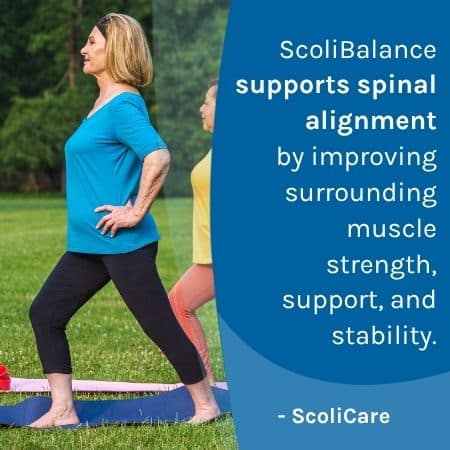
Scoliosis-specific exercise that’s customized around a patient’s age, posture, scoliosis type, severity, and curve location is a key facet of nonsurgical treatment; it can help improve the spine’s flexibility, alignment, surrounding muscle strength and balance, and prevent progression (6).
The power of ScoliBalance® is that it can impact the spine and its surrounding muscles which are key to spinal alignment, support, and stability.
When ScoliBalance® is combined with the potential of corrective 3-dimensional bracing, the potential for treatment to straighten the spine increases.
ScoliBrace®
The ScoliBrace® is a custom 3-dimensional scoliosis brace that’s evidence-based and individualized to address the specifics of a patient’s posture, scoliosis type, and severity (6).
The ScoliBrace®® individualizes potential corrective results through the use of an overcorrective approach where applicable to improve spinal alignment and balance through spinal coupling, and as the spine is held in an overcorrective position in the brace, the brain and body are being retrained together to maintain the position out of the brace (6).
While many traditional scoliosis braces immobilize the spine, the ScoliBrace® was designed with movement in mind, which is why it’s more effective when combined with ScoliBalance® (6).
Clinicians who are also trained and certified in the Chiropractic BioPhysics® method, as well as ScoliBrace® and ScoliBalance®, can provide a well-rounded and comprehensive treatment plan (5, 6).
By combining these different facets of treatment that complement one another, the spine’s flexibility and strength may be improved, scoliosis can be impacted on multiple levels, and surgical intervention may be avoided.
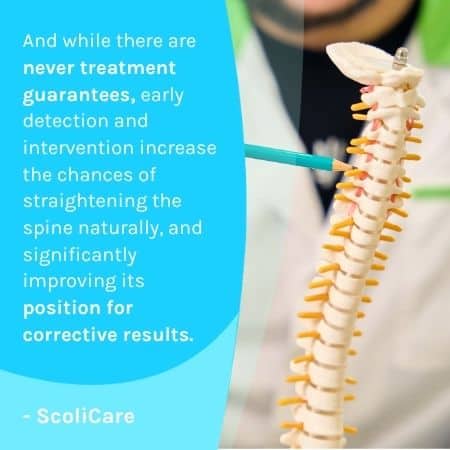
And while there are never treatment guarantees, early detection and intervention increase the chances of straightening the spine naturally and significantly improving its position for corrective results.
Surgical Scoliosis Treatment
Now, it’s also possible to straighten a scoliotic spine with spinal fusion surgery, and there are cases where surgery is recommended as the best recourse.
There are different types of spinal fusion from pedicle screws attaching metal rods to the spine to hold it in place, after the curve’s most tilted vertebrae are fused together, to tethers adjusting tension on the spine.
While less-invasive nonsurgical treatment is ideal, cases that may require survival intervention include large curves that continue progressing, patients looking for cosmetic results nonsurgical treatment can’t offer, and in severe cases with organ involvement (lung impairment) (7, 8).
With progressive conditions such as scoliosis, the timing of treatment is key, including determining if it’s better to perform or delay spinal fusion, particularly common in cases of adolescent idiopathic scoliosis where rapid growth is occurring; however, research also shows that many adolescents will respond to bracing, and early detection and intervention can prevent the need for spinal surgery (6, 8).
There are also studies that show spinal fusion surgery produces poor results in terms of long-term spinal health and function (8).
In some cases, bracing can be used to manage progression until surgery can be performed. ScoliCare Clinicians prioritize determining the best course of action for each individual patient
While varying treatment approaches offer different paths toward treatment outcomes, the goal is to restore the spine’s balance, stability, and function through improving its position for a straighter alignment.
Conclusion
So can you straighten a scoliotic spine? It may not be possible to restore the spine to its pre-scoliosis position, but in many cases, it can be straightened through improving its alignment and support.
Scoliosis causes the spine to develop an unnatural lateral curvature and rotation, and this disrupts the straight alignment of the spine and the entire body.
Because scoliosis is progressive, the timing of treatment is crucial, particularly in cases of childhood scoliosis; we don’t know why most cases of scoliosis develop initially, but we know growth is the primary trigger for progression.
The best way to restore the spine’s balance and stability is through a proactive and customized treatment plan that works towards improving the spine’s alignment, strength, flexibility, and support, but it’s important to understand that once scoliosis develops, it rarely resolves on its own, and the longer it’s left untreated, the more likely related complications become.
Find Your Nearest Clinic
ScoliCare Clinics, affiliates and product providers are in over 200 locations around the world. Find your nearest ScoliCare location here.

References:
- Lenz, M., Oikonomidis, S., Harland, A. et al. Scoliosis and Prognosis—a systematic review regarding patient-specific and radiological predictive factors for curve progression. Eur Spine J 30, 1813–1822 (2021). https://doi.org/10.1007/s00586-021-06817-0
- Kotwal S, Pumberger M, Hughes A, Girardi F. Degenerative scoliosis: a review. HSS J. 2011 Oct;7(3):257-64. doi: 10.1007/s11420-011-9204-5. Epub 2011 Jun 11. PMID: 23024623; PMCID: PMC3192887
- Negrini, S., Donzelli, S., Aulisa, A. G., Czaprowski, D., Schreiber, S., de Mauroy, J. C., … & Zaina, F. (2018). 2016 SOSORT guidelines: orthopaedic and rehabilitation treatment of idiopathic scoliosis during growth. Scoliosis and spinal disorders, 13(1), 3
- Beaulieu M, Toulotte C, Gatto L, Rivard CH, Teasdale N, Simoneau M, Allard P. Postural imbalance in non-treated adolescent idiopathic scoliosis at different periods of progression. Eur Spine J. 2009 Jan;18(1):38-44. doi: 10.1007/s00586-008-0831-6. Epub 2008 Dec 6. PMID: 19066989; PMCID: PMC2615119
- Haggard, J. S., Haggard, J. B., Oakley, P. A., & Harrison, D. E. (2017). Reduction of progressive thoracolumbar adolescent idiopathic scoliosis by chiropractic biophysics®(CBP®) mirror image® methods following failed traditional chiropractic treatment: a case report. Journal of Physical Therapy Science, 29(11), 2062-20
- Marchese, R., Du Plessis, J., Pooke, T., & McAviney, J. (2024). The Improvement of Trunk Muscle Endurance in Adolescents with Idiopathic Scoliosis Treated with ScoliBrace® and the ScoliBalance® Exercise Approach. Journal of Clinical Medicine, 13(3), 653. https://doi.org/10.3390/jcm13030653
- Akazawa T, Kotani T, Sakuma T, Minami S, Orita S, Fujimoto K, Shiga Y, Takaso M, Inoue G, Miyagi M, Aoki Y, Niki H, Torii Y, Morioka S, Ohtori S, Takahashi K. Spinal fusion on adolescent idiopathic scoliosis patients with the level of L4 or lower can increase lumbar disc degeneration with sagittal imbalance 35 years after surgery. Spine Surg Relat Res. 2017 Dec 20;1(2):72-77. doi: 10.22603/ssrr.1.2016-0017. PMID: 31440615; PMCID: PMC6698554
- Menger RP, Sin AH. Adolescent Idiopathic Scoliosis. [Updated 2023 Apr 3]. In: StatPearls [Internet]. Treasure Island (FL): StatPearls Publishing; 2025 Jan-. Available from: https://www.ncbi.nlm.nih.gov/books/NBK499908/
More news
-
 25 November 2025
Scoliosis is complex but treatable—nonsurgical care like scoliosis-specific chiropractic can support spinal health and function when part of a proactive plan.
-
 3 February 2026
Early detection and customized nonsurgical care—like 3D bracing and scoliosis-specific rehab—can help stop progression and improve spinal health.
-
 24 October 2025
Adolescents face rapid scoliosis progression during growth. Early, customized, nonsurgical treatment can help realign the spine and prevent worsening.