
The spine’s natural curves facilitate its optimal function; they make it stronger and more resistant to injury, more flexible for a wide range of motion, and better able to absorb and distribute mechanical stress. There are also unhealthy spinal curves that can disrupt the spine’s strength and function.
There are healthy and unhealthy spinal curves, and the loss of a single healthy spinal curve can affect more than a single section of the spine. Two main spinal curve types that can be healthy or unhealthy are lordosis and kyphosis (when viewing the spine from the side), and scoliosis refers to an unnatural lateral spinal curve that also rotates.
Let’s talk about the basic structure of the spine and why its healthy curves are important.
A Healthy Spine
A healthy spine has its natural and healthy curves in place; it’s strong, aligned, flexible, acts as the body’s central axis anchoring the torso, is able to handle stress, protects important organs, and the spinal cord within (1).
The spine’s natural and healthy curves help support movement and balance weight, and as the spine aligns the head over the pelvis and hips, upper body weight can be evenly distributed throughout the lower body for an economical gait (1).
An unhealthy spine can disrupt a person’s quality of life in a number of ways from postural to movement changes and pain.
A healthy spine is curved at each of its main sections, and adjacent vertebrae are separated by an intervertebral disc.
Spinal Discs
Spinal health is also shaped by disc health; the discs act as the spine’s shock absorbers, provide cushioning between vertebrae, combine forces to facilitate the spine’s flexibility, and provide structural support as vertebral bodies attach to the disc in between (2).
Due to the many important roles of the discs, they are often the first spinal structures to feel the effects of degenerative changes, and a healthy disc is one that’s hydrated and maintains its shape and central position between adjacent vertebral bodies (2).
Degenerative disc disease is a contributing factor in a number of spinal conditions/issues/injuries, and when it comes to healthy spinal curves, if a disc is degenerating and changes shape as a result, it can affect the position of vertebrae attached, causing an unhealthy spinal curvature to develop (2).
So healthy spinal discs are important for maintaining healthy spinal curves.
Now that we’ve talked generally about spinal health, let’s focus on two primary curve types that affect the spine’s overall health.
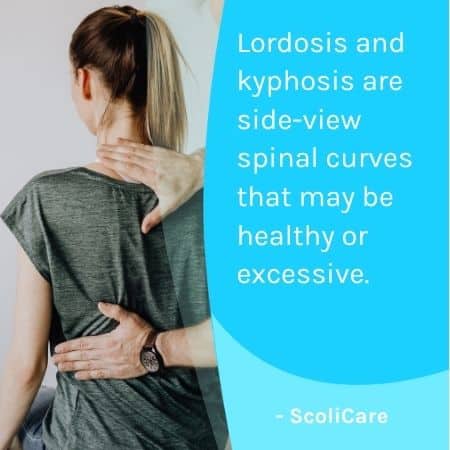
Lordosis and kyphosis are two main types of spinal curvatures when viewing the spine from the side, and they can be healthy or unhealthy, depending on their size.
Lordosis
Lordosis causes the spine to curve inward at the cervical and lumbar spinal sections, so the neck and lower back’s health and function are shaped by the spine’s ability to maintain a normal range of lordosis (3).
Healthy spinal curves can vary in size from one person to the next, but if a person’s degree of lordosis is lost, that portion of the spine can become excessively straight (3).
Spinal-curve size is measured in degrees, and as long as a person’s level of lordosis falls within a normal range, the curve size is considered typical, but if enough of a loss occurs to make the spine excessively straight, this can become problematic as it disrupts the function of the section affected (3).
And as each spinal section’s health is dependent on the other sections, a loss of a single spinal section’s healthy curve can also affect how the other sections function.
If the neck’s natural inward-bending spinal curvature is lost and becomes excessively straight, this can cause forward head posture to develop, disrupting the neck’s ability to support the weight of the head and facilitate a wide range of motion (3, 4).
If the lumbar spine loses its healthy lordosis and becomes excessively straight, this can disrupt the lower back’s primary role: supporting the weight of the spinal sections above and the torso (5).
The vertebrae of the lumbar spine also facilitate side bending, extension, flexion, and rotation so are essential for a number of movements (5).
Kyphosis
Kyphosis refers to a type of spinal curvature that curves outwards and characterizes the thoracic spine (6).
Unhealthy kyphosis commonly involves a person’s degree of kyphosis becoming excessive, and this can cause the upper back and shoulders to round forward excessively and is diagnosed as hyperkyphosis (6).
If the thoracic spine’s kyphosis becomes excessive, it can affect its range of motion, strength, cause a muscular imbalance to develop, and pain (6).
There are also different types of kyphosis with different causes; postural kyphosis is caused by chronic poor posture, Scheuermann’s kyphosis is structural so involves the vertebrae being misshapen, and age-related hyperkyphosis is caused by degenerative instability (6).
So a healthy spinal curve becoming unhealthy can have different causes, and there are also spinal conditions like scoliosis that cause the spine to curve and rotate unnaturally.
What is Scoliosis?
Scoliosis is a prevalent unhealthy spinal curvature disorder, and what makes it unique is that it doesn’t just cause an unhealthy lateral curvature to develop, it also causes the spine to rotate, making scoliosis a 3-dimensional unhealthy spinal curvature (7).
Scoliosis affects all ages, with adolescent idiopathic scoliosis the most prevalent form, and there are also multiple types of scoliosis from idiopathic scoliosis to neuromuscular scoliosis, degenerative scoliosis, and congenital scoliosis.
Scoliosis ranges widely in severity from mild scoliosis to moderate scoliosis and severe scoliosis, and it’s progressive, so the size and rotation of the spinal curvature is likely to increase over time.
Most cases of scoliosis are idiopathic, meaning no single-known cause, but we know what makes it progress: growth (7).
We also know that progression makes scoliosis more challenging to treat, so proactively managing scoliosis during growth is key (7).
An unnatural spinal curve means the spine is not balanced, and this can also cause misalignment elsewhere in the body.
Scoliosis Symptoms
The larger an unnatural spinal curve is, the more noticeable its effects are likely to be, and the more challenging it can be to correct.
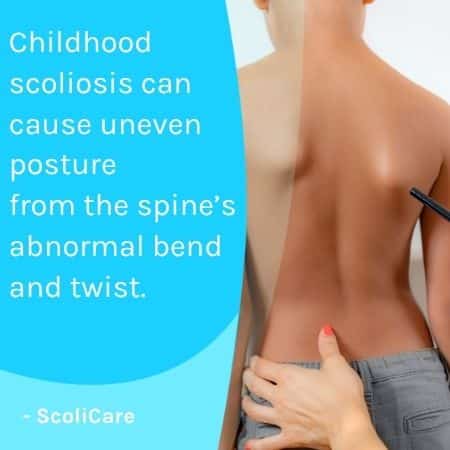
The main effects of childhood scoliosis include postural changes such as uneven shoulders, uneven shoulder blades, a rib cage arch, and an uneven waist and hips; postural changes are caused by the uneven forces introduced by the spine’s unnatural bend and twist (7, 8).
As the body’s postural symmetry is further disrupted, unhealthy movement patterns can develop as balance, coordination and gait are based on symmetrical movement (8, 9).
For adults, pain is the main symptoms of scoliosis and can include muscle pain, localized back pain, and pain that radiates into the extremities due to nerve compression (10).
So when the spine bends and twists unnaturally, it can cause postural changes, movement changes, and pain.
A misaligned spine means a misaligned body, so when treating an unnatural spinal curve, the goal is to restore as much of the spine’s healthy curves as possible to improve the spine and body’s alignment, balance, and stability.
Conclusion
If the spine is unstable, so too is the body. A healthy spine is needed for structural support, healthy movement patterns, straight posture, and protecting the spinal cord within.
If the spine loses a healthy curvature, it’s replaced by an unhealthy curve, and this can involve a loss of lordosis, excessive kyphosis, and/or the development of scoliosis.
Lordosis refers to the spine bending inward, while kyphosis refers to the spine’s outward curve, and scoliosis causes an abnormal curve that bends to the side and rotates.
While surgical treatment remains an option for correcting severe spine curvature disorders, many cases of lordosis, kyphosis, and scoliosis respond well to nonsurgical treatment, and while there are no treatment guarantees, in most cases, the sooner treatment is started, the better.
Particularly in cases of unnatural spinal curves that are progressive and triggered by growth, children need to be treated proactively in an effort to prevent progression, increasing effects, and the need for invasive spinal surgery.
A scoliosis curve is not going to resolve on its own, so merely observing a scoliosis can mean wasting valuable treatment time, and here at ScoliCare, the approach is patient-centered and proactive, so treatment is started immediately following a scoliosis diagnosis.
Find Your Nearest Clinic
ScoliCare Clinics, affiliates and product providers are in over 200 locations around the world. Find your nearest ScoliCare location here.


References:
- Cologne, Germany: Institute for Quality and Efficiency in Health Care (IQWiG); 2006-. In brief: How does the spine work? [Updated 2022 May 11]. Available from: https://www.ncbi.nlm.nih.gov/books/NBK279468/
- Scarcia L, Pileggi M, Camilli A, Romi A, Bartolo A, Giubbolini F, Valente I, Garignano G, D’Argento F, Pedicelli A, Alexandre AM. Degenerative Disc Disease of the Spine: From Anatomy to Pathophysiology and Radiological Appearance, with Morphological and Functional Considerations. J Pers Med. 2022 Nov 1;12(11):1810. doi: 10.3390/jpm12111810. PMID: 36579533; PMCID: PMC9698646
- Guo GM, Li J, Diao QX, Zhu TH, Song ZX, Guo YY, Gao YZ. Cervical lordosis in asymptomatic individuals: a meta-analysis. J Orthop Surg Res. 2018 Jun 15;13(1):147. doi: 10.1186/s13018-018-0854-6. PMID: 29907118; PMCID: PMC6003173
- Oakley PA, Kallan SZ, Harrison DE. Structural rehabilitation of the cervical lordosis and forward head posture: a selective review of Chiropractic BioPhysics® case reports. J Phys Ther Sci. 2022 Nov;34(11):759-771. doi: 10.1589/jpts.34.759. Epub 2022 Nov 1. PMID: 36337218; PMCID: PMC9622351
- Been E, Kalichman L. Lumbar lordosis. Spine J. 2014 Jan;14(1):87-97. doi: 10.1016/j.spinee.2013.07.464. Epub 2013 Oct 2. PMID: 24095099
- Lam JC, Mukhdomi T. Kyphosis. [Updated 2023 Aug 8]. In: StatPearls [Internet]. Treasure Island (FL): StatPearls Publishing; 2025 Jan-. Available from: https://www.ncbi.nlm.nih.gov/books/NBK558945/
- Weinstein, S. L. (2019). The natural history of adolescent idiopathic scoliosis. Journal of Pediatric Orthopaedics, 39, S44-S46.
- Negrini S, Donzelli S, Aulisa AG, Czaprowski D, Schreiber S, de Mauroy JC, Diers H, Grivas TB, Knott P, Kotwicki T, Lebel A, Marti C, Maruyama T, O’Brien J, Price N, Parent E, Rigo M, Romano M, Stikeleather L, Wynne J, Zaina F. 2016 SOSORT guidelines: orthopaedic and rehabilitation treatment of idiopathic scoliosis during growth. Scoliosis Spinal Disord. 2018 Jan 10;13:3. doi: 10.1186/s13013-017-0145-8. PMID: 29435499; PMCID: PMC5795289
- Hong KS, Van Minh P, Nguyen HT, Phan MH, Nguyen HN, Pham TP. Re-evaluation of Incorrect Posture as a Diagnostic Criterion for Scoliosis in School Screenings: A Cross-Sectional Study in Vietnam. Cureus. 2025 Mar 31;17(3):e81535. doi: 10.7759/cureus.81535. PMID: 40314041; PMCID: PMC12043434
- Zaina F, Marchese R, Donzelli S, Cordani C, Pulici C, McAviney J, Negrini S. Current Knowledge on the Different Characteristics of Back Pain in Adults with and without Scoliosis: A Systematic Review. J Clin Med. 2023 Aug 9;12(16):5182. doi: 10.3390/jcm12165182. PMID: 37629224; PMCID: PMC10455254
More news
-
 12 June 2026
Scoliosis is a condition that affects the spine: an unnatural sideways-bending spinal curvature that rotates develops. As a progressive lateral curvature of the spine, the nature of scoliosis is to…
-
 13 May 2026
Scoliosis types vary by cause—idiopathic is most common, while atypical forms are often more severe. Treatment must be customized for each case.
-
 15 April 2026
Structural scoliosis involves spinal rotation and fixed curves, while functional scoliosis stems from external factors like posture or imbalance and may resolve.