
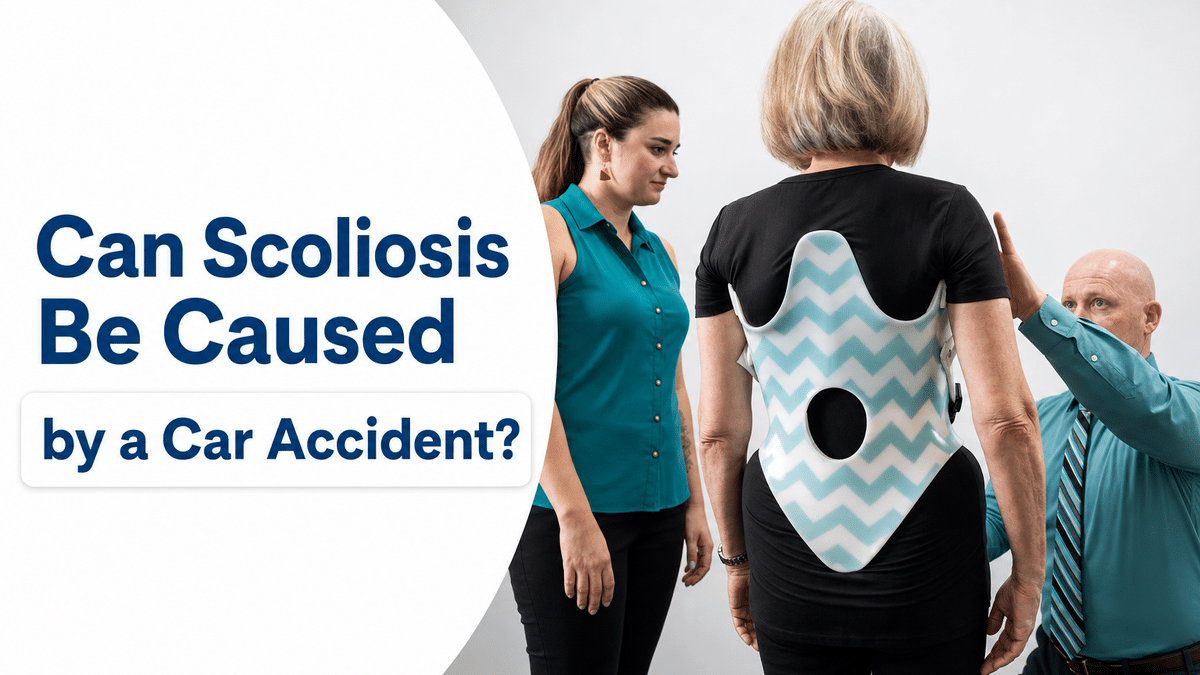
There are different types of scoliosis with varying severity levels and causes. While most cases of scoliosis are idiopathic, scoliosis can also be caused by neuromuscular conditions, degenerative instability, and trauma. Traumatic scoliosis develops due to the spine sustaining a significant trauma that impacts its alignment and stability.
While it’s more likely that a car accident will worsen a pre-existing scoliosis, significant spinal trauma such as a fracture, dislocation, or increasing instability can cause the development of traumatic scoliosis.
Traumatic scoliosis isn’t as common as other types, but let’s explore how car accidents can affect pre-existing scoliosis and/or cause the development of traumatic scoliosis.
Traumatic Scoliosis
Scoliosis is a structural spinal issue that involves the development of an unnatural lateral curvature with rotation, and it can have different causes and characteristics.
Traumatic scoliosis is caused by a spinal injury that interferes with its ability to stay aligned and balanced. They may be caused by a severe event such as a fall, fracture, dislocation or car accident.
Motor vehicle accidents are the leading cause of spinal cord injuries, followed by occupational accidents (1).
Spinal injuries benefit from early intervention and proactive efforts to restore the integrity and stability of the spinal column (2).
Spinal fractures, dislocations, or excessive instability caused by a fall or car accident can cause traumatic scoliosis by weakening and/or damaging the spine’s vertebrae, supportive ligaments, and/or other structures.
Car accidents/traumas that involve a jarring impact can further compress the spine; high-impact car accidents that involve being hit from behind are most likely to cause the type of trauma capable of impacting and/or causing scoliosis (3).
As the spine protects the spinal cord within, a spinal trauma can also cause spinal cord injuries that can involve severe nerve damage capable of causing a number of symptoms.
When it comes to treatment options for traumatic scoliosis, plans need to be customized and can include scoliosis-specific physical therapy programs, chiropractic care, corrective bracing, pain management, and in severe cases, surgery.
As traumatic scoliosis isn’t a common form, it’s more likely that a car accident will worsen pre-existing scoliosis by further weakening the spine and disrupting its alignment.
In cases of a pre-existing scoliosis being aggravated by a car accident, this is most likely to involve the condition’s most-common type: idiopathic scoliosis.
Idiopathic Scoliosis
What’s interesting about scoliosis is that in the majority of cases, there is no known cause, and this is classified as idiopathic scoliosis, and as scoliosis is progressive, it’s not going to resolve on its own.
Idiopathic scoliosis accounts for approximately 80 percent of cases and is thought to be multifactorial, but not knowing the cause doesn’t mean we don’t know how to treat it effectively (4).
ScoliCare Clinics around the world are leaders in successfully treating scoliosis with proactive nonsurgical treatment combining the power of scoliosis-specific exercise, chiropractic treatment, and corrective bracing.
Regardless of the cause, scoliosis patients can benefit from treatment in a number of ways.
In cases of a car accident causing a pre-existing scoliosis to progress, this can include idiopathic scoliosis, neuromuscular scoliosis, and degenerative scoliosis.
Neuromuscular Scoliosis
Neuromuscular scoliosis (NMS) develops due to the presence of an underlying neurological or muscular condition like spina bifida, muscular dystrophy, or cerebral palsy.
As NMS doesn’t just affect the spine but also the muscles, ligaments, and connective tissues that support and stabilize the spine, these cases can be severe and cause patients to require mobility assists like walkers and wheelchairs.
Neuromuscular scoliosis treatment has to focus on the larger neuromuscular condition as the underlying cause of the scoliosis.
A car accident can worsen pre-existing neuromuscular scoliosis by further weakening the spine and muscles/ligaments that support and stabilize the spine.
Degenerative Scoliosis
After idiopathic scoliosis, degenerative scoliosis is the most prevalent type to affect adults, and as degenerative scoliosis affects older adults and is caused by degenerative instability, a car accident can be particularly damaging (7).
Degenerative scoliosis, also known as degenerative de novo scoliosis (DDS), develops in later adulthood with no prior history, and is caused by age-related spinal degeneration that most often starts in the discs that sit between adjacent vertebrae (7).
Degenerative scoliosis treatment focuses on fall prevention, pain management, and improving posture and core strength for more spinal support and stability.
Because degenerative scoliosis causes the spine to become increasingly unbalanced and unstable, it’s almost always progressive and painful, so a degenerative scoliosis patient could experience significant worsening of the curve, nerve damage, and/or spinal injury caused by a car accident.
Conclusion
The spine’s strength, flexibility, and function can be disrupted by scoliosis, and any additional trauma can significantly worsen a pre-existing scoliosis and/or cause the development of traumatic scoliosis.
Most cases of scoliosis have no known cause, but neuromuscular, degenerative, and traumatic scoliosis are associated with known causes.
Traumatic scoliosis is caused by a trauma and/or injury sustained by the spine that disrupts its ability to stay aligned; this can be due to injured muscles, ligaments, connective tissues that support and stabilize the spine, damage to the bones of the spine (vertebrae), or other spinal structures.
Car accidents that involve being rear-ended are the most likely to aggravate a pre-existing scoliosis and/or cause the development of traumatic scoliosis due to the jarring impact.
Managing scoliosis caused by a car accident means addressing the injury and/or damage, while working towards restoring the spine’s balance and alignment; this can involve scoliosis-specific exercise rehabilitation, chiropractic care, and corrective bracing.
Find Your Nearest Clinic
ScoliCare Clinics, affiliates and product providers are in over 200 locations around the world. Find your nearest ScoliCare location here.


References:
- Barbiellini Amidei, C., Salmaso, L., Bellio, S. et al. Epidemiology of traumatic spinal cord injury: a large population-based study. Spinal Cord 60, 812–819 (2022). https://doi.org/10.1038/s41393-022-00795-w
- Vaccaro AR, Silber JS. Post-traumatic spinal deformity. Spine (Phila Pa 1976). 2001 Dec 15;26(24 Suppl):S111-8. doi: 10.1097/00007632-200112151-00019. PMID: 11805617
- Kishen TJ, Mohapatra B, Diwan AD, Etherington G. Post-traumatic thoracic scoliosis with rib head dislocation and intrusion into the spinal canal: a case report and review of literature. Eur Spine J. 2010 Jul;19 Suppl 2(Suppl 2):S183-6. doi: 10.1007/s00586-010-1321-1. Epub 2010 Feb 21. PMID: 20582558; PMCID: PMC2899628
- Trobisch P, Suess O, Schwab F. Idiopathic scoliosis. Dtsch Arztebl Int. 2010 Dec;107(49):875-83; quiz 884. doi: 10.3238/arztebl.2010.0875. Epub 2010 Dec 10. PMID: 21191550; PMCID: PMC3011182.
- Dunn J, Henrikson NB, Morrison CC, et al. Screening for Adolescent Idiopathic Scoliosis: A Systematic Evidence Review for the U.S. Preventive Services Task Force [Internet]. Rockville (MD): Agency for Healthcare Research and Quality (US); 2018 Jan. (Evidence Synthesis, No. 156.) Chapter 1, Introduction. Available from: https://www.ncbi.nlm.nih.gov/books/NBK493369/
- Mandadi AR, Koutsogiannis P, Das JM, et al. Pediatric Spine Trauma. [Updated 2024 Mar 10]. In: StatPearls [Internet]. Treasure Island (FL): StatPearls Publishing; 2025 Jan-. Available from: https://www.ncbi.nlm.nih.gov/books/NBK442027/
- Marty-Poumarat, Catherine MD*; Scattin, Luciana MD†; Marpeau, Michèle MD*; Garreau de Loubresse, Christian MD‡; Aegerter, Philippe MD, PhD§. Natural History of Progressive Adult Scoliosis. Spine 32(11):p 1227-1234, May 15, 2007. | DOI: 10.1097/01.brs.0000263328.89135.a6
More news
-
 24 February 2023
The short answer is yes, people with scoliosis can live normally. However, it is important to understand the condition and its impact on the individual's life. Scoliosis is a complex…
-
 14 March 2021
Kurt Cobain and his Scoliosis Part of our series of famous people who have/had a Scoliosis. Next up is Kurt Cobain! Kurt Cobain is best known as the lead…
-
 1 November 2022
It is hard to believe that the fastest man on earth has scoliosis! Olympian Usain Bolt was born with scoliosis. His right leg is half an inch shorter than his…