
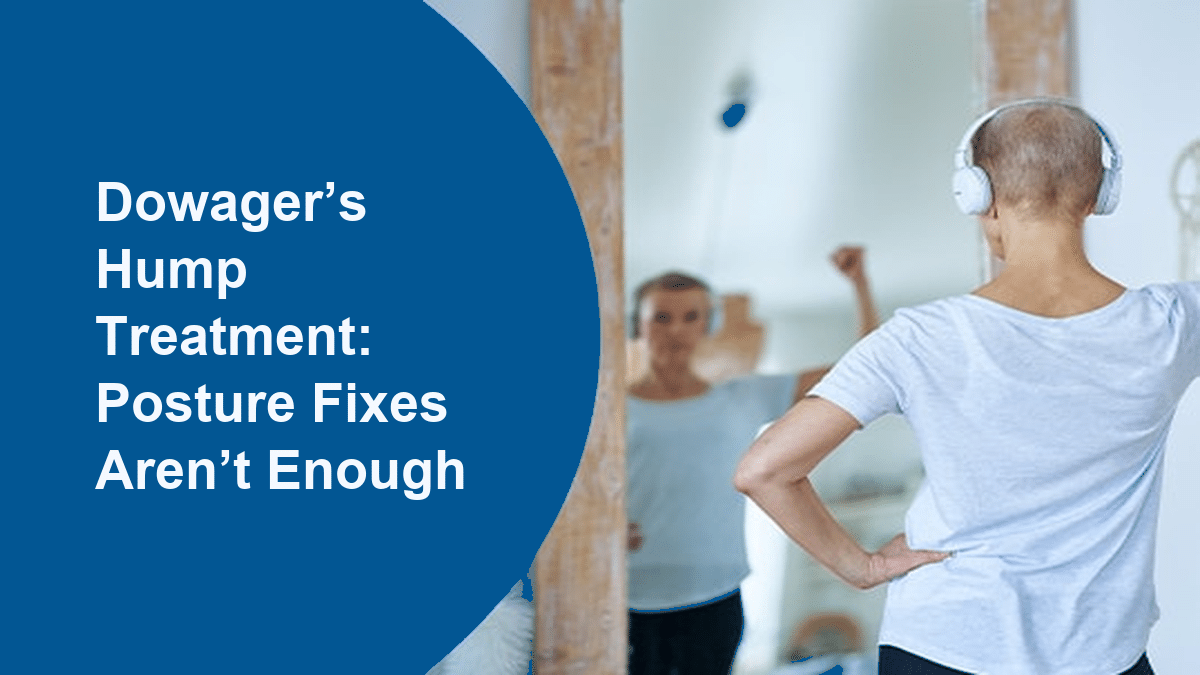
A Dowager’s hump commonly affects older females and refers to an excessive rounded-forward appearance of the upper back at the base of the neck (hyperkyphosis), referencing the spine’s natural outward curvature (kyphosis) that characterizes the thoracic spine.
While postural hyperkyphosis may respond well to postural restoration alone through kyphosis-specific exercise-based treatment, a Dowager’s hump commonly involves weakened vertebrae so may require a more comprehensive treatment plan that includes corrective bracing. Corrective bracing for Dowager’s is likely more related to working on the posture below the hump, to give the body a better foundation for improving the hump.
When the spine develops an unhealthy spinal curvature, it can disrupt the spine’s balance and function and needs to be addressed with a proactive treatment plan.
Kyphosis
Each of the spine’s main sections has a characteristic curve type that shapes its health and function.
Lordosis is the curve type found in the cervical spine (neck) and the lumbar spine (lower back) and causes the spine to curve inwards in a standard C-shape, when viewed from either side.
Kyphosis is opposite to lordosis; it causes the spine to bend outwards in a reverse C-shape, when viewed from either side.
Kyphosis is found in the thoracic spine (middle/upper back), and it’s the largest and only spinal section that attaches to the rib cage; as such, the thoracic spine helps anchor the rib cage, provides structural support, protects the heart and lungs, and facilitates a wide range of upper-body motion (1).
The thoracic spine’s ability to perform its key functions is shaped by a number of factors, one of which is its degree of kyphosis.
There is a natural range of kyphosis that varies from person to person, but if a person’s degree of kyphosis falls beyond a normal range, becoming excessive, the thoracic spine’s kyphotic curve is excessive, disrupting spinal alignment, and causing too much rounding forward of the upper back and shoulders (1, 2).
A moderate increase in kyphosis might not be problematic, but if the curve size becomes excessive, this is diagnosed as hyperkyphosis, and can disrupt the spine’s balance and alignment (1, 2), and Dowager’s hump is a form of hyperkyphosis that commonly involves weakened vertebrae (3).
Dowager’s Hump
While hyperkyphosis can affect all ages and also develops in the spine’s main thoracic region, a dowager’s hump mainly affects the upper portion of the thoracic spine, at the base of the neck, and develops later in life (3).
Dowager’s hump is an excessive rounded curve that develops at the base of the neck and/or upper back.
The main effect of an excessive rounded curve at the base of the neck is a hunched-forward posture, and while hyperkyphosis can be caused by chronic poor posture in younger individuals, as a Dowager’s hump develops later in life, its common causes include spinal degeneration and osteoporosis (3).
Additional symptoms of a Dowager’s hump can include the development of forward head posture as the upper back’s excessive curve pushes the head forward, increasing its weight on the cervical spine (3, 4).
Neck and shoulder pain are common and can be accompanied by headaches, fatigue, and stiffness in the upper back, shoulders, and neck, and in severe cases, digestive and nerve issues can occur (3, 4).
As Dowager’s commonly affects older females, treatment is needed to restore as much of the spine’s healthy curves as possible because this means improving its balance and stability for fall prevention and pain management (3).
Dowager’s Hump Causes
As we age, there is a natural amount of spinal degeneration to be expected, and as the body becomes less able to resist the downward force of gravity, muscles and ligaments needed to support the spine can become weaker, causing a lack of spinal support.
Patients experiencing bone-health changes (osteoporosis) are particularly vulnerable to a dowager’s hump; older females are the most vulnerable to developing excessive kyphosis at the base of the neck due to changes in hormones and bone health related to menopause (3).
For menopausal females experiencing bone-health changes, it can be harder to resist the downward force of gravity and related effects, and this can lead to the front of vertebrae collapsing, known as compression fractures, associated with osteoporosis and general spinal degeneration (3).
Compression fractures cause a wedge-shaped structural abnormality of the vertebrae, and if left untreated, older adults face increasing risk of injury through a fall; the more out of balance the spine becomes, the more likely increasing degenerative changes become (3).
Increasing spinal instability is a serious concern, so while improving a patient’s posture is a focus of age-related hyperkyphosis treatment, its potential increases when combined with kyphosis-specific bracing) (3).
In some cases, particularly when diagnosed early enough, kyphosis-specific exercise rehabilitation may be enough to restore a healthy degree of kyphosis to the thoracic spine, but if a patient’s degree of kyphosis is excessive and is caused by osteoporosis, a KyphoBrace® may be deemed necessary for pain management, to stop progression, further reduce curve size, and stabilize the spine (3, 4).
Postural Restoration as Treatment
A customized treatment plan will address a condition’s underlying cause, not just its symptoms, so in some cases, postural improvements may be enough, but in others, a more integrative treatment approach may be necessary.
Healthy posture is facilitated by a healthy spine and vice versa. The way a person positions their body during activity and rest, over time, can affect spinal health and, specifically, the health of important spinal curves (5).
When patients come to a ScoliCare Clinic, an initial assessment is comprehensive and includes a postural, strength, and mobility assessment; our clinicians can tell a lot about the health of a person’s spine by their posture and gait.
Over time, chronic poor posture can put extra pressure on the spine’s vertebrae, affecting its alignment, the discs that sit between adjacent vertebrae, and the spinal nerves (5).
Poor posture can also contribute to weak and unbalanced muscles, so poor posture can affect the spine and its surroundings. Strong core and back muscles are needed to maintain the spine’s straight and neutral alignment (5).
So postural restoration is a focus of treatment for a number of spinal conditions (5), including Dowager’s hump, and this is delivered through kyphosis-specific exercise rehabilitation; however, exercise-based treatment alone is generally more successful in cases caused by chronic poor posture that don’t involve structural abnormalities or weak vertebrae.
So when it comes to postural hyperkyphosis, kyphosis-specific exercise can be an effective treatment option, but in older patients dealing with weakened vertebrae due to osteoporosis and/or general degenerative changes, kyphosis-specific bracing may also be needed (3, 4).
In cases where there are structural issues and degenerative instability within the spine, a combination of kyphosis-specific exercise and kyphosis-specific bracing may be the best approach for improving the spine’s balance and body posture (3, 4).
KyphoBrace®
KyphoBrace® is a brace specifically designed to treat hyperkyphosis in adolescents and adults by improving the body and spine’s 3D posture and alignment (4).
A KyphoBrace® is customized to suit a patient’s body type and curve degree through advanced 3D scanning technology and computer-aided design and manufacture (CAD and CAM); this patient-centered approach ensures the brace is as comfortable and effective as possible for the best potential treatment outcome (4).
While results can never be guaranteed, when worn as prescribed, and particularly when combined with the power of a kyphosis-specific exercise rehabilitation program, the KyphoBrace® may help stop progression, reduce curve size, improve posture, and reduce pain (3, 4).
Improving posture below the hump through corrective bracing, and muscle strength through kyphosis-specific rehabilitative exercise, may help restore a healthy degree of kyphosis above, thereby improving the balance and stability of the thoracic spine and its surroundings (3, 4, 5).
Conclusion
The spine’s healthy curves are important for optimal spinal health and function, and while postural fixes may be enough in cases of postural hyperkyphosis, in cases of age-related hyperkyphosis (Dowager’s hump), structural improvements may also be necessary.
Kyphosis refers to the thoracic spine’s healthy outward curve, and if a person’s degree of kyphosis becomes excessive and problematic, this is diagnosed as hyperkyphosis.
Several factors will shape how hyperkyphosis affects a person, with moderate increases often being asymptomatic, but an excessive increase can cause forward head posture, sore neck muscles, neck pain, tight muscles surrounding the spine, muscle weakness, rounded shoulders and upper back, back pain, bad posture, and in severe cases, sensory changes caused by nerve compression.
When it comes to prevention, the best way to preserve the spine’s healthy curves is to cultivate a healthy lifestyle including regular exercise, strength training to maintain muscle strength and balance, a healthy diet rich in vitamin d (essential for bone health), and practicing good posture.
For those recently diagnosed with age-related hyperkyphosis, the best time to start treatment is always now, before the increased kyphosis causes increasing spinal rigidity, making it less responsive to treatment, and increasing degenerative changes that further disrupt the spine’s health and function.
Find Your Nearest Clinic
ScoliCare Clinics, affiliates and product providers are in over 200 locations around the world. Find your nearest ScoliCare location here.


References:
- Lam JC, Mukhdomi T. Kyphosis. [Updated 2023 Aug 8]. In: StatPearls [Internet]. Treasure Island (FL): StatPearls Publishing; 2025 Jan-. Available from: https://www.ncbi.nlm.nih.gov/books/NBK558945/
- Veintemillas Aráiz MT, Beltrán Salazar VP, Rivera Valladares L, Marín Aznar A, Melloni Ribas P, Valls Pascual R. Changes in spinal alignment. Radiologia. 2016 Apr;58 Suppl 1:115-27. English, Spanish. doi: 10.1016/j.rx.2016.01.007. Epub 2016 Mar 12. PMID: 26976664
- Katzman WB, Wanek L, Shepherd JA, Sellmeyer DE. Age-related hyperkyphosis: its causes, consequences, and management. J Orthop Sports Phys Ther. 2010 Jun;40(6):352–60. doi: 10.2519/jospt.2010.3099. [DOI] [PMC free article] [PubMed] [Google Scholar]
- Sánchez-Pinto-Pinto B, Romero-Morales C, López-López D, de-Labra C, García-Pérez-de-Sevilla G. Efficacy of Bracing on Thoracic Kyphotic Angle and Functionality in Women with Osteoporosis: A Systematic Review. Medicina (Kaunas). 2022 May 24;58(6):693. doi: 10.3390/medicina58060693. PMID: 35743956; PMCID: PMC9228437
- Fasser MR, Furrer PR, Fisler L, Urbanschitz L, Snedeker JG, Farshad M, Widmer J. The triadic relationship between spinal posture, loading, and degeneration. Front Bioeng Biotechnol. 2025 Mar 18;13:1444540. doi: 10.3389/fbioe.2025.1444540. PMID: 40171041; PMCID: PMC11959076
More news
-
 15 July 2024
In recent years, patient-centred care has revolutionised the approach to scoliosis treatment by focusing on the unique needs, preferences and values of each patient. This approach places patients at the…
-
 19 November 2021
What was the Article Looking for? This article aimed to provide an overview of practical experience and the scientific evidence in relation to the psychological aspects of scoliosis in adolescents…
-
 12 July 2022
Is it okay for adolescents with idiopathic scoliosis (AIS) to participate in swimming? And, if so, is the sport a viable ‘treatment’ approach for these growing children? There…