
Scoliosis causes the spine to curve and rotate unnaturally, and common effects include postural changes, mobility changes, and pain. While not everyone with scoliosis experiences pain and sleeping issues, they are common effects, and knowing the best sleeping positions for spinal health can help.
When it comes to sleeping with scoliosis, it’s important to understand the importance of spinal alignment and healthy body positioning. The sleeping position that best supports the spine’s healthy alignment and weight distribution is sleeping flat on the back, followed by side-sleeping, and sleeping on the stomach can strain the spine.
Before getting to the best sleeping positions for comfort and spinal health, for a better understanding of why healthy sleep patterns are so important, let’s talk briefly about scoliosis effects.
How Scoliosis Affects the Spine and Body
Scoliosis involves the development of an unnatural lateral spinal curvature with a rotational component, meaning the spine both curves and twists unnaturally (1).
Scoliosis is also progressive, so the spine’s unnatural curve and rotation is likely to increase over time, and during progression, effects are becoming more overt and potentially disruptive to quality of life (1).
Scoliosis disrupts the spine’s alignment, balance, and stability, and as spinal health is key to overall health, it can affect the spine’s surroundings and the entire body, particularly when severe (1).
In children, the earliest sign of scoliosis is asymmetrical posture involving uneven shoulders and hips, and changes to gait, balance, and coordination are also common (1).
Adult scoliosis is more closely associated with pain due to compression and increasing spinal instability caused by age-related degenerative changes (2).
Severe cases can cause severe symptoms, but scoliosis can be highly treatable, particularly when treatment is started early, so patients most likely to experience pain and sleep problems involve cases of severe and/or untreated scoliosis.
Why Healthy Sleep Patterns Matter for Scoliosis Patients
Healthy sleep patterns are important for everyone, but when it comes to patients also dealing with scoliosis and scoliosis treatment, regular cathartic sleep is needed to help the body heal and increase potential treatment efficacy (3, 4).
Sleep provides the body with crucial restorative time, and a scoliotic spine is being exposed to uneven forces and strain. More time to heal during quality sleep can help with inflammation and pain (3).
Patients who have quality sleep are well-rested when they come in for treatment sessions, and their bodies are better able to handle the rigors of treatment and perform scoliosis-specific rehabilitative exercises that are crucial facets of nonsurgical scoliosis treatment (3, 4).
Energy is important for scoliosis treatment; the more energy a patient brings to a session, the more potential benefits there may be, and there is nothing more motivating to a patient than seeing results.
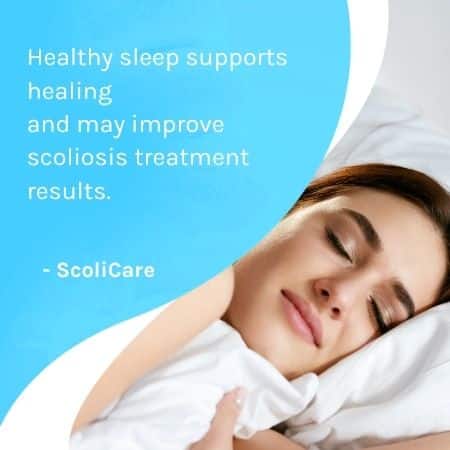
Healthy quality sleep initiates a cycle of energy from rest and more healing, responsiveness to treatment, and motivating results.
How Scoliosis can Affect Sleep
Pain is the primary reason scoliosis patients experience sleep problems, and additional factors include difficulty finding a comfortable position and changes to respiratory function (4, 5, 6).
Not everyone with scoliosis experiences back and nerve pain, but it is particularly common in adults for whom scoliosis is compressive; once skeletal maturity is reached, the spine’s lengthening motion during growth is stopped, and this is when compressive back and nerve pain become more problematic (6).
Sciatic nerve pain, for example, is a common complication of lumbar scoliosis; the sciatic nerve starts in the lower back and extends down the back of the lower body, and sciatica pain can involve painful flare ups, become chronic, and disrupt sleep (6, 7).
Breathing problems aren’t considered a primary symptom of scoliosis, but when severe and/or if left untreated, compression can cause a loss of space within the thoracic cage and impact the ability of the lungs to fully inhale and exhale; patients experiencing the complication of lung impairment can find it difficult to settle into a rhythmic breathing pattern during sleep (8).
While children can also experience back and muscle pain caused by scoliosis, chronic and severe pain is more closely associated with adult scoliosis (2, 4, 5, 6).
Scoliosis pain can also involve the muscles surrounding the spine becoming strained, tight, and/or unbalanced, and muscle pain can interfere with sleep and make it difficult to get comfortable (4, 5).
While nothing offers more scoliosis pain-relief potential than a proactive treatment plan, knowing the best sleep positions for scoliosis can help improve a patient’s quality of life and responsiveness to treatment.
Best Sleeping Positions for Scoliosis
The best sleeping positions for scoliosis are those that reduce pain and support healthy spinal alignment.
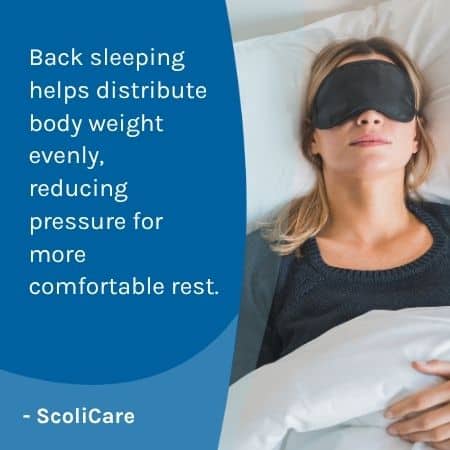
The best sleeping position for people with and without scoliosis is sleeping flat on the back. Back-sleeping supports spinal health through even body-weight distribution and holding the spine in a neutral and aligned position (9).
Sleeping flat on the back doesn’t arch the spine unnaturally, and because body weight is evenly distributed, pressure points are minimized for pain relief and a more-comfortable sleep position (10).
After back-sleeping, side-sleeping is the next best position for spinal health, and there are modifications that can further improve its ability to support spinal alignment (10).
Sleeping on the side with a pillow between the knees can further support the spine’s neutral position and reduce the tendency of the hips to rotate (10).
For additional support, a small rolled-up towel or flat pillow can be slid under the waist on the side of the body where the curve prevents contact with the mattress (10).
Those with and without scoliosis should avoid sleeping flat on the stomach as this is considered the worst sleeping position for spinal health (10).
Sleeping flat on the stomach isn’t recommended for people with or without scoliosis because it doesn’t support the spine’s healthy alignment and increases pressure on the spine’s vertebrae, joints, and supportive muscles (10).
Stomach-sleeping strains the lower back by pushing the torso into the mattress, and in order to breathe properly, the cervical spine (neck) has to be twisted at an awkward angle to maximize air flow; as one long structure, if a single spinal section is strained, the effects can be felt throughout the entire spine (10).
In addition, when waking up after an unhealthy spinal position during sleep, the back will be stiffer and more painful, impacting mobility and pain throughout the day (9, 10).
Conclusion
The best sleep position for scoliosis is sleeping flat on the back, followed by side-sleeping with modifications, and stomach-sleeping is considered the worst position for spinal health.
Additional tips for quality sleep include the value of a supportive comfortable mattress and proper pillow placement.
Healthy sleep patterns are important for general quality of life, and for scoliosis patients, quality sleep can help create an internal environment that’s conducive to healing and recovery.
When people are in pain, it can be difficult to settle into a healthy sleep pattern. Pain can interfere with getting comfortable and the ability to stay asleep, and frequent waking can lead to position-changes that further disrupt comfort and sleep duration.
Broken and/or low-quality sleep can have lasting effects as it transfers into the following day and initiates a cycle of tiredness, lack of energy, and motivation; these are factors capable of impacting scoliosis treatment response and potential efficacy.
In addition, if scoliosis patients aren’t getting enough rest and healing time during sleep, their ability to perform key corrective rehabilitative exercises can be disrupted, further limiting potential treatment efficacy.
ScoliCare Clinicians work closely with patients, from the initial comprehensive assessment to shaping treatment and lifestyle needs, including customized guidance on how to improve sleep for optimal spinal health, pain relief, and healing.
Find Your Nearest Clinic
ScoliCare Clinics, affiliates and product providers are in over 200 locations around the world. Find your nearest ScoliCare location here.


References:
- Janicki JA, Alman B. Scoliosis: Review of diagnosis and treatment. Paediatr Child Health. 2007 Nov;12(9):771-6. doi: 10.1093/pch/12.9.771. PMID: 19030463; PMCID: PMC2532872
- Aebi M. The adult scoliosis. Eur Spine J. 2005 Dec;14(10):925-48. doi: 10.1007/s00586-005-1053-9. Epub 2005 Nov 18. PMID: 16328223
- Worley SL. The Extraordinary Importance of Sleep: The Detrimental Effects of Inadequate Sleep on Health and Public Safety Drive an Explosion of Sleep Research. P T. 2018 Dec;43(12):758-763. PMID: 30559589; PMCID: PMC6281147
- Yakut Y, Pelin Z, Yagci G. An investigation of sleep profiles in individuals with idiopathic scoliosis. Sleep Sci. 2022 Apr-Jun;15(2):172-178. doi: 10.5935/1984-0063.20220038. PMID: 35755911; PMCID: PMC9210568
- Sarkovich S, Leonardi C, Darlow M, Martin D, Issa P, Soria T, Bronstone A, Clement C. Back pain in adolescent idiopathic scoliosis: frequency and risk factors. Spine Deform. 2024 Sep;12(5):1319-1327. doi: 10.1007/s43390-024-00904-0. Epub 2024 Jun 23. PMID: 38910187; PMCID: PMC11344019
- Zaina F, Marchese R, Donzelli S, Cordani C, Pulici C, McAviney J, Negrini S. Current Knowledge on the Different Characteristics of Back Pain in Adults with and without Scoliosis: A Systematic Review. J Clin Med. 2023 Aug 9;12(16):5182. doi: 10.3390/jcm12165182. PMID: 37629224; PMCID: PMC10455254
- Davis D, Taqi M, Vasudevan A. Sciatica. [Updated 2024 Jan 4]. In: StatPearls [Internet]. Treasure Island (FL): StatPearls Publishing; 2025 Jan-. Available from: https://www.ncbi.nlm.nih.gov/books/NBK507908/
- Koumbourlis AC. Scoliosis and the respiratory system. Paediatr Respir Rev. 2006 Jun;7(2):152-60. doi: 10.1016/j.prrv.2006.04.009. Epub 2006 Jun 2. PMID: 16765303
- Cary D, Briffa K, McKenna L. Identifying relationships between sleep posture and non-specific spinal symptoms in adults: A scoping review. BMJ Open. 2019 Jun 28;9(6):e027633. doi: 10.1136/bmjopen-2018-027633. PMID: 31256029; PMCID: PMC660907
- Cary D, Jacques A, Briffa K. Examining relationships between sleep posture, waking spinal symptoms and quality of sleep: A cross sectional study. PLoS One. 2021 Nov 30;16(11):e0260582. doi: 10.1371/journal.pone.0260582. Erratum in: PLoS One. 2024 Jul 2;19(7):e0306662. doi: 10.1371/journal.pone.0306662. PMID: 34847195; PMCID: PMC863162
More news
-
 1 June 2022
Long trips can be a little difficult for brace wearers, especially if sitting for hours at a time. Here are some tips for scoliosis brace wearers that may help make…
-
 31 January 2024
A good night’s sleep is extremely important but if you have scoliosis, finding the perfect sleeping position can at times be a little difficult. Whether you wear a brace or…
-
 28 June 2023
By Rebecca Phillips - Exercise Physiologist Team Leader Scoliosis can cause pain of varying intensity and frequency for each person. It is often thought that pain is more common in…