
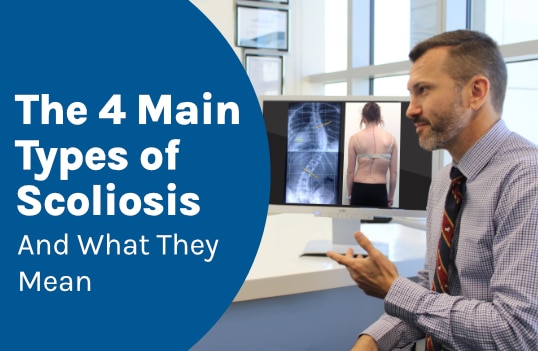
Part of diagnosing scoliosis includes comprehensive assessment to further classify cases by patient age, curve location, severity, and type. The accuracy of a patient’s initial assessment directs treatment recommendations, so a knowledgeable, experienced team of scoliosis Clinicians diagnosing and treating scoliosis is key.
The 4 main types of scoliosis are idiopathic scoliosis, degenerative scoliosis, neuromuscular scoliosis, and congenital scoliosis. Different types of scoliosis have unique characteristics and treatment needs. Type is determined by cause.
Idiopathic scoliosis is the most common form of scoliosis to affect all ages.
Idiopathic Scoliosis
Idiopathic scoliosis doesn’t have a single-known cause. There are a number of causative theories from links to low body mass to issues with bone formation and irregular muscle development (1).
The most prevalent type of idiopathic scoliosis is adolescent idiopathic scoliosis diagnosed commonly at the onset of puberty and into young adulthood; its earliest signs are often uneven shoulders and hips (2).
Scoliosis is progressive so its nature is to increase in severity over time, and growth is the main trigger for progression, making how scoliosis is managed during periods of rapid growth crucial (2, 3).
What a diagnosis of adolescent idiopathic scoliosis means is that proactive treatment is necessary; the focus is on counteracting the progressive nature of scoliosis and restoring as much of the spine’s healthy curves as possible (2, 3).
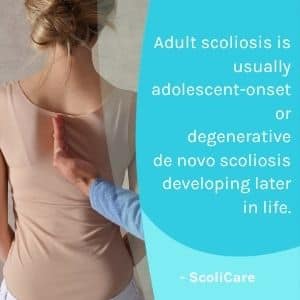
Adolescents are the most common age group to be diagnosed with scoliosis, and idiopathic scoliosis is the most common type of adult scoliosis; these involve cases of adolescent scoliosis that weren’t diagnosed or treated prior to reaching skeletal maturity: highlighting the importance of early detection (4).
Once growth stops and scoliosis becomes compressive, increasing back and radiating pain can lead to a diagnosis, years after the initial onset of the scoliosis (4).
Idiopathic scoliosis accounts for approximately 80 percent of cases, and the remaining types are associated with known causes.
When adults are diagnosed, most cases involve idiopathic scoliosis that’s pre-existing from adolescence as adolescent scoliosis in adults (ASA), or scoliosis that’s developed in later in life with no prior history as degenerative de-novo scoliosis (4, 5).
Degenerative Scoliosis
Degenerative scoliosis is most commonly diagnosed after the age of 45, and it’s more prevalent in females due to changes in hormone levels and bone density caused by menopause (5).
The first step to customizing an effective adult scoliosis treatment plan is determining if a scoliosis is pre-existing or has recently developed.
Degenerative scoliosis is caused by spinal degeneration and can make the spine increasingly unstable (5).
Most spinal degeneration starts in the intervertebral discs, making degenerative disc disease a contributing factor in the development of a number of spinal conditions (6).
If a disc degenerates, it can dry out and change shape as a result, and this affects the position of adjacent vertebrae attached to the disc in between (6).
When there is degenerative instability, there is too much movement within the spine, and this disrupts overall balance, making fall prevention in older adults a focus of scoliosis treatment (6).
Because instability is an issue for degenerative scoliosis patients, most cases are progressive and painful; lower back pain is the most common symptom of degenerative scoliosis (6, 7).
A diagnosis of degenerative scoliosis means treatment that improves the spine’s balance and stability is necessary for pain relief and fall prevention (6, 7).
Neuromuscular Scoliosis
Neuromuscular scoliosis is caused by the presence of a pre-existing muscular or neurological condition such as spina bifida, muscular dystrophy, cerebral palsy, or muscular atrophy (8).
Pelvic obliquity, a symptom of neuromuscular conditions, can also cause scoliosis to develop and/or progress due to the excessive tilting of the pelvis disrupting the spine’s alignment (9).
Not all neuromuscular conditions will cause scoliosis, but it is a common complication.
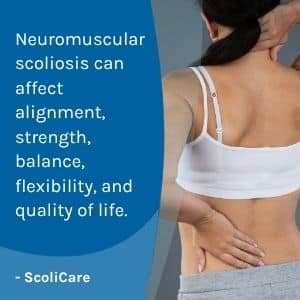
Neuromuscular scoliosis (NMS) develops due to functional deficits in the muscles and nerves that control posture and movement, and the lack of support can cause the spine to become misaligned (8).
Neuromuscular scoliosis affects the spine’s alignment and flexibility, strength, balance, and can greatly impact quality of life (8).
Cases of neuromuscular scoliosis tend to be severe with some patients requiring mobility aids (canes, walkers, and wheelchairs) (8).
Because the scoliosis is caused by a pre-existing condition, this complicates the treatment process; the focus has to be the underlying neurological or muscular condition.
It’s important that neuromuscular scoliosis is diagnosed early and treated proactively to minimize potential complications.
Treatment options are case specific, but for patients with a degree of neuromuscular control over their torso, a combination of scoliosis-specific exercise rehabilitation and corrective bracing are potential nonsurgical treatment options.
Congenital Scoliosis
Congenital scoliosis is a rare type affecting approximately 1 in 10,000 babies (10).
Congenital scoliosis is caused by structural abnormalities within the spine that develop in utero, and babies born with congenital scoliosis often present with additional congenital abnormalities (10).
During fetal development, the spine’s vertebrae can form improperly; they can be irregularly shaped, or multiple vertebrae fuse together into one bone, rather than separate vertebral bodies (10).
If one or more vertebrae are misshapen or fused together, the spine doesn’t form properly.
Cases of congenital scoliosis can progress with growth so close monitoring is necessary.
Conclusion
ScoliCare clinics around the world are diagnosing and treating different types of scoliosis with proactive evidence-based nonsurgical treatment plans.
The four main types of scoliosis include idiopathic scoliosis, degenerative scoliosis, neuromuscular scoliosis, and congenital scoliosis.
Most cases of scoliosis are idiopathic, with no known cause, and degenerative scoliosis is caused by degenerative instability. Neuromuscular scoliosis develops as a related complication of a pre-existing neuromuscular condition, and cases of congenital scoliosis are rare and involve a malformed spine developing in utero.
Determining the underlying cause of scoliosis is important for customizing treatment plans accordingly.
Find Your Nearest Clinic
ScoliCare Clinics, affiliates and product providers are in over 200 locations around the world. Find your nearest ScoliCare location here.


References:
- Trobisch P, Suess O, Schwab F. Idiopathic scoliosis. Dtsch Arztebl Int. 2010 Dec;107(49):875-83; quiz 884. doi: 10.3238/arztebl.2010.0875. Epub 2010 Dec 10. PMID: 21191550; PMCID: PMC3011182
- Weinstein SL. The Natural History of Adolescent Idiopathic Scoliosis. J Pediatr Orthop. 2019 Jul;39(Issue 6, Supplement 1 Suppl 1):S44-S46. doi: 10.1097/BPO.0000000000001350. PMID: 31169647
- Negrini, S., Donzelli, S., Aulisa, A. G., Czaprowski, D., Schreiber, S., de Mauroy, J. C., … & Zaina, F. (2018). 2016 SOSORT guidelines: orthopaedic and rehabilitation treatment of idiopathic scoliosis during growth. Scoliosis and spinal disorders, 13(1), 3
- Aebi M. The adult scoliosis. Eur Spine J. 2005 Dec;14(10):925-48. doi: 10.1007/s00586-005-1053-9. Epub 2005 Nov 18. PMID: 16328223
- Kotwal S, Pumberger M, Hughes A, Girardi F. Degenerative scoliosis: a review. HSS J. 2011 Oct;7(3):257-64. doi: 10.1007/s11420-011-9204-5. Epub 2011 Jun 11. PMID: 23024623; PMCID: PMC3192887
- Scarcia L, Pileggi M, Camilli A, Romi A, Bartolo A, Giubbolini F, Valente I, Garignano G, D’Argento F, Pedicelli A, Alexandre AM. Degenerative Disc Disease of the Spine: From Anatomy to Pathophysiology and Radiological Appearance, with Morphological and Functional Considerations. J Pers Med. 2022 Nov 1;12(11):1810. doi: 10.3390/jpm12111810. PMID: 36579533; PMCID: PMC9698646
- Zaina, F., Marchese, R., Donzelli, S., Cordani, C., Pulici, C., McAviney, J., & Negrini, S. (2023). Current knowledge on the different characteristics of back pain in adults with and without scoliosis: a systematic review. Journal of Clinical Medicine, 12(16), 5182.
- Allam AM, Schwabe AL. Neuromuscular scoliosis. PM R. 2013 Nov;5(11):957-63. doi: 10.1016/j.pmrj.2013.05.015. PMID: 24247014
- Winter RB, Pinto WC. Pelvic obliquity. Its causes and its treatment. Spine (Phila Pa 1976). 1986 Apr;11(3):225-34. PMID: 3715623
- Arlet V, Odent T, Aebi M. Congenital scoliosis. Eur Spine J. 2003 Oct;12(5):456-63. doi: 10.1007/s00586-003-0555-6. Epub 2003 Jun 14. PMID: 14618384; PMCID: PMC3468011
More news
-
 14 March 2021
Kurt Cobain and his Scoliosis Part of our series of famous people who have/had a Scoliosis. Next up is Kurt Cobain! Kurt Cobain is best known as the lead…
-
 1 November 2022
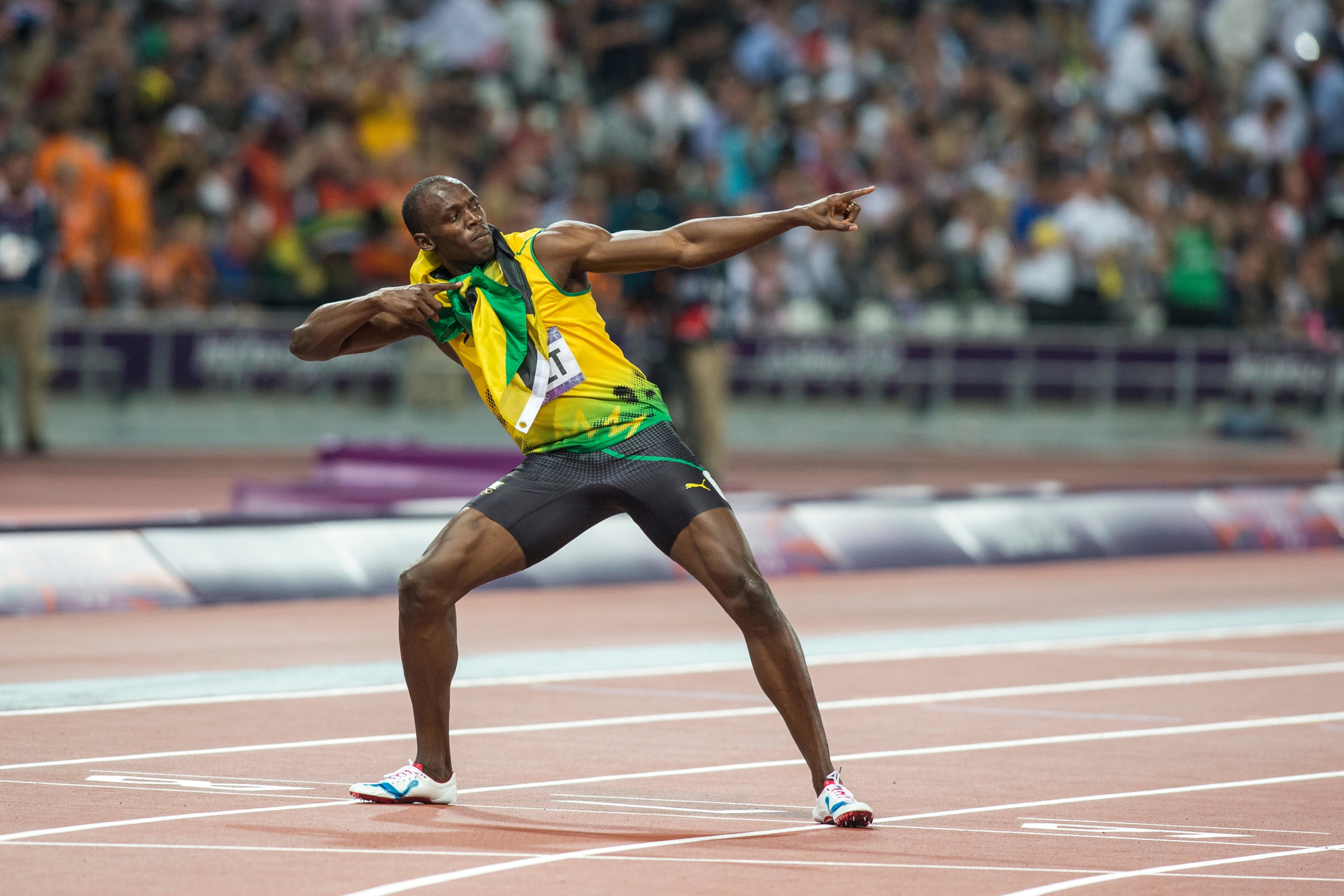
It is hard to believe that the fastest man on earth has scoliosis! Olympian Usain Bolt was born with scoliosis. His right leg is half an inch shorter than his…
-
 24 April 2023
Scoliosis and hyperkyphosis are complex conditions that can present significant challenges for healthcare providers. With progressive and degenerative cases, it's essential that patients have access to the right treatment options…