
Scoliosis can be difficult to notice early, especially when changes are subtle. That is why knowing the common signs and arranging a necessary professional assessment can be important. Early assessment can help determine whether monitoring, imaging, or treatment is needed.
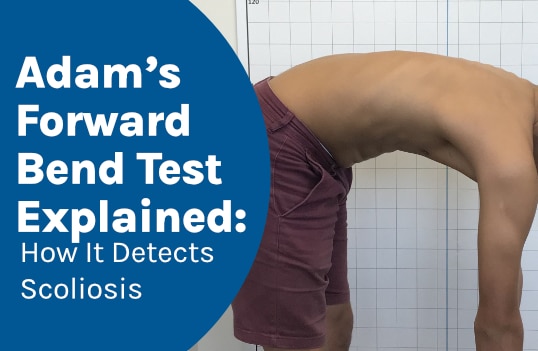
The Adam’s forward bend test is a simple scoliosis screening test where a clinician looks for unevenness in the ribs, back, shoulders, or hips while the person bends forward. Early assessment helps patients and families understand the type of scoliosis, the risk of progression, and which treatment options may be appropriate.
If signs of scoliosis are noticed, a professional scoliosis-specific assessment can help determine whether further testing is needed and what the next steps should be.
Adam’s Forward Bend Test
When patients go for an initial scoliosis assessment, they can expect an Adam’s forward bend test because it looks for early signs of scoliosis and helps determine the next steps that should be taken (1).
The test involves examining the back while the patient bends forward at the hips with arms hanging neutrally at the side and fingers pointing down; the spine, and postural changes caused by scoliosis, are the easiest to see in this position (1).
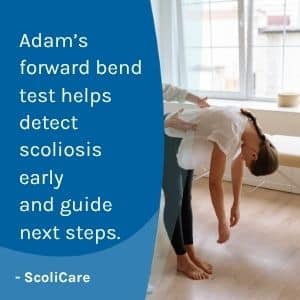
The earliest sign of scoliosis in children is asymmetrical posture, and the forward bend position makes it easier to see the spine, unlevel shoulders, unlevel hips, and the characteristic rib arch (2).
An Adam’s test can also involve the use of a ScolioMeter: a small device that looks like a ruler with a bubble in the center (3).
The ScolioMeter is considered a safe and noninvasive method for assessing how much rotation there is in a patient’s spine (3).
A Scoliometer may be moved along the back during the forward bend position to estimate trunk rotation. When it’s held over the unnatural curve, where the bubble sits indicates how much the patient’s spine unnaturally twists (3).
Finding out whether the spine rotates or not is essential because it’s a defining feature of scoliosis; it’s the spine’s unnatural curve and rotation that sets it apart from a number of other spinal conditions that aren’t 3-dimensional.
Rotation is an important feature clinicians look for, but an X-ray is needed to confirm scoliosis and measure the spinal curve, and knowing how much the spine rotates is necessary for planning how to treat the scoliosis (4).
The more we know about everything that’s happening in and around a patient’s spine, the more detailed a treatment plan can be, and the more precisely clinicians can tailor the treatment plan to the patient’s curve, age, growth stage, and goals.
So an Adam’s forward bend test is looking for signs of scoliosis, including rotation, and determines if further testing is needed, and if signs of scoliosis are found, the next step is an X-ray to diagnose, and further assess, a patient’s scoliosis (1, 4).
An Adam’s test screens for signs of scoliosis, but can’t confirm a diagnosis; only a comprehensive X-ray can diagnose scoliosis (4).
When is a Scoliosis X-Ray Needed?
A scoliosis X-ray is needed if an assessment finds signs of scoliosis and should be performed as soon as it’s recommended so a diagnosis can be confirmed, fully discussed, and a personalized treatment plan can be started (4).
A scoliosis X-ray diagnoses scoliosis and provides the information needed to treat it effectively. An X-ray confirms the presence of an unnatural sideways spinal curve with rotation, determines curve size, location, the amount of rotation, and the risk of curve progression (4).
Knowing how much progression may occur, and whether it’s more likely to occur quickly or slowly, is a focus of childhood scoliosis treatment because progression is triggered by growth (5).
A child who is still growing may have a higher risk of advancing quickly, which is why early assessment and monitoring is so important (5).
It is important that scoliosis X-rays are requested, performed, and interpreted appropriately, so the curve can be measured accurately. If a patient’s curve is severe and is in the thoracic spine, we know these curves are the most prone to rapid advancement, and if the patient is a child with a lot of remaining growth, we know there may also be a high risk of curve progression (4, 5).
Spinal-curve size is expressed in degrees by a patient’s Cobb angle measurement; it has to be measured accurately because treatment is planned around important factors such as curve size (6).
Because most cases of scoliosis increase in severity over time, this can complicate the treatment process, and the timing of treatment can affect the results (5).
Early Detection and Early Intervention
Early detection can give patients and families more time to understand the condition, monitor changes, and consider appropriate treatment options, but it’s important to understand that even when scoliosis is mild, it should be assessed carefully so the right plan can be made, whether that involves monitoring, scoliosis-specific exercises, bracing, or another treatment approach.

Diagnosing scoliosis early means while it’s still mild, and although there are no treatment guarantees, mild scoliosis is easier to treat, so it’s ideal to start treatment while scoliosis is mild and most likely to respond well (5).
Starting care early may help reduce the risk of progression, especially when treatment is matched to the patient’s curve and growth stage. A proactive treatment plan works to keep mild cases mild and prevent them from becoming more severe (5).
Not only does preventing progression mean managing scoliosis effectively, it can also mean helping patients avoid the need for invasive surgical treatment (7, 8). The more severe a patient’s scoliosis is at the time of diagnosis, or becomes, the more likely it is that surgical treatment may be necessary (7, 8).
Small flexible curves may respond to scoliosis-specific bracing alone as early intervention, but larger more rigid curves may need bracing, a scoliosis-specific exercise plan, and scoliosis-specific chiropractic care working together, and if patients cross the surgical threshold, spinal fusion may be recommended (9, 10).
As scoliosis progresses, the spine’s unnatural lateral curve and rotation is increasing, so the uneven forces the spine and body are exposed to are also increasing, and the longer these forces aren’t addressed, the more likely they may contribute to increasing symptoms, posture changes, or functional strain over time (7).
In children, not diagnosing and treating scoliosis early can mean fast progression, noticeable symptoms, and needing future surgical treatment (5), and in adults, diagnosing scoliosis after it’s become severe can mean a damaging cycle of uneven pressure, wear, and degeneration has been started (11).
It’s never too late to start treatment, but early assessment is valuable because it can identify scoliosis while curves are smaller and treatment decisions may be clearer (7).
So if you have concerns, the next step is to arrange an assessment with a clinician who understands scoliosis and can guide you through the options.
Conclusion
A scoliosis-specific assessment can help clarify what is happening and what options may be appropriate. Through a comprehensive initial assessment and a patient’s X-ray results, treatment planning can be proactive and customized.
While an Adam’s forward bend test can detect indicators of scoliosis, the only way to definitively diagnose scoliosis is with a scoliosis X-ray, and if signs of scoliosis are noticed, an X-ray should be performed as soon as possible because scoliosis can change quickly.
So for parents concerned about scoliosis, the first step is seeking professional assessment that looks for early signs, and if indicators are found, X-ray imaging to see what’s happening in and around the spine is necessary.
From early assessment to diagnosis and treatment, there is support available for patients and their families to ensure the best treatment choices are made moving forward.
References:
- Senkoylu A, Ilhan MN, Altun N, Samartzis D, Luk KDK. A simple method for assessing rotational flexibility in adolescent idiopathic scoliosis: modified Adam’s forward bending test. Spine Deform. 2021 Mar;9(2):333-339. doi: 10.1007/s43390-020-00221-2. Epub 2020 Oct 8. PMID: 33030701
- Weinstein SL. The Natural History of Adolescent Idiopathic Scoliosis. J Pediatr Orthop. 2019 Jul;39(Issue 6, Supplement 1 Suppl 1):S44-S46. doi: 10.1097/BPO.0000000000001350. PMID: 31169647
- Murrell GA, Coonrad RW, Moorman CT 3rd, Fitch RD. An assessment of the reliability of the Scoliometer. Spine (Phila Pa 1976). 1993 May;18(6):709-12. doi: 10.1097/00007632-199305000-00006. PMID: 851669
- Ng SY, Bettany-Saltikov J. Imaging in the Diagnosis and Monitoring of Children with Idiopathic Scoliosis. Open Orthop J. 2017 Dec 29;11:1500-1520. doi: 10.2174/1874325001711011500. PMID: 29399226; PMCID: PMC5759132
- Negrini, S., Donzelli, S., Aulisa, A. G., Czaprowski, D., Schreiber, S., de Mauroy, J. C., … & Zaina, F. (2018). 2016 SOSORT guidelines: orthopaedic and rehabilitation treatment of idiopathic scoliosis during growth. Scoliosis and spinal disorders, 13(1), 3
- Horng MH, Kuok CP, Fu MJ, Lin CJ, Sun YN. Cobb Angle Measurement of Spine from X-Ray Images Using Convolutional Neural Network. Comput Math Methods Med. 2019 Feb 19;2019:6357171. doi: 10.1155/2019/6357171. PMID: 30996731; PMCID: PMC6399566
- McCarthy RE. Prevention of the complications of scoliosis by early detection. Clin Orthop Relat Res. 1987 Sep;(222):73-8. PMID: 2957138.
- Fan H, Wang Q, Huang Z, Sui W, Yang J, Deng Y, Yang J. Comparison of Functional Outcome and Quality of Life in Patients With Idiopathic Scoliosis Treated by Spinal Fusion. Medicine (Baltimore). 2016 May;95(19):e3289. doi: 10.1097/MD.0000000000003289. PMID: 27175629; PMCID: PMC4902471
- Marchese R, Du Plessis J, Pooke T, McAviney J. The Improvement of Trunk Muscle Endurance in Adolescents with Idiopathic Scoliosis Treated with ScoliBrace® and the ScoliBalance® Exercise Approach. J Clin Med. 2024 Jan 23;13(3):653. doi: 10.3390/jcm13030653. PMID: 38337346; PMCID: PMC10856658
- Haggard, J. S., Haggard, J. B., Oakley, P. A., & Harrison, D. E. (2017). Reduction of progressive thoracolumbar adolescent idiopathic scoliosis by chiropractic biophysics®(CBP®) mirror image® methods following failed traditional chiropractic treatment: a case report. Journal of Physical Therapy Science, 29(11), 2062-2067
- Fasser MR, Furrer PR, Fisler L, Urbanschitz L, Snedeker JG, Farshad M, Widmer J. The triadic relationship between spinal posture, loading, and degeneration. Front Bioeng Biotechnol. 2025 Mar 18;13:1444540. doi: 10.3389/fbioe.2025.1444540. PMID: 40171041; PMCID: PMC11959076
More news
-
 24 February 2023
The short answer is yes, people with scoliosis can live normally. However, it is important to understand the condition and its impact on the individual's life. Scoliosis is a complex…
-
 14 March 2021
Kurt Cobain and his Scoliosis Part of our series of famous people who have/had a Scoliosis. Next up is Kurt Cobain! Kurt Cobain is best known as the lead…
-
 1 November 2022
It is hard to believe that the fastest man on earth has scoliosis! Olympian Usain Bolt was born with scoliosis. His right leg is half an inch shorter than his…