
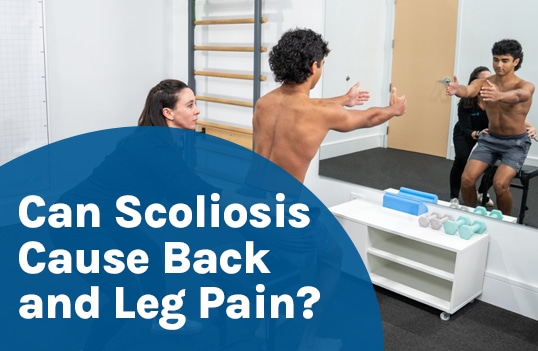
The effects of scoliosis can be felt throughout the body. While not all patients will experience scoliosis pain, the more severe a condition is, the more likely it is to be painful, and as scoliosis is progressive, its effects can become more disruptive over time.
Scoliosis can cause back and leg pain due to the uneven forces caused by a misaligned spine. Back pain can be caused by the structural changes within the spine and/or muscular imbalance in the back, and leg pain can be a result of postural changes, the development of unhealthy movement patterns, and/or nerve compression.
Scoliosis treatment plans are customized around a number of variables that change from patient to patient; these same variables shape the type of symptoms a patient is likely to experience, including pain.
Scoliosis Pain
Scoliosis back pain is more common in adults, (1) but it can still appear in adolescents with scoliosis (2).
Before getting to the specifics of scoliosis leg and back pain, let’s talk generally about scoliosis pain and why it’s not experienced by everyone (1).
Scoliosis ranges in severity, and the goal is to diagnose it while mild, before it progresses to moderate and/or severe scoliosis.
Because it’s progressive, scoliosis treatment has to be proactive.
Scoliosis treatment plans also need to be customized to address the specifics of a patient’s scoliosis, posture, ability, symptoms, age, and more; the more comprehensive a patient’s initial assessment is, the more potential there is for specific treatment results.
Scoliosis affects all ages, and while it’s more often diagnosed during childhood, adults are also affected, and when it comes to progression and pain, patient age is a key factor.
We don’t know why most cases of scoliosis develop (idiopathic scoliosis), but we know that growth makes it progress, so patient age is an important predictor of how much potential progression a patient may face (2).
Patient age is also important in terms of compressive pain.
Compressive pain is caused by uneven pressure, and scoliosis becomes compressive once skeletal maturity is reached, so children are less likely to experience compressive pain while they are still growing.
However, compression isn’t the only cause of scoliosis pain, and studies show that children also experience scoliosis pain, so let’s talk about how the spine’s structural changes can cause back pain (3).
Scoliosis Back Pain
As scoliosis develops, certain vertebrae are becoming unnaturally tilted and are also rotating unnaturally, and this is a structural change within the spine itself, capable of causing back pain (1).
Scoliosis can develop in any of the spine’s main sections – the cervical spine, thoracic spine, and the lumbar spine – and most back pain will be concentrated in the primary section affected by the scoliosis (1, 3).
Scoliosis that develops in the thoracic spine commonly has more vertebral rotation so also tends to be more painful (4).
Lumbar scoliosis develops in the lower back so lower back and leg pain is common (1).
Lower back pain is the most common type of back pain in general, and this is due to the unique roles of the lower back; it has to support the spinal sections above, the weight of the torso, and its vertebrae feel the strain of complex movement (5).
If scoliosis progresses, the size and rotation of the spine’s unnatural curvature will increase, potentially causing more pain due to the spine becoming increasingly misaligned and off-balance (4).
A spine that’s not aligned is one that can experience excessive movement due its lack of stability, and this can also cause varying levels of back pain (4).
Back pain and radiating pain in the extremities is a common complaint that brings adults in for assessment and diagnosis.
And when it comes to older adults affected by scoliosis, degenerative scoliosis is caused by degenerative instability and is almost always progressive and painful, lower back pain being the main complaint.
Scoliosis back pain can also involve the muscles that support and stabilize the spine and pelvis.
Muscular Imbalance
A common effect of scoliosis is the development of a muscular imbalance, particularly common as scoliosis progresses and becomes more severe (5).
The deep core and back muscles include the transversus abdominis, multifidus, erector spinae, obliques, and the gluteal muscles; together, these muscles provide deep core/back support for the pelvis and spine, support proper spinal alignment, and facilitate trunk rotation and movement, while not allowing excessive movement.
So as the core and back muscles are so essential for spinal support, stability, and mobility, a spine affected by scoliosis can also impact its surrounding muscles.
A muscular imbalance can develop as the spine curves unnaturally and pulls its surrounding muscles in different directions: causing muscles on one side of the spine to work harder, becoming strained and sore, while muscles on the opposite side lose strength from lack of use (5). It is therefore important to address trunk muscle endurance and this can be done by an effective scoliosis-specific, non-surgical rehabilitation plan incorporating ScoliBalance® and ScoliBrace® (6).
A muscular imbalance can cause muscle tension, painful muscle spasms, and mean less support for the spine, which can contribute to increasing back pain.
As scoliosis progresses, the asymmetrical postural changes it’s associated with can cause unhealthy movement patterns to develop, and this can further contribute to scoliosis back and leg pain.
Posture and Movement Changes
The main visual effect of scoliosis is asymmetrical posture. People with scoliosis often lean more to one side; a misaligned spine can shift the balance and stability of the entire body (1, 2).
In many cases, the earliest signs of scoliosis in children involve the body becoming less symmetrical due to postural changes such as uneven shoulders, shoulder blades, a rib cage arch, uneven hips, arm and leg length (3).
Postural changes are more often painful for adults due to compression, but the more muscles and movement are affected, the more painful scoliosis can become for most patients.
As posture is affected, this can disrupt healthy movement patterns as gait, balance, and coordination can change.
If scoliosis causes uneven hips, such as one hip being higher than the other, it can disrupt the pelvis’s position and stability; this may lead to uneven weight distribution across the pelvis and lower body, potentially worsening an existing leg length discrepancy (LLD) or causing a new one, resulting in an inefficient gait and associ
ated back and leg pain.
Scoliosis doesn’t just affect the spine’s structure, surrounding muscles, body posture and movement, it can also impact the spinal nerves within and where they exit the spine to transmit signals throughout the body.
Back and Leg Pain Caused by Nerve Irritation
A primary role of each spinal section is to protect the spinal cord within, so if the stability, balance, and alignment of a given spinal section is disrupted due to scoliosis, it can affect the nerves within.
When nerves are exposed to uneven pressure (compression), they can become irritated, inflamed, and/or impinged and cause a number of symptoms based on the nerve’s function and location.
For example, lumbar scoliosis that develops in the lower back is associated with sciatic nerve pain due to where the sciatic nerve originates: the lumbar spine.
If the lumbar spine is misaligned, it can expose the sciatic nerve to uneven pressure, and as the sciatic nerve is a mixed nerve with both sensory and motor fibers, symptoms of nerve irritation can involve sensation and mobility.
As the path of the sciatic nerve extends from the lumbar spine down the back of the hip, buttock, leg, and into the foot, pain and a number of sensations can be felt anywhere along this pathway.
So leg pain can also be a result of a compressed spinal nerve above, and nerve-related back pain can be severe.
If a spinal nerve is compressed, it can also cause pain in its immediate surroundings, so localized back pain can also be the result of an irritated spinal nerve within or where it exits the spine.
Conclusion
Scoliosis can affect the body in a number of ways from changes to posture, movement, and nerve compression.
As a progressive condition, scoliosis symptoms can become more severe over time, but when treated proactively, scoliosis can be highly treatable.
Scoliosis can vary widely in severity, type, symptoms, and age groups affected, so treatment plans need to be customized.
Scoliosis pain is more closely associated with adult scoliosis due to the presence of compressive pain and degenerative changes, but it can also be shaped by curvature location, size, angle of trunk rotation, spinal balance, and stability.
Scoliosis back pain can involve localized back pain due to structural changes, muscle pain, and/or nerve-related back pain, and scoliosis leg pain can involve muscle strain, unhealthy movement patterns, and/or compressed nerves.
The best long-term solution for scoliosis back and leg pain is addressing its underlying cause: the postural changes caused by the misaligned spine.
Here at ScoliCare, our approach is patient-centered, proactive, and nonsurgical, and as the goal is preventing progression and correcting scoliosis through the power of scoliosis-specific exercise and corrective bracing, the sooner these treatment options are applied, the better.
So for those showing signs of scoliosis and experiencing unexplained back and leg pain, don’t hesitate to reach out for an assessment; it could lead to a diagnosis and the design of a proactive treatment plan.
References:
- Zaina, F., Marchese, R., Donzelli, S., Cordani, C., Pulici, C., McAviney, J., & Negrini, S. (2023). Current Knowledge on the Different Characteristics of Back Pain in Adults with and without Scoliosis: A Systematic Review. Journal of Clinical Medicine, 12(16), 5182. https://doi.org/10.3390/jcm12165182
- Negrini, S., Grivas, T. B., Kotwicki, T., Maruyama, T., Rigo, M., Weiss, H. R., & Members of the Scientific society On Scoliosis Orthopaedic and Rehabilitation Treatment (SOSORT) (2006). Why do we treat adolescent idiopathic scoliosis? What we want to obtain and to avoid for our patients. SOSORT 2005 Consensus paper. Scoliosis, 1, 4. https://doi.org/10.1186/1748-7161-1-4
- Negrini, S., Grivas, T. B., Kotwicki, T., Maruyama, T., Rigo, M., Weiss, H. R., & Members of the Scientific society On Scoliosis Orthopaedic and Rehabilitation Treatment (SOSORT) (2006). Why do we treat adolescent idiopathic scoliosis? What we want to obtain and to avoid for our patients. SOSORT 2005 Consensus paper. Scoliosis, 1, 4. https://doi.org/10.1186/1748-7161-1-4
- Xantus, G., Burke, D. & Kanizsai, P. Previously undiagnosed scoliosis presenting as pleuritic chest pain in the emergency department – a case series and a validating retrospective audit. BMC Emerg Med 21, 62 (2021). https://doi.org/10.1186/s12873-021-00455-x
- Li, Y., et al. (2024). “Global burden of low back pain and its attributable risk factors from 1990 to 2021: a comprehensive analysis from the global burden of disease study 2021.” Frontiers in Public Health, 12, 1480779.
- Marchese, R., Du Plessis, J., Pooke, T., & McAviney, J. (2024). The Improvement of Trunk Muscle Endurance in Adolescents with Idiopathic Scoliosis Treated with ScoliBrace®® and the ScoliBalance®® Exercise Approach. Journal of Clinical Medicine, 13(3), 653. https://doi.org/10.3390/jcm13030653
- Asher, M. A., & Burton, D. C. (2006). Adolescent idiopathic scoliosis: Natural history and long-term treatment effects. Scoliosis, 1(1), 2. doi:10.1186/1748-7161-1-2
The post Can Scoliosis Cause Back and Leg Pain? appeared first on ScoliCare.
More news
-
 21 September 2022
By Ella Bourne - Chiropractor Background Idiopathic Scoliosis is the most common spinal deformity in adolescents, with established prevalence 2-3% in adolescents (1). The estimated prevalence of lower back pain…
-
 25 October 2023
Back pain in patients with scoliosis is quite prevalent. It is also possible that patients with scoliosis present with specific features of low back or leg pain. ScoliCare Head of…
-
 1 November 2020
Is Scoliosis a Cause of Pain? It might seem obvious that a bent or twisted spine would be painful, right! However doctors and other health professionals are taught that scoliosis…