
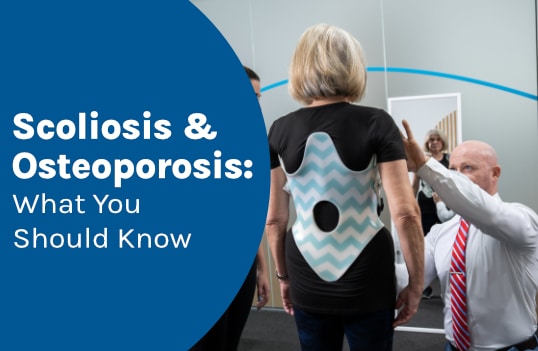
Scoliosis affects the spine by causing an unnatural lateral curvature to develop that also rotates, and osteoporosis is a bone disease that causes a loss of bone tissue, making bones weak and vulnerable to injury. If osteoporosis develops in the spine, it can contribute to scoliosis progression and/or the onset of degenerative scoliosis, particularly in older females.
Scoliosis and osteoporosis affect the spine by weakening its vertebrae and can co-exist. It’s not always clear which condition is more causative, particularly in older women, as they can be diagnosed simultaneously.
Before connecting the two, let’s explore how scoliosis and osteoporosis each affect bone health.
Scoliosis and Bone Health
The spine consists of vertebrae (bones) stacked on top of one another, and in a healthy spine, the vertebrae are aligned and straight, and adjacent vertebrae are separated by an intervertebral disc (1).
The spine’s healthy curves and alignment shape overall spinal health and function, and disc health is an important contributing factor (1).
The spine’s curves and alignment keep it balanced and stable and facilitate its strength, flexibility, and ability to evenly distribute mechanical stress throughout the spine: key to preventing uneven wear and degenerative changes in the spine (1).
Most spinal degeneration starts in the discs. Degenerative disc disease is involved in a number of spinal conditions/injuries and changes to bone health, including degenerative scoliosis and osteoporosis (2).
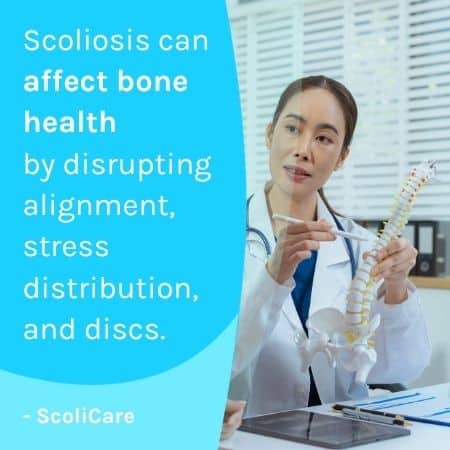
The discs of the spine combine forces to facilitate its flexibility, strength, act as the spine’s shock absorbers, provide structural support for the vertebrae, and cushioning between adjacent vertebrae to prevent friction and uneven wear (1, 2).
Scoliosis causes the spine to develop an unnatural lateral curvature, and the vertebrae also rotate, making scoliosis 3-dimensional (3).
Scoliosis is known for postural changes and pain (more common in adult scoliosis). When skeletal maturity is reached, scoliosis becomes compressive, and compression is uneven/excessive pressure that can damage the spine, its discs, and surroundings (3).
Scoliosis can affect bone health by disrupting the vertebrae’s natural alignment, the spine’s ability to evenly absorb and distribute stress, and can involve and/or be caused by disc degeneration (3, 4).
Osteoporosis and Bone Health
Osteoporosis is a bone disease that increases bone loss. Osteoporosis that develops in the spine weakens its bones by causing rapid loss of bone tissue (5).
The loss of tissue makes bones less dense, more porous, brittle, and vulnerable to fractures. When there is significant bone density loss, minor falls and typical movements can cause injury (5, 6).
Spinal osteoporosis causes a loss of bone mineral density, making bones lighter and weaker. The internal structure of vertebrae is affected as more internal space makes the bones porous and less able to handle stress from movement and impact (5, 6).
Bone is living tissue that’s constantly regenerating, and osteoporosis disrupts the bone remodeling process, causing bone loss to occur faster than bones can regenerate new tissue (5).
Spinal osteoporosis can cause pain, a loss of trunk height, postural and mobility changes, and injury (5, 6).
So as you can see, both scoliosis and osteoporosis can disrupt bone health in a number of ways, and because they occur together so often, particularly in older females, it can be difficult to determine which condition developed first; however, the cycle of spinal degeneration and bone health, and the connection between the two, is clear (4, 6).
Now that we’ve looked at scoliosis and osteoporosis as distinct conditions shaping the spine’s bone health, let’s discuss why they are frequently diagnosed at the same time.
Degenerative Scoliosis and Osteoporosis
Degenerative scoliosis is the second most common type of adult scoliosis; it most often affects older adults over 45 years of age and is more common in females, as is osteoporosis (4, 5).
Females are more vulnerable to bone disease due to changes in bone density and hormones that occur during menopause (4, 5).
So if a patient is already experiencing bone mineral density changes that weaken the spine, not only are its vertebrae more vulnerable to injury, they are also more vulnerable to the development of an unnatural spinal curve, which can further disrupt bone and spinal health (4, 5).
And degenerative scoliosis involves uneven spinal loading that can disrupt disc and bone health, potentially contributing to osteoporosis (4, 5).
Research does show more support for osteoporosis contributing to the onset of degenerative spinal curves than degenerative scoliosis triggering osteoporosis onset, but it’s clear that both can contribute to the onset and/or worsening of the other (7).
Osteoporosis can worsen scoliosis by making the spine’s bones more vulnerable to fractures that can change the shape of vertebrae from rectangular (typical vertebrae) to triangular, disrupting the vertebrae’s alignment, balance, and stability (7).
Scoliosis is progressive, so its nature is to increase in severity over time, and anything that makes the spine weaker and more vulnerable to injury can contribute to curve progression (4, 7).
Due to the shared demographics of scoliosis and osteoporosis in older adult females, it’s not uncommon for them to be diagnosed simultaneously, making it difficult to pinpoint the initial causative connection.
The prevalence of low bone mineral density in adolescent idiopathic scoliosis patients further supports the potential connection between scoliosis and bone development issues, but whether bone disease causes the onset of scoliosis, or scoliosis causes spinal osteoporosis remains unclear (8).
Conclusion
The main type of scoliosis is idiopathic scoliosis that’s not clearly associated with a single-known cause, and degenerative scoliosis is caused by degenerative changes in the spine.
Spinal osteoporosis increases bone mineral density loss, making its vertebrae weaker and more vulnerable to injury and asymmetry, and as scoliosis is an asymmetrical condition, the cycle between bone density changes, degenerative instability, and unhealthy spinal curves is clear.
What you need to know about scoliosis and osteoporosis is that both weaken the bones of the spine, make the spine more vulnerable to injury, are more prevalent in older females, and frequently occur together.
References:
- DeSai C, Reddy V, Agarwal A. Anatomy, Back, Vertebral Column. [Updated 2023 Aug 8]. In: StatPearls [Internet]. Treasure Island (FL): StatPearls Publishing; 2025 Jan-. Available from: https://www.ncbi.nlm.nih.gov/books/NBK525969/
- Scarcia L, Pileggi M, Camilli A, Romi A, Bartolo A, Giubbolini F, Valente I, Garignano G, D’Argento F, Pedicelli A, Alexandre AM. Degenerative Disc Disease of the Spine: From Anatomy to Pathophysiology and Radiological Appearance, with Morphological and Functional Considerations. J Pers Med. 2022 Nov 1;12(11):1810. doi: 10.3390/jpm12111810. PMID: 36579533; PMCID: PMC9698646
- Janicki JA, Alman B. Scoliosis: Review of diagnosis and treatment. Paediatr Child Health. 2007 Nov;12(9):771-6. doi: 10.1093/pch/12.9.771. PMID: 19030463; PMCID: PMC2532872
- Kotwal S, Pumberger M, Hughes A, Girardi F. Degenerative scoliosis: a review. HSS J. 2011 Oct;7(3):257-64. doi: 10.1007/s11420-011-9204-5. Epub 2011 Jun 11. PMID: 23024623; PMCID: PMC3192887
- Porter JL, Varacallo MA. Osteoporosis(Archived) [Updated 2023 Aug 4]. In: StatPearls [Internet]. Treasure Island (FL): StatPearls Publishing; 2025 Jan-. Available from: https://www.ncbi.nlm.nih.gov/books/NBK441901/
- US Preventive Services Task Force. Curry SJ, Krist AH, Owens DK, Barry MJ, Caughey AB, Davidson KW, Doubeni CA, Epling JW, Kemper AR, Kubik M, Landefeld CS, Mangione CM, Phipps MG, Pignone M, Silverstein M, Simon MA, Tseng CW, Wong JB. Screening for Osteoporosis to Prevent Fractures: US Preventive Services Task Force Recommendation Statement. JAMA. 2018 Jun 26;319(24):2521-2531. [PubMed] [Reference list]
- Tomé-Bermejo F, Piñera AR, Alvarez-Galovich L. Osteoporosis and the Management of Spinal Degenerative Disease (I). Arch Bone Jt Surg. 2017 Sep;5(5):272-282. PMID: 29226197; PMCID: PMC5712392
- Sadat-Ali M, Al-Othman A, Bubshait D, Al-Dakheel D. Does scoliosis causes low bone mass? A comparative study between siblings. Eur Spine J. 2008 Jul;17(7):944-7. doi: 10.1007/s00586-008-0671-4. Epub 2008 Apr 22. PMID: 18427842; PMCID: PMC2443267
More news
-
 24 February 2023
The short answer is yes, people with scoliosis can live normally. However, it is important to understand the condition and its impact on the individual's life. Scoliosis is a complex…
-
 14 March 2021
Kurt Cobain and his Scoliosis Part of our series of famous people who have/had a Scoliosis. Next up is Kurt Cobain! Kurt Cobain is best known as the lead…
-
 1 November 2022
It is hard to believe that the fastest man on earth has scoliosis! Olympian Usain Bolt was born with scoliosis. His right leg is half an inch shorter than his…